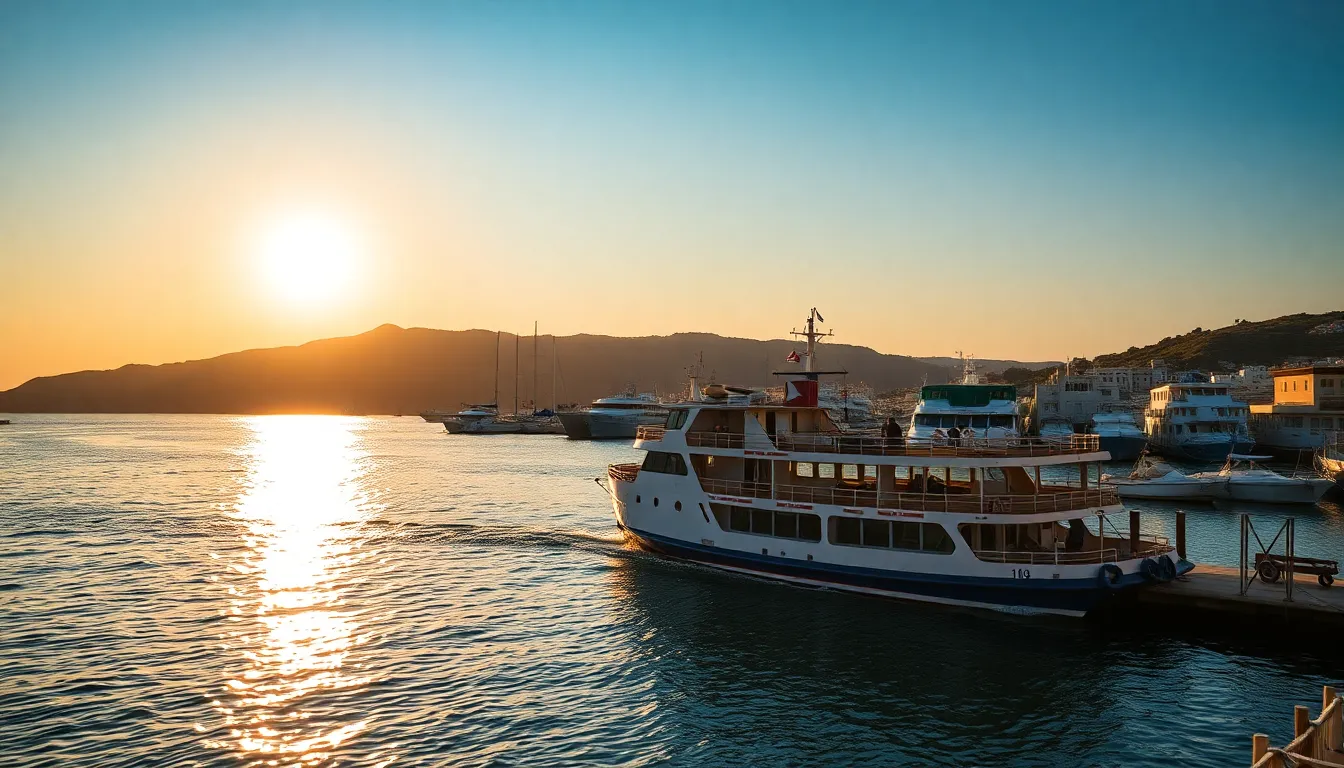
The first time I brought a group to Patmos by ship, I watched a retired schoolteacher stand at the rail as the island came up out of the haze, and she said, quietly, that John saw this same coastline. That is the case for the cruise in one sentence. But I have also had cruise days eaten alive by a tender line and a short port window, and I have stood on a dock in rough weather wondering if we would sail at all. So when a group leader asks me whether to do Greece by land or by sea, I do not give them a slogan. I give them the trade-offs.
Both work. They give your group different things, and the right call depends on what is on your itinerary and who is traveling with you.
What a Land Tour Gives You
A land-based Greece tour means your own bus, your own guide, and hotels in the cities where Paul’s story actually unfolded. You sleep in Thessaloniki, in Athens, near Corinth. You set your own departure times. If the group wants an extra hour at the Areopagus or a slow morning after a long day, the schedule bends.
The mainland Pauline route, the heart of a Christian heritage trip, is a land route. Philippi, Thessaloniki, Berea, Athens, Corinth. None of it requires a ship. A land tour lets you follow that arc in order, at your own pace, with full control, which is exactly why most of our Pauline itineraries are built on the ground. I lay that route out in our guide to the footsteps of Paul in Greece.
Where Land Tours Shine
Control and depth. On land, you decide how long you linger and when you move. For a group that wants to read scripture on site without watching the clock, for a congregation with mixed mobility that needs flexible pacing, and for any trip centered on the mainland sites, land travel is hard to beat. You also wake up inside the places that matter rather than visiting them between ship departures.
What an Aegean Cruise Gives You
A cruise turns the islands into the easy part. The same water that makes Rhodes, Patmos, and the Cyclades a logistical puzzle on a land trip becomes the path itself. You unpack once. The ship moves while you sleep, and you wake up at the next island. For a group that wants to reach several islands, that simplicity is real and worth a lot.
And there is the thing the cruise does that nothing else can. Approaching Patmos by sea, where John received the Revelation, you arrive the way the ancient world arrived. The Cave of the Apocalypse and the monastery sit above a harbor your group sails into. That arrival lands emotionally in a way a bus park-and-walk never quite does.
Where Cruises Shine
Multi-island itineraries and the islands of the Revelation and Sephardic story. If your trip is built around Patmos, Rhodes, Crete, and the Aegean rather than the mainland, a cruise carries your group between them without the repeated airport and ferry transfers a land version would demand. Unpack once, see many islands, let the sea do the moving.
The Honest Trade-offs of a Cruise
I owe you the hard parts, because cruise marketing rarely mentions them.
Port time is limited. A ship docks for a window, often a single morning or afternoon, and you tour on the ship’s clock, not yours. A site that deserves a slow half-day gets a rushed two hours. For heritage groups who came to sit with scripture in a place, that compression is the real cost.
You also share the ship. Even on a good cruise, your group is one of many, and you lose the dedicated-bus, dedicated-guide intimacy of a land tour. Smaller heritage-focused vessels handle this better than the mega-ships, but it is a genuine difference. And weather can move or cancel a port call. The sea does not consult your itinerary.
How I Usually Resolve It
Here is the pattern I land on for most groups.
If your trip is centered on the mainland Pauline route, go by land. The story is on the ground, and land travel gives you the control and the depth those sites deserve. Add Patmos or Rhodes as a flight or ferry extension if you want one island, which I compare in our look at mainland versus islands for a Greece trip.
If your trip is genuinely island-heavy, several Aegean stops where the sailing between them is half the point, a cruise earns its place. And there is a strong hybrid that I often recommend: do the mainland by land, then board a shorter cruise for the islands at the end. Your group gets the depth of land travel where the Pauline story lives and the ease of the sea where the islands begin.
One more practical note. For groups with mobility concerns, cruise tendering, the small boats that ferry passengers ashore where a ship cannot dock, can be a challenge. A land tour with one chosen island extension is often kinder to a mixed-ability group than a multi-tender cruise.
What the Daily Rhythm Feels Like
The difference between land and sea is something your group feels most in the shape of an ordinary day, so let me describe both.
On a land tour, the day is yours to set. You leave the hotel when your group is ready, you spend as long as a site deserves, and if a moment opens up, a reading by Lydia’s river that runs long because nobody wants to move, you let it. The cost is that you pack and unpack as you move between cities, and some days carry real driving time. But the pacing belongs to you.
On a cruise, the day is shaped by the ship. You wake already at the next island, which is a genuine gift, and you never live out of a rolling suitcase. But the clock is the port’s clock. You go ashore when the ship docks and you return before it sails, and a guide who knows that window builds the visit around it. For groups that value not repacking and not driving, this is liberating. For groups that came to linger, it can chafe.
I tell leaders to picture their people on day four. The ones who would love waking up at a new island without lifting a bag lean cruise. The ones who would resent being pulled away from a site by a sailing time lean land. That single image decides it for most groups faster than any feature list.
FAQ: Cruise or Land for Greece Heritage
Is a cruise or a land tour better for a Greece heritage trip?
It depends on your itinerary. For the mainland Pauline route, Philippi through Corinth, a land tour gives more control and depth. For a trip built around several Aegean islands, a cruise carries your group between them far more easily. Many groups do best with a land tour plus one island extension, or a hybrid of land then a short cruise.
What is the best way to reach Patmos for a group?
Both work, and both are moving. A cruise lets your group sail into Patmos the way the ancient world arrived, which is a powerful experience. From a land base, Patmos is reached by ferry or a combination of flight and ferry as an extension. If Patmos is your only island, an extension off a land tour is usually simpler than building the whole trip around a cruise.
Do cruises give you enough time at heritage sites?
This is the main trade-off. Cruise port windows are limited, often a single morning or afternoon, so sites that deserve a slow visit can feel rushed. Land tours let your group set the pace and linger. If unhurried time at each site matters most to your group, lean toward land.
Is a cruise good for older or mixed-mobility groups?
It can be, but watch the tendering. Where a ship anchors offshore, small boats ferry passengers to land, which can be hard for less mobile travelers. A land tour with controlled pacing and one well-chosen island extension is often easier for a mixed-ability group than a multi-island cruise.
Does the free group leader benefit apply to cruises?
Yes. When your group reaches fifteen paying participants, the group leader travels free, including the cruise fare, hotels on land portions, meals, and ground transportation. The benefit applies whether your Greece trip is by land, by sea, or a hybrid of both.
If you are deciding how your group should move through Greece, I am glad to help you weigh it against your itinerary. You can see how we structure these journeys on our Greece heritage page or how the group format works on our group heritage tours page.
Contact us whenever you are ready to start planning.