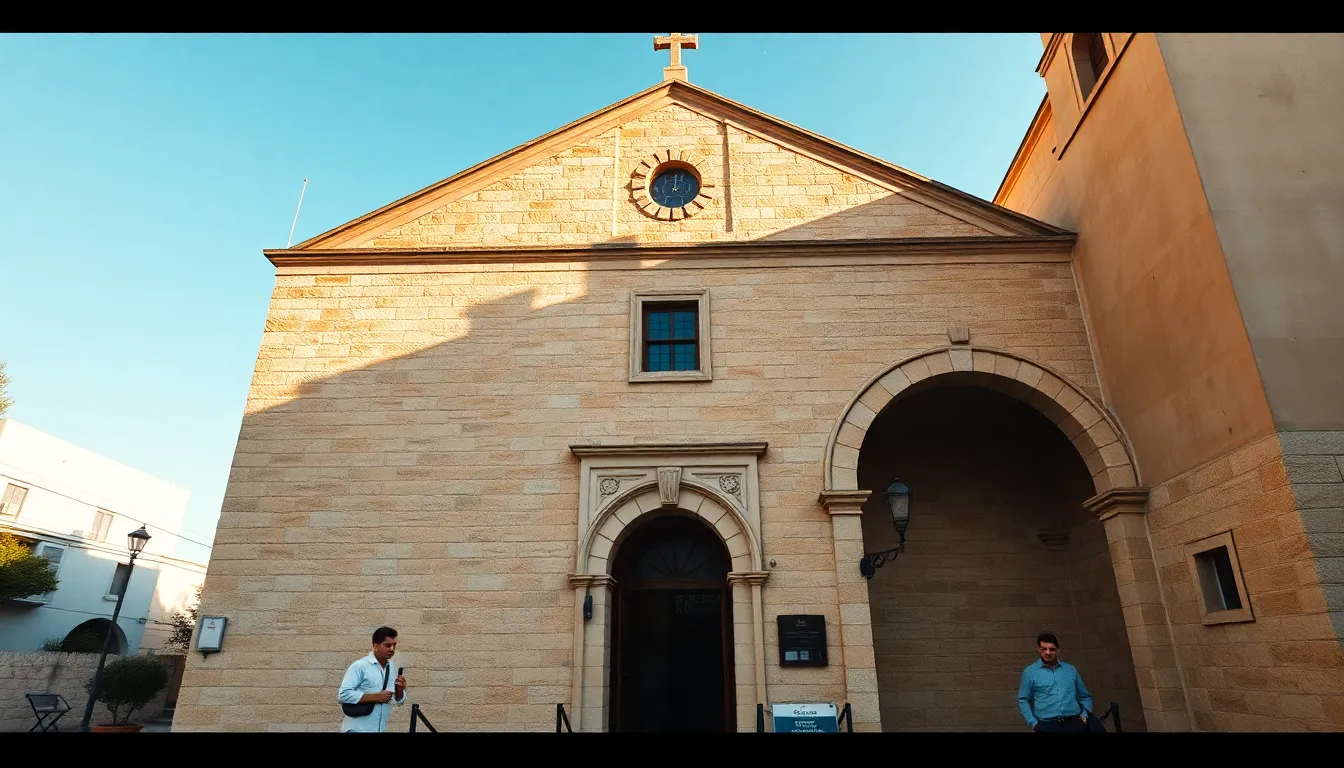
There is a black and white pebble mosaic on the floor of the Kahal Shalom Synagogue in Rhodes, the kind the island is known for, laid in a pattern that has been underfoot for centuries. I always ask groups to look down when we enter, before they look up at the bimah. The floor is where you feel the age of the place. People have prayed on these stones since 1577. That is older than almost any synagogue still standing anywhere in Greece, and it is one of the reasons I bring rabbis and community groups here.
Let me tell you what Kahal Shalom is, what it holds, and how to visit it with the dignity the story demands.
The Oldest Synagogue in Greece
Kahal Shalom, the Synagogue of Peace, was built in 1577, during the period of Ottoman rule over Rhodes. That date makes it the oldest synagogue in Greece, and it still holds services today, which makes its survival all the more remarkable.
It sits inside La Juderia, the old Jewish Quarter of Rhodes, within the medieval walled city. The walled city of Rhodes is one of the best-preserved medieval towns in Europe, and the Jewish Quarter is woven into it, narrow stone streets and low buildings that have changed little in shape over the centuries. Unlike so many Jewish quarters across Europe that were destroyed in the war or redeveloped afterward, the streets of La Juderia are physically intact. You walk where the community walked.
The synagogue follows the Sephardic tradition. The Jews of Rhodes traced their roots to the expulsion from Spain in 1492, and over the following centuries they built an island culture of their own, connected to the wider Sephardic world but shaped by Rhodes and its closeness to the Turkish coast. The interior reflects that tradition: a central bimah, a women’s gallery, and a simplicity that carries its own weight.
What the Building Holds
Step inside and the first thing that strikes most people is the bimah set in the center of the room, in the Sephardic manner, rather than at the front. The reading of the Torah happened in the middle of the community, surrounded on all sides.
The pebble mosaic floor, in the black and white Rhodian style, is original to the building’s tradition and grounds the whole space. The arched windows let in the Mediterranean light. It is not a grand or ornate building. It was a working synagogue for a community of ordinary people, and that is exactly what gives it its honesty.
Adjoining the synagogue is the Rhodes Jewish Museum, which I consider an essential part of any visit. It tells the story of the community through photographs, documents, religious objects, and personal belongings. The museum carries the human detail: families, weddings, daily life, the texture of a world that existed here for centuries. Plan time for it. The synagogue shows you where they prayed. The museum shows you who they were.
The Loss the Square Remembers
I do not rush this part, and I ask groups not to either.
The Jewish community of Rhodes numbered roughly 2,000 people before the war. In July 1944, the entire community, around 1,700 people, was assembled and deported to Auschwitz. Almost none returned. A community that had lived on this island for centuries was destroyed in a matter of days, very near the end of the war.
At the heart of La Juderia stands the Square of the Jewish Martyrs, with its memorial fountain. This is where the community was gathered before the deportation. The names of the lost are recorded on the memorial. Reading them aloud with your group is a practice we encourage. These were not abstract figures. They were the people who prayed in the synagogue you just stood in and lived in the houses you walked past to reach it.
Handled with care, this moment is often the one a congregation carries home. It belongs in the visit, told plainly and with respect.
What Survives Today
A very small Jewish community remains on Rhodes, and during the summer months services are held at Kahal Shalom, both for the local community and for the visitors and descendants who come to pray. To pray in the oldest synagogue in Greece, in a building that has held continuous tradition for over four centuries despite everything, is a profound experience for a group.
That continuity is the point. The deportation tried to end the story. The building is still here, the floor is still here, prayer still happens here. For a congregation seeking to understand Sephardic Jewish life in the Diaspora, Kahal Shalom is living evidence, not a museum piece alone.
How Groups Visit Rhodes
Most Jewish heritage itineraries give Rhodes about a day and a half. That allows for an unhurried walk through La Juderia, time inside Kahal Shalom and its museum, and quiet time in the Square of the Martyrs. The walled city around it rewards exploration too, and the island setting gives groups room to breathe and reflect between the heavier moments.
Rhodes is one of three pillars of a full Greek Jewish heritage journey, alongside the Sephardic world of Thessaloniki and the ancient Romaniote tradition of Ioannina. Each represents a different chapter. For the wider picture, see our overview of Jewish heritage in Greece and our deep dive on the Kehila Kedosha Yashan synagogue of Ioannina, which tells the Romaniote side of the story.
A Practical Word on Access
The walled city of Rhodes is medieval, which means cobblestones and uneven stone underfoot throughout La Juderia. The streets are mostly flat, but the surfaces are old and irregular, so sensible shoes matter. The synagogue and museum are at ground level and reachable on foot from within the old town.
Opening hours vary by season, and the synagogue is most active in summer, so timing matters for groups hoping to attend a service. We coordinate these details in advance so your visit lands when the building is open and, where possible, when prayer is happening. For mixed-age groups, we pace the walk through the old town gently and build in rest and shade.
FAQ: Visiting the Kahal Shalom Synagogue
What is the oldest synagogue in Greece?
The Kahal Shalom Synagogue in Rhodes, built in 1577, is the oldest synagogue in Greece still in use. It stands in La Juderia, the old Jewish Quarter inside the medieval walled city, and holds services during the summer months.
Can groups attend a service at Kahal Shalom?
Yes. During the summer, services are held for the small remaining community and for visiting groups and descendants. Because activity is seasonal and hours vary, we coordinate timing in advance so your group can attend where possible.
What happened to the Jewish community of Rhodes?
The community numbered around 2,000 before the war. In July 1944, roughly 1,700 Jews were assembled in what is now the Square of the Jewish Martyrs and deported to Auschwitz. Almost none survived. The memorial fountain in the square records the names.
What is there to see beyond the synagogue?
The adjoining Rhodes Jewish Museum tells the community’s story through photographs, documents, and personal objects. The Square of the Jewish Martyrs and the streets of La Juderia, largely intact since medieval times, complete the visit.
How long should a group spend in Rhodes?
A day and a half is typical for a heritage group. That allows unhurried time in the synagogue and museum, quiet reflection in the Square of the Martyrs, a walk through La Juderia, and room to take in the walled city around it.
Kahal Shalom is the kind of place that stays with a group long after the trip ends, a building that outlasted the worst of history and still gathers people in prayer. If you are a rabbi or community leader planning a Greece heritage journey, I would be glad to help you build Rhodes into it with the care it deserves. You can see how we structure these trips on our Greece heritage page or explore our group heritage tours.
Contact us whenever you are ready to start the conversation.