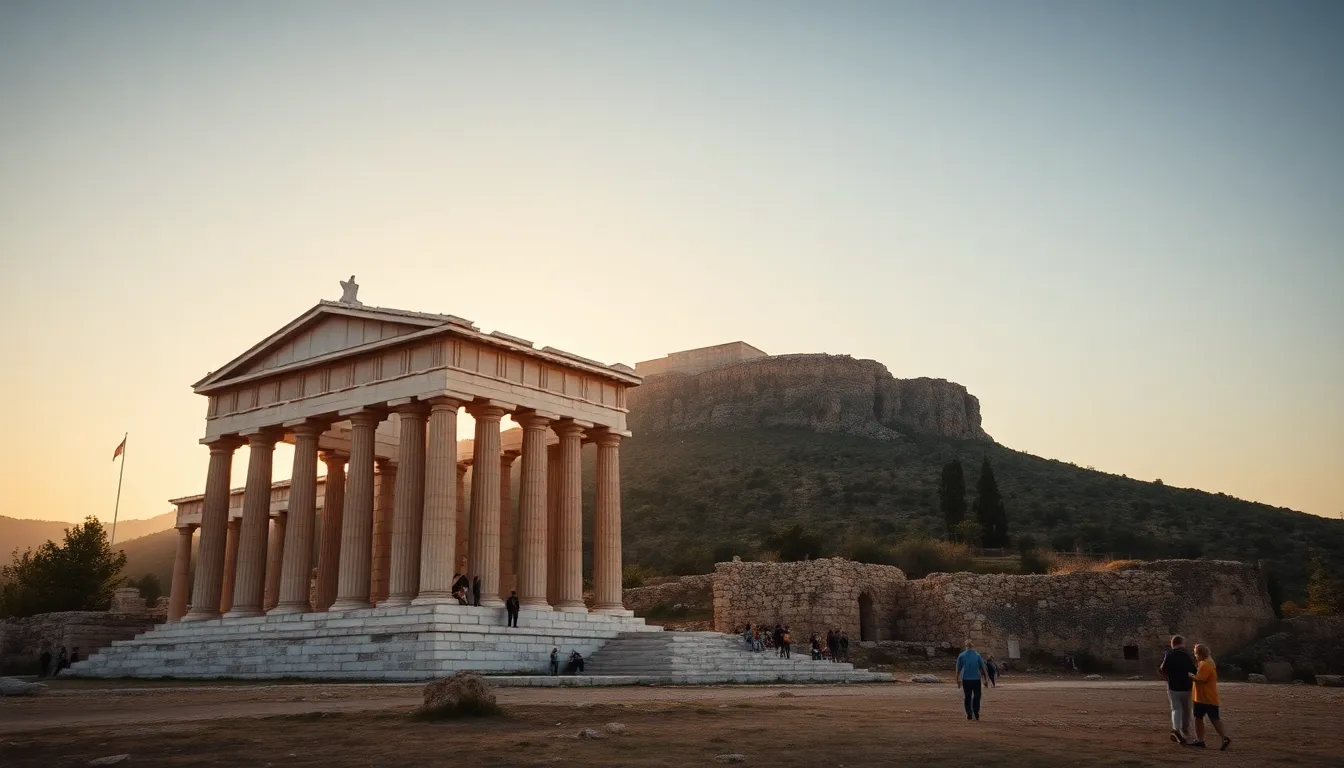
There is a stone platform at ancient Corinth, the bema, and when I bring a group to it I do not say much at first. I let them stand there. This is the judgment seat where Paul was hauled before the proconsul Gallio, and the moment is recorded in Acts 18. It is also one of the few places in the whole New Testament that historians can date to a specific year, because Gallio’s term is fixed by an inscription. So your group is standing on a spot that anchors the entire chronology of the early church. When somebody in the group works that out, you can see it land.
Corinth is the city where Paul stayed longest in Greece, a year and a half, and it received two of his most important letters. For a faith group it is often the climax of a Greece journey, and it deserves to be understood as more than a single ruin. Let me orient you to the place.
The Layout: Three Sites, Not One
People say “Corinth” and picture one archaeological park. It is really three connected places, and a good visit takes in all of them.
There is ancient Corinth itself, the excavated Roman city where Paul lived and worked. There is the Corinth Canal, the dramatic cut through the isthmus, a short drive away. And there is Cenchreae, the eastern port, where Paul set sail and where the church had a deacon named Phoebe. Together they tell the fuller story. All three sit close together on the isthmus that links mainland Greece to the Peloponnese, an easy day from Athens, which is why Corinth so often closes out a Greece route. Our Greece heritage travel guide shows how it fits the larger map.
Ancient Corinth: Where Paul Lived and Wrote
This is the core, and it is rich.
The excavated city centers on the Roman forum, and the bema stands right in it, the raised platform where Paul faced Gallio. Above the forum rise the columns of the Temple of Apollo, some of the oldest standing Greek architecture in the country, dating to the sixth century BC. Paul saw these same columns. Around the forum you can trace the shops, the fountains, and the road to the port of Lechaion.
What makes Corinth click for a group is the character of the city it was. First-century Corinth was a wealthy, cosmopolitan, freewheeling Roman colony, a port town with all the energy and all the trouble that implies. When you read First Corinthians here, the letter’s worries about division, status, lawsuits, sexual ethics, and a community pulling in different directions suddenly make complete sense. You are standing in exactly the kind of place that produced those problems. I always read a passage from the Corinthian letters on site. The setting does half the teaching.
The Temple of Aphrodite once crowned the Acrocorinth, the steep mountain above the city, and its cult shaped the city’s reputation. The Acrocorinth can be climbed for those who want the view and the Byzantine and medieval fortifications at the top, but it is a serious climb and most groups admire it from below.
The small museum at the site holds finds from the city, including an inscription mentioning the synagogue, a tangible link to the Jewish community where Paul first preached when he arrived.
The Corinth Canal: A Stop Worth the Few Minutes
The Corinth Canal is not a biblical site, but it is a stop I always include, and groups love it. It is a narrow, vertiginous cut through solid rock that separates the Peloponnese from the mainland, finished in the nineteenth century. But the idea is ancient. In Paul’s day, ships were dragged across the isthmus on a paved trackway, the diolkos, to avoid the long and dangerous voyage around the Peloponnese. Standing at the canal, you understand why Corinth was rich: it controlled the shortcut between two seas. The city’s wealth, its diversity, and its restlessness all flow from that geography. A ten-minute stop here explains the whole character of the place.
Cenchreae: The Port Paul Sailed From
Cenchreae gets skipped on rushed itineraries, and I think that is a small loss. This was Corinth’s eastern harbor, on the Saronic Gulf. Paul sailed from here at the end of his stay, and Acts 18 notes that he had his hair cut at Cenchreae because of a vow. In Romans 16, he commends Phoebe, “a deacon of the church at Cenchreae,” one of the named women leaders of the early church.
The ruins are modest, partly underwater, but the setting is quiet and the connection is real. For a group that values the role of women in the early church, or that simply wants to stand where Paul boarded a ship for Ephesus, it is a meaningful and peaceful addition. The story carries on from here to Patmos and Asia Minor; for the island chapter, see the Patmos heritage guide.
Practical Orientation for Group Leaders
What I tell leaders planning a Corinth day:
- Base from Athens. Corinth is roughly an hour and a half from Athens, which makes it an easy long day trip or a natural stop heading into the Peloponnese.
- Allow a full half day at the ancient site. The forum, the bema, the temple, and the museum reward unhurried time, and the on-site reading of the Corinthian letters needs room to breathe.
- Add the canal and Cenchreae if you have the day. The canal is a quick photo and geography lesson. Cenchreae is a quiet twenty minutes that rounds out the story.
- Skip the Acrocorinth climb for most groups. It is steep and long. Admire it from the forum unless you have a fit group and time to spare.
- Bring sun protection. The ancient site is open and offers little shade. Hats, water, and good shoes for uneven stone.
One thing worth knowing as you plan: with Heritage Tours, the group leader travels free when you bring fifteen or more participants. For a pastor building a congregational trip, that changes the budget conversation, and it is worth factoring in early.
FAQ: Corinth for Faith Groups
What is the bema at Corinth and why does it matter?
The bema is the raised public platform in the Roman forum where Paul was brought before the proconsul Gallio, recorded in Acts 18. It matters because Gallio’s term of office is fixed by an external inscription, which lets historians date this episode precisely. That single anchor helps date Paul’s whole journey and much of the New Testament timeline, so the bema is one of the most historically grounded spots in Christian heritage travel.
How long does a group need at Corinth?
Plan a full half day at the ancient site itself, with the on-site reading of First Corinthians built in. If you add the Corinth Canal and the port of Cenchreae, a relaxed full day covers all three. It works well as a day trip from Athens or as the gateway into the Peloponnese.
What is Cenchreae and is it worth visiting?
Cenchreae was Corinth’s eastern port, where Paul set sail at the end of his stay and where Phoebe, a deacon Paul commends in Romans 16, served the church. The ruins are modest and partly underwater, but for groups interested in the early church and the role of women in it, it is a quiet, meaningful stop worth the short detour.
Why does First Corinthians make more sense when read at Corinth?
Because the letter’s concerns reflect the city. First-century Corinth was a rich, diverse, status-driven port full of competing influences, and the letter’s worries about division, ethics, and rivalry grow directly out of that environment. Reading it on the site, your group feels the connection between the place and the pastoral problems Paul was addressing.
Is Corinth suitable for older group members?
The main archaeological site is mostly flat with uneven stone, manageable for most with good shoes and a steady pace. The one strenuous part, the Acrocorinth climb, is optional and we skip it for most groups. The canal and Cenchreae involve little walking. With sun protection and a sensible pace, Corinth works well for mixed-age congregations.
If you are imagining Corinth as the high point of your congregation’s Greece journey, I would be glad to help you shape it. The site tells its own story once your people are standing in it. You can see how we build these trips on our Greece heritage page or learn how the group experience works on our group heritage tours page.
Contact us whenever you are ready to start planning.