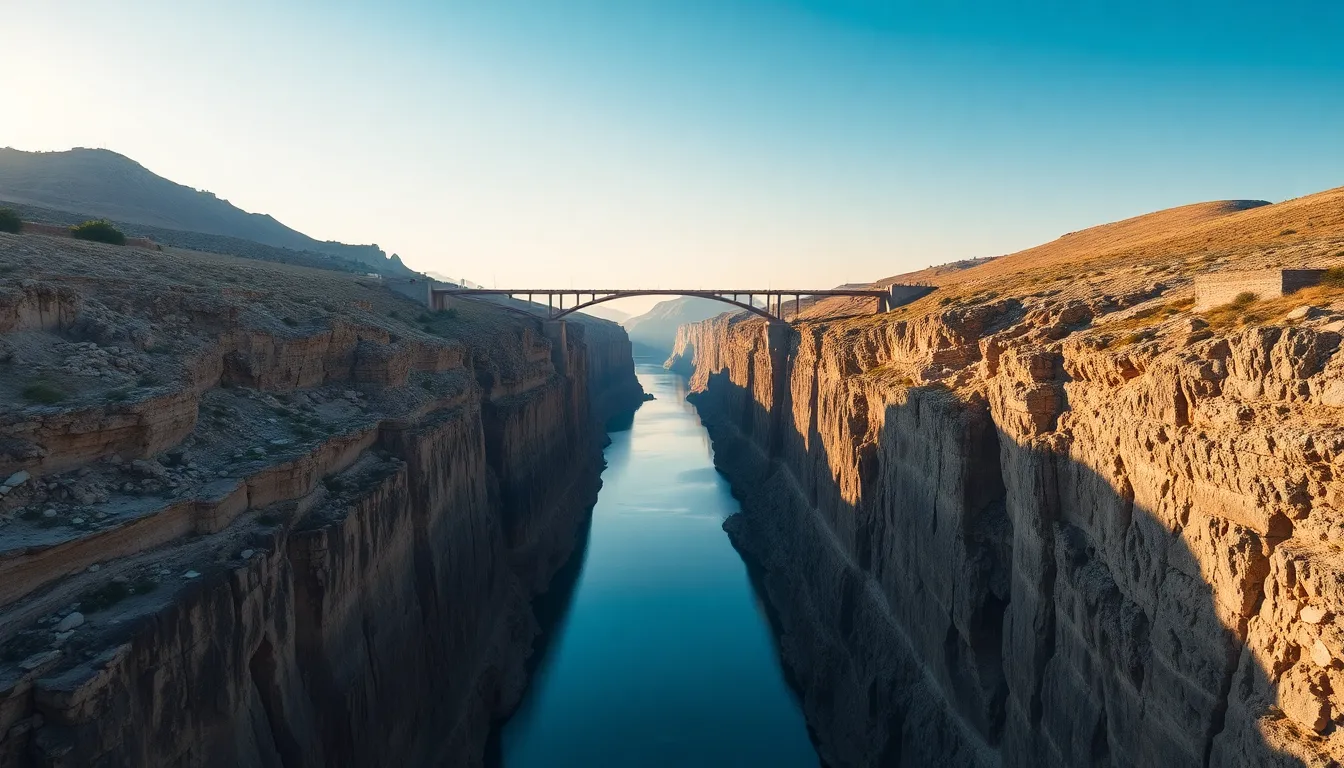
The first time I brought a group to the Corinth Canal, I made the mistake of mentioning ancient Corinth in the same breath. People looked over the bridge rail at the canal, then asked where the ruins were, and I had to explain they are a few miles away and built in a different age entirely. So now I separate the two before we ever arrive. The canal is a modern marvel of engineering. Ancient Corinth is where Paul lived and wrote. Both are worth your time, and they sit close enough to do in one morning, but they tell two different stories.
Let me walk you through both, and how to fit them into a Greece journey for your congregation.
The Corinth Canal: A Cut Through the Rock
The Corinth Canal slices straight through the narrow isthmus that joins the Peloponnese to mainland Greece. It is just over four miles long, and at its deepest the rock walls rise around 250 feet above the water. Standing on the bridge and looking down, the scale is hard to take in. The cut is so narrow and so sheer that ships pass through it one at a time, often under tow.
The idea is ancient. Rulers had dreamed of cutting through this isthmus for two thousand years, going back to the tyrant Periander in the sixth century BC and later the emperor Nero, who reportedly broke the first ground with a golden pickaxe. None of them finished it. The engineering defeated them. The canal you see today was finally completed in 1893.
Before the canal, the Greeks had a different solution. They built a stone trackway called the Diolkos and physically hauled ships overland across the isthmus on rollers. Parts of the Diolkos are still visible near the western end of the canal. For a group, it is a striking thing to point out, because it explains why Corinth grew rich in the first place.
Why the Geography Made Corinth
This is the part I want groups to understand before we move on to the ruins, because it makes sense of everything in Paul’s letters.
Corinth controlled the isthmus. Any cargo moving between the Aegean in the east and the Adriatic in the west either rounded the dangerous southern cape of the Peloponnese or crossed the narrow neck of land at Corinth. Most chose Corinth. The city had two ports, one on each sea, and it taxed and serviced the trade that flowed between them.
That made Corinth wealthy, busy, and crowded with people from everywhere. Sailors, merchants, travelers, every nationality and every cult passed through. It was a city of money and movement and mixed loyalties. When you read Paul writing to the Corinthians about division, about sexual immorality, about food sacrificed to idols, about people from radically different backgrounds trying to become one church, the geography is the reason. This was a port city at the crossroads of the ancient world. The pressures Paul addresses were the pressures of that exact place.
Ancient Corinth: Where Paul Lived and Wrote
The archaeological site of ancient Corinth sits a few miles southwest of the canal, at the foot of the towering rock of Acrocorinth. Paul spent around eighteen months here, longer than almost anywhere else on his journeys. He worked as a tentmaker alongside Aquila and Priscilla, and he wrote letters from this region that became part of Scripture.
The site holds real things your group can stand in front of. The Temple of Apollo, with its heavy Doric columns, still dominates the ruins and dates from before Paul’s time. The agora, the marketplace, is where daily commerce and disputes played out. And then there is the Bema.
The Bema is the raised public platform where Paul was brought before the proconsul Gallio, recorded in Acts 18. The Jewish community accused him, Gallio refused to hear the case, and Paul was released. The remains of the Bema are identified on the site, and it is one of the few places in Greece where you can stand at the precise spot of a named New Testament event. I always read Acts 18 aloud here. It lands differently when the platform is in front of you.
Nearby, an inscription found at Corinth mentions Erastus, a city official Paul names in Romans 16. Small details like that turn the letters from text into the record of real people in a real place.
What to Do With Your Group
Here is the rhythm that works.
Start at the canal. Walk out onto the bridge, look down, and let people take photographs. This is a good place to explain the isthmus, the Diolkos, and why this strip of land mattered for trade. It sets up everything that follows. There are cafes at the bridge if your group needs a coffee stop.
Then drive to ancient Corinth. Walk the agora, see the Temple of Apollo, and gather at the Bema for a reading of Acts 18 and a short devotional. The small on-site museum is worth a pass for the sculpture and the everyday objects that show what life here looked like.
If your group is fit and you have the time, the rock of Acrocorinth rises above the site with a fortress on top and a wide view over both seas. It is a climb, and not every group should attempt it, but for those who can, it makes the geography unforgettable.
For how Corinth fits into the wider journey, see our guide to following the Apostle Paul through Greece and our deep dive on the Areopagus in Athens, the city Paul came to Corinth from.
A Practical Word on Access
The canal bridge is easy. Flat, paved, and a short walk from parking. Anyone in your group can manage it.
Ancient Corinth is a different matter. It is an open archaeological site with uneven stone paths, loose gravel, and almost no shade. In summer the heat is serious. Bring water, wear hats and proper shoes, and plan the visit for the morning if you can. The Bema and the temple are reachable without much climbing, so even members who cannot walk far will see the heart of the site. Acrocorinth, by contrast, is only for the sure-footed.
We pace these visits around the people you actually bring, and we make sure no one misses the moments that matter.
FAQ: Visiting the Corinth Canal and Ancient Corinth
Are the Corinth Canal and ancient Corinth the same place?
No. The Corinth Canal is a modern shipping canal completed in 1893, cut through the isthmus. Ancient Corinth is an archaeological site a few miles away, where Paul lived and wrote. They are close enough to visit in one morning, but they belong to different eras and tell different stories.
What can you see at ancient Corinth?
The main features are the Temple of Apollo, the agora or marketplace, and the Bema, the raised platform where Paul was brought before Gallio in Acts 18. There is also a small museum on site and, above it all, the fortress rock of Acrocorinth.
Why was Corinth important in the Bible?
Corinth controlled trade across the narrow isthmus between two seas, which made it wealthy, crowded, and morally mixed. Paul spent about eighteen months there and wrote letters to the Corinthian church that became part of the New Testament. The issues he addresses reflect the pressures of this busy port city.
How long should a group spend here?
Plan a half day. Allow thirty to forty-five minutes at the canal and about two hours at ancient Corinth, including a reading at the Bema and time in the museum. Add more if your group plans to climb Acrocorinth.
Is ancient Corinth difficult to walk?
The main site has uneven stone paths and little shade, but the key features are reachable without serious climbing. We recommend hats, water, good shoes, and a morning visit in summer. Acrocorinth is a real climb and suits only sure-footed travelers.
Corinth gives your group both the engineering wonder and the biblical ground in a single morning, and the canal makes the geography of Paul’s letters impossible to forget. If you are planning a Greece heritage journey for your congregation, I would be glad to help you build it well. You can see how we structure these trips on our Greece heritage page or explore our group heritage tours.
Contact us whenever you are ready to start the conversation.