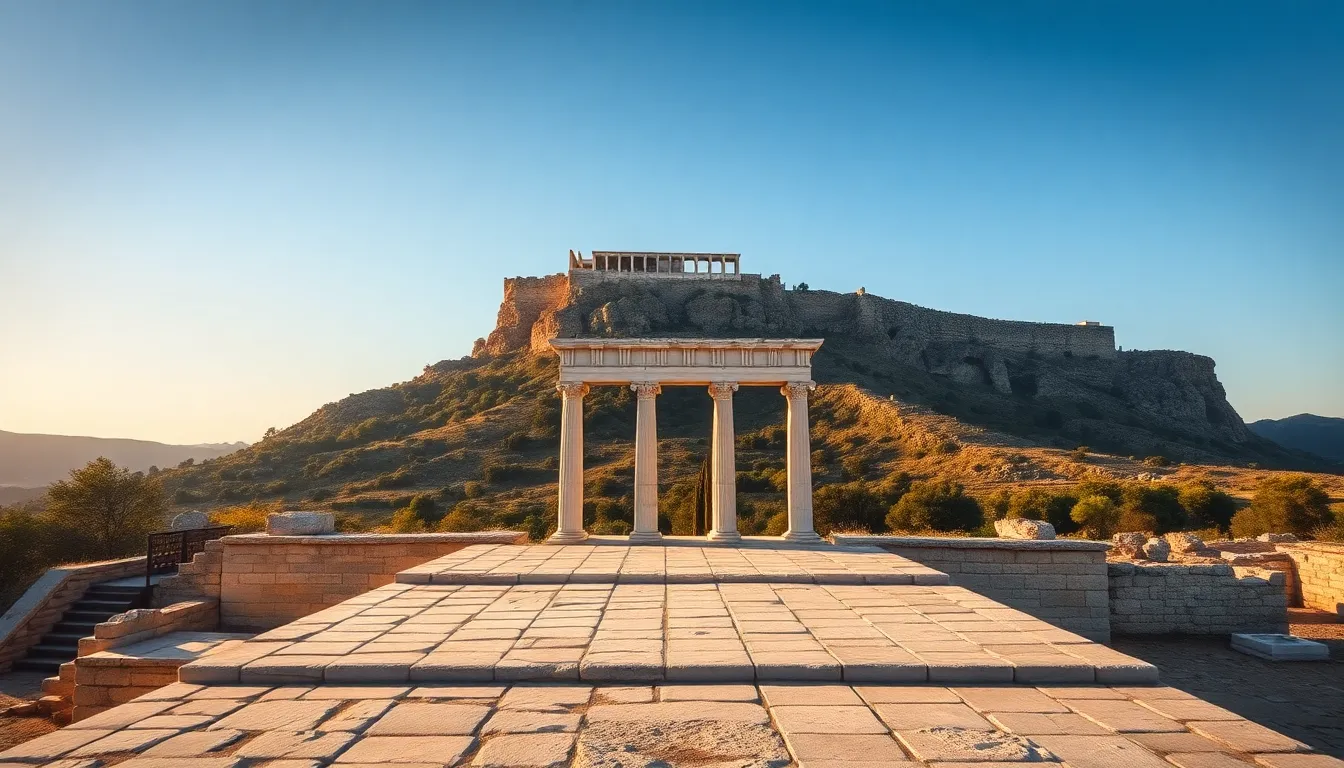
There is a low stone platform in the middle of the ruins at ancient Corinth, set back from the main road through the forum, and most visitors walk right past it. I never let my groups do that. We stop, we open Acts 18, and we read the trial of Paul before Gallio standing right in front of the place it happened. The platform is the Bema. It is one of the few spots in all of Paul’s travels where you can match a courtroom drama in the New Testament to a structure you can still see and touch.
Corinth was the city where Paul stayed longest in Greece, a year and a half, and the Bema is where his time here nearly ended in front of a Roman judge. Let me tell you what the Bema is, why it matters for your group, and how to read it well on the ground.
What the Bema Actually Is
The word “bema” simply means a raised platform or speaker’s stand. In a Roman city it was the official tribunal, the place where the governor sat to hear cases, deliver rulings, and address the public. Corinth was the capital of the Roman province of Achaia, so its Bema was the seat of real authority. When a proconsul wanted to render judgment, this is where he sat.
What survives today is the stone core of that platform, raised above the level of the forum, with steps and the foundations of the structures that once framed it. It sat at the heart of the agora, between the rows of shops, in full public view. Decisions made here were meant to be seen.
For a Christian group, the value of the Bema is its specificity. Acts names the governor, names the charge, and records the outcome. You are not standing at a “traditional site.” You are standing at the actual civic tribunal of the city, the kind of platform a proconsul named Gallio would have used.
The Trial of Acts 18
Here is the scene worth reading aloud with your group before you move on.
Paul had been preaching in Corinth for some time, and the local Jewish leaders brought him before Gallio, the proconsul, with a charge. They said he was persuading people to worship God in ways contrary to the law. It was a religious dispute dressed up as a legal one, and they wanted Roman power to settle it.
Gallio refused. Before Paul could even open his defense, the proconsul threw the case out. He told the accusers that if this were a matter of crime or fraud he would hear them, but questions of their own law and their own words were their business, not his. He drove them from the Bema. Rome would not adjudicate the dispute.
That ruling mattered far beyond Corinth. By declining to treat Paul’s preaching as a crime, Gallio set a kind of precedent that gave the early church breathing room across the empire. Your group is standing where a Roman official effectively decided that the gospel was not against the law.
Why Gallio Anchors the Whole Timeline
There is a detail here that I always share, because it gives even the skeptics in a group something solid to hold.
Gallio is not only a name in Acts. An inscription found at Delphi, just across the gulf, records his term as proconsul of Achaia and lets historians date it to roughly the early 50s AD. That single dated stone gives scholars one of the firmest anchor points in the entire New Testament timeline. From Gallio’s term, you can work backward and forward to place much of Paul’s ministry on a real calendar.
So when you read Acts 18 at the Bema, you are reading an account that lines up with archaeology and inscription evidence. For pastors and educators, that is a powerful teaching moment. The text and the ground agree.
What to Do With Your Group at the Bema
Here is how I structure the stop.
Gather the group in front of the platform, not on top of it, so everyone can see it as the focal point. Read Acts 18:12 to 17 aloud. Let the verses settle before you say anything.
Then talk about what the place represents. This is a fitting spot for a short reflection on standing firm under pressure, on the difference between a religious dispute and a real crime, and on how God protected the mission through an unlikely Roman ruling. Keep it brief. The forum is open and sound carries off.
Take a few minutes to look around. The temple of Apollo stands above the agora, the Acrocorinth towers behind, and the shop foundations stretch out on either side. This was a loud, commercial, cosmopolitan city, and the Corinthian letters make complete sense once your people have seen it. The Bema is the natural place to connect the trial to the church Paul wrote to. For the full route into and out of Corinth, see our guide to following the Apostle Paul through Greece.
Combining the Bema With the Rest of Corinth
The Bema sits inside the main archaeological site at ancient Corinth, so you see it as part of one walk through the forum. Most groups pair it with the temple of Apollo, the Peirene fountain, and the small on-site museum, then look up at the Acrocorinth, the fortified peak that loomed over the ancient city.
Corinth fits naturally with Athens, which is about a ninety-minute drive away across the isthmus. Many itineraries do Athens and the Areopagus first, then come to Corinth to close the Greek mainland leg of the journey. If you want to see how the Areopagus reading pairs with the Bema, our guide to the Areopagus in Athens covers that stop in detail.
A Practical Word on Access
The Corinth site is open-air and the ground is uneven, with ancient paving, gravel paths, and some low steps around the forum. The Bema itself is roped in places, so plan to view it from the front rather than climbing on it.
The walking is moderate and flat overall, which makes Corinth one of the easier major sites for a mixed-age group. There is little shade in the forum, so bring water and hats in the warmer months, and start earlier in the day when you can. Anyone who tires can rest near the museum while the rest of the group reads at the platform. We set the pace around the people you bring, and we make sure no one misses the moment at the Bema.
FAQ: Visiting the Bema of Corinth
What is the Bema at Corinth?
The Bema is the raised stone tribunal in the forum of ancient Corinth, where the Roman governor of Achaia sat to hear cases and address the public. It is the platform where Paul was brought before the proconsul Gallio in Acts 18.
What happened to Paul at the Bema?
Local opponents accused Paul before Gallio of persuading people to worship contrary to the law. Gallio refused to hear the case, ruling that it was a dispute about their own law and not a Roman crime, and dismissed the charge. The decision protected Paul and the early church.
Why is Gallio important for dating the New Testament?
An inscription at Delphi records Gallio’s term as proconsul of Achaia and dates it to the early 50s AD. That fixed date lets historians anchor Paul’s time in Corinth, making the Bema one of the firmest chronological points in the New Testament.
How long should a group spend at the Bema?
Plan for fifteen to twenty-five minutes at the platform itself, including the reading and a short reflection, within a Corinth visit of about ninety minutes to two hours that also covers the temple of Apollo, the agora, and the museum.
Can we hold a devotional at the Bema?
Yes. It is one of the most fitting places in Corinth for a brief reflection on standing firm under pressure. Gather close in front of the platform, since the forum is open and sound carries away.
The Bema is a short stop, but it turns the Corinthian letters from a Bible study into a place your group has stood. If you are planning a Greece heritage journey for your congregation, I would be glad to help you build Corinth into it well. You can see how we structure these trips on our Greece heritage page or explore our group heritage tours.
Contact us whenever you are ready to start the conversation.