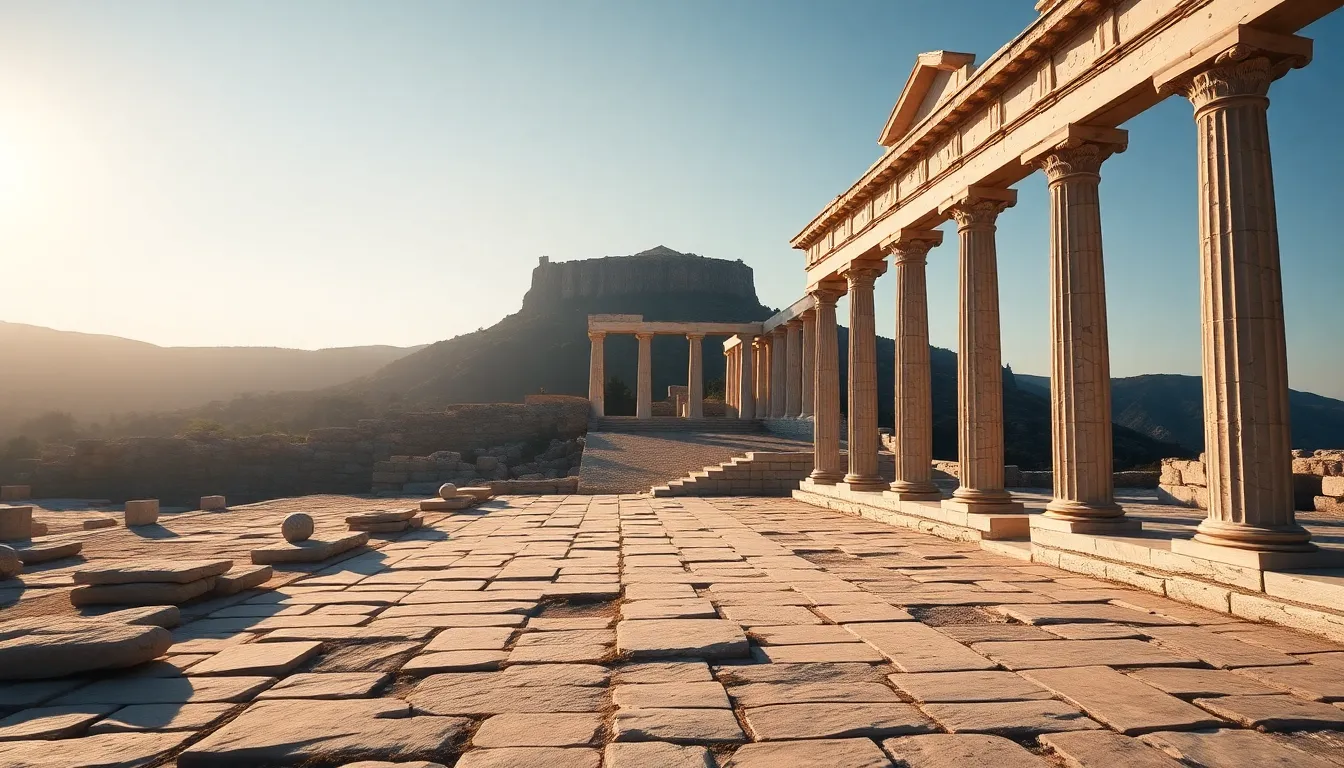
I have stood at the bema in Corinth with a lot of groups, and the same thing happens almost every time. Someone opens Acts 18, reads the part where Paul is dragged before Gallio, and then looks up at the stone platform in front of them. You watch it click. This is the place. Not a place like it, not a reconstruction, the actual platform where the proconsul heard the charge and refused to rule. For a faith group, Corinth is where the New Testament stops being a book and starts being a street you can walk.
Corinth is also the city Paul knew longest. He spent eighteen months here, more than anywhere else in Greece, and two of his most personal letters were written to the people who lived in these ruins. Let me walk you through the site the way I would walk you through it on the ground, and explain why I always save it for near the end of a Pauline journey.
Why Corinth Mattered So Much to Paul
To understand the church Paul planted here, you have to understand the city. Ancient Corinth sat on the narrow isthmus connecting mainland Greece to the Peloponnese, with a harbor on each side. Goods, money, sailors, and ideas flowed through it constantly. It was rich, crowded, multicultural, and famous for its loose morals. The Romans had destroyed the old Greek city in 146 BC and rebuilt it as a colony a century later, so the Corinth Paul knew was a relatively new Roman boomtown full of freedmen, traders, and people on the make.
That context explains everything about the Corinthian letters. The divisions, the lawsuits between believers, the questions about food sacrificed to idols, the confusion about sexual ethics, the showing off with spiritual gifts: all of it makes sense once you understand you are reading mail sent to a noisy, ambitious port city. When your group reads First Corinthians standing in the agora, the letter stops sounding like ancient theology and starts sounding like a pastor writing to a difficult congregation. Because that is exactly what it was.
Paul arrived here after Athens, worked as a tentmaker alongside Aquila and Priscilla, and reasoned in the synagogue every Sabbath. The Lord told him in a vision to keep speaking, for “I have many people in this city.” He stayed a year and a half. That is the backdrop your group carries onto the site.
The Bema: Where Paul Stood Before Gallio
The bema is the heart of a Christian visit to Corinth, and it deserves the time. This raised stone platform in the center of the forum was where Roman officials addressed the public and rendered judgment. Acts 18 records that the Jewish community brought Paul here before Gallio, the proconsul of Achaia, accusing him of persuading people to worship contrary to the law. Gallio refused to hear the case and drove them from the tribunal.
That single episode is one of the most useful dates in the whole New Testament. We know from an inscription found at Delphi that Gallio served as proconsul around AD 51 to 52. Because Acts places Paul before him here, scholars can anchor Paul’s missionary timeline to actual calendar years. When I explain this to a group at the bema, people often realize for the first time that the New Testament is fastened to real, datable history. That moment of recognition is worth crossing an ocean for.
This is also a natural place for a short devotional. The bema where a Roman judge dismissed the case against Paul is a fitting spot to talk about courage, about speaking truth in a hostile city, and about the protection that carried the mission forward.
The Agora, the Temple of Apollo, and the Shops
Around the bema spreads the agora, the marketplace that was the commercial and social engine of Corinth. Walk it slowly. You can see the foundations of shops and stoas, the paving where business was done, and the Lechaion Road running north toward the harbor. This is the world of First Corinthians, the marketplace where meat from pagan temples was sold and where a young church had to figure out how to live as followers of Christ in a city built on commerce and appetite.
Above the agora stand the surviving columns of the temple of Apollo, seven monolithic Doric columns dating to the sixth century BC. They are some of the oldest standing temple columns in Greece, and they dominate the site. For your group they are a vivid reminder of the religious environment Paul preached into. He was not speaking to empty air. He was speaking to people surrounded by the old gods, by temples and altars and festivals, calling them toward something new.
Look too for the Erastus inscription nearby, a paving stone that names Erastus, the city treasurer, who laid the pavement at his own expense. Paul mentions an Erastus, “the treasurer of the city,” in Romans 16, a letter written from Corinth. Whether it is the same man cannot be proven, but standing at a stone that may bear the name of someone in Paul’s circle brings the text very close.
The Acrocorinth Above
Rising behind the ancient city is the Acrocorinth, a massive rock that served as the citadel and the high sanctuary. In Paul’s day it held a temple of Aphrodite, and its presence loomed over the whole valley. Most groups do not climb it, since the ruins on top are mainly medieval fortifications and the walk is steep, but I always point it out and explain what it meant.
The Acrocorinth is a useful teaching image. The temple on the height, the marketplace below, the harbor beyond: this was a city oriented around trade and pleasure, watched over by a goddess of desire. Into that landscape Paul wrote about love that is patient and kind, about a body that is a temple, about a more excellent way. Seeing the rock helps your people feel the contrast he was drawing.
A practical note for leaders: the main archaeological site is mostly flat and walkable, with some uneven stone underfoot. It is manageable for most mixed-age groups. The Acrocorinth itself is a separate, demanding climb, and I rarely build it into a congregation itinerary unless the group is fit and eager.
Reading the Corinthian Letters on Site
The single best thing you can do in Corinth is read. Find a quiet edge of the agora, gather your group, and read a chapter of First Corinthians out loud. Chapter 13, the passage on love, lands with extraordinary weight when you read it where it was first received. So does chapter 1, with its talk of a church divided into factions, when you are standing in the busy marketplace that bred that rivalry.
This is also why Corinth works so well near the end of a journey that follows Paul through Greece. Your group has already stood at Philippi, the first church in Europe, and traced Paul’s troubled ministry in Thessaloniki. By the time they reach Corinth they understand the shape of the mission, and the maturity and mess of the Corinthian church make sense as the next chapter. For the full route, see our hub on Greece spiritual sites.
FAQ: Visiting Ancient Corinth
Where exactly did Paul stand before Gallio in Corinth?
At the bema, the raised stone judgment platform in the center of the ancient forum. It is one of the best-preserved and most identifiable features on the site, and it is the spot most groups gather to read Acts 18. The encounter with Gallio, dated to around AD 51 to 52 from an inscription at Delphi, is what allows scholars to anchor Paul’s timeline to real calendar years.
How long do you need at the ancient Corinth site?
Plan for about two to three hours to see the bema, the agora, the temple of Apollo, and the museum without rushing. If you want time to read a full chapter of First Corinthians with the group and hold a short devotional at the bema, give it a little more. Corinth rewards a slower pace.
Is ancient Corinth easy to visit for older group members?
The main site is largely flat with some uneven ancient paving, so it is manageable for most mixed-age groups with sensible footwear and a steady pace. The Acrocorinth, the citadel on the rock above, is a steep separate climb that I do not include in most congregation itineraries. We shape the walking around the group you bring.
What is the connection between Corinth and the book of Romans?
Paul wrote his letter to the Romans from Corinth, near the end of his time in Greece. The Erastus inscription on the site names a city treasurer of that name, and Paul greets an Erastus, “the treasurer of the city,” in Romans 16. It is a small detail that brings the writing of Romans very close to the ground you are standing on.
Should Corinth come at the start or end of a Greece heritage trip?
I almost always place Corinth near the end. Following Paul north to south, your group arrives in Corinth after Philippi, Thessaloniki, Berea, and Athens, and the mature, complicated Corinthian church reads as the culmination of the journey. Ending here gives people a real sense of completion.
If you are imagining a journey for your congregation that puts them at the bema with an open Bible, I would love to help you build it. With Heritage Tours, the group leader travels free when you bring fifteen or more participants, which changes the planning math for a lot of pastors. You can see how we structure these trips on our Greece heritage page or learn how the group experience works on our group heritage tours page.
Contact us whenever you are ready to start planning.