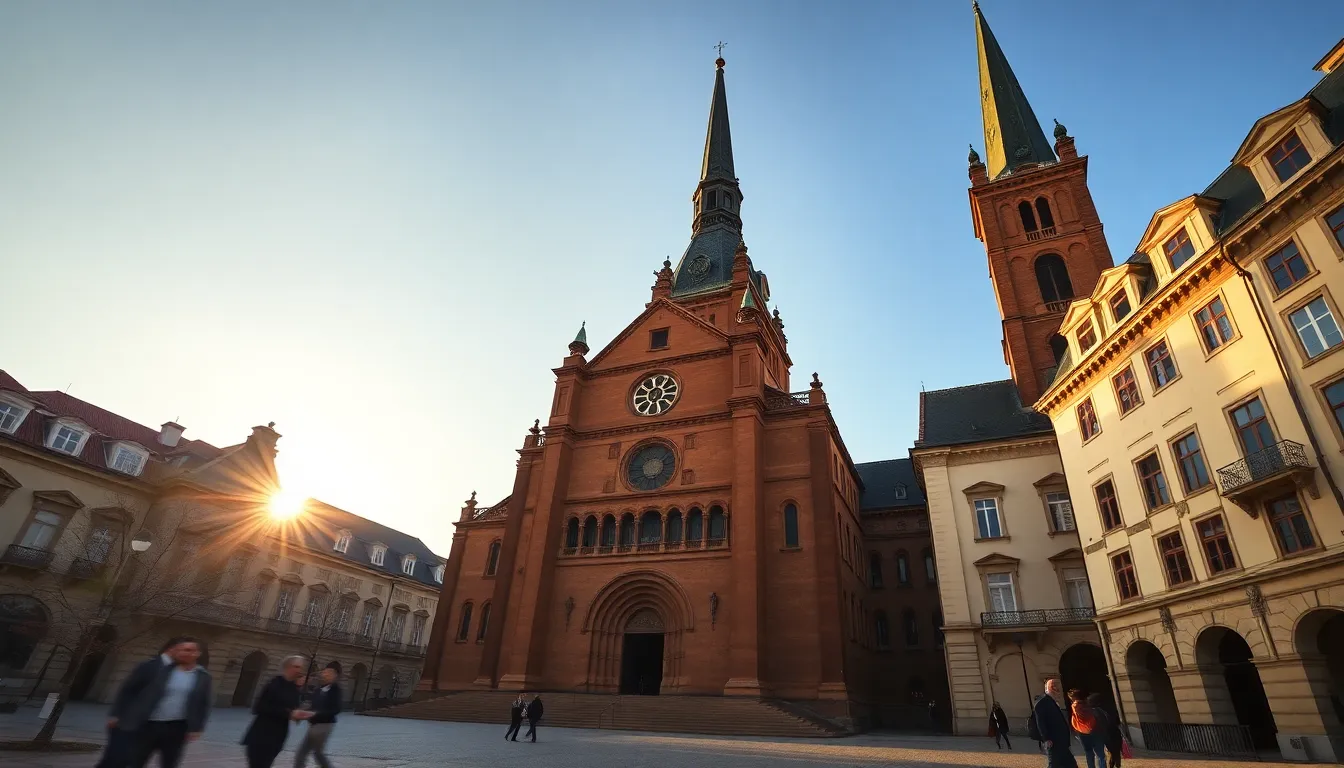
When the Choir Started Singing, Nobody Moved
I have learned to keep my mouth shut at certain moments on a tour. One of them is a Friday afternoon at St Thomas Church in Leipzig, when the Thomanerchor, the boys’ choir Bach himself once led, files into the chancel and begins the motet. I had a group of pastors with me the first time I planned a visit around it. When the voices opened up under that vaulted ceiling, a man next to me, a choir director back home, just put his hand over his mouth. Afterward he told me he had spent forty years conducting and had never understood Bach until that hour.
That is what St Thomas does. It takes a name everyone knows and makes it a living sound in the room where it was written.
Bach’s Church and What Happened Here
The Thomaskirche, St Thomas Church, has stood in Leipzig in some form since the 13th century, with the Gothic building groups see today largely completed by 1496. But for most of the people who travel here, the story starts in 1723. That year Johann Sebastian Bach became Thomaskantor, the cantor and music director of St Thomas, a post he held for 27 years until his death in 1750.
It is hard to overstate what those years produced. As cantor, Bach was responsible for the music in Leipzig’s main churches, which meant writing, rehearsing, and performing new sacred music week after week. Much of the work that defines Western sacred music came out of this job. The St Matthew Passion was first performed in Leipzig. So was the St John Passion. Cantatas poured out of him at a pace that still seems impossible. He was not composing for posterity. He was composing because the service on Sunday needed music, and he signed many of his scores with the letters S.D.G., Soli Deo Gloria, glory to God alone.
For a Christian group, this is the heart of the visit. Bach’s music was not concert music. It was worship. Standing in the church where it was made for the liturgy, not the stage, changes how you hear it.
His Grave, in the Floor He Walked
Bach was not originally buried in St Thomas. He was laid to rest in a different Leipzig churchyard in 1750 and, remarkably, the exact location was nearly lost. His remains were identified and eventually moved, and in 1950, on the 200th anniversary of his death, they were reinterred in the chancel of St Thomas itself. A simple bronze plate in the floor marks the spot, usually with fresh flowers on it left by visitors from all over the world.
I always let groups approach it quietly. There is no grand monument. Just his name in the stone, in the church where he worked, a few steps from where the choir still sings his music. For many travelers, this is the most moving moment of the whole Germany trip, and it has nothing to do with spectacle.
The Thomanerchor, a Choir Older Than Bach
The boys’ choir that Bach directed, the Thomanerchor, was founded in 1212. It is one of the oldest choirs in the world and it is still singing. The boys live and study together and continue the tradition of singing motets and cantatas in St Thomas, often on Friday evenings and Saturday afternoons during term, and at Sunday services.
When I build a Leipzig visit for a group, I check the choir’s schedule first and build the day around it where I can. A tour of the church is meaningful on its own. A tour of the church with the Thomanerchor singing in it is something people talk about for years.
It is worth knowing that Bach is not the only giant who worked here. Mendelssohn led the Leipzig revival of the St Matthew Passion in 1829, the performance that rescued Bach’s choral music from near-obscurity and put it back in front of the world. Wagner was baptized in St Thomas. Mozart played the organ here. The church groups walk into is not a Bach shrine frozen in 1750. It is a place where the line of Western sacred music kept running, generation after generation, in the same nave.
How Groups Visit St Thomas
A focused visit to St Thomas runs about an hour for the church itself, including time at Bach’s grave and the windows and memorials around the nave. The Bach Museum sits directly across the small square and adds a strong forty-five minutes to an hour for groups that want the fuller story of his life and work. The two together make a natural half-day.
The thing I tell every group leader is to plan around the music. Choir performances and organ recitals are scheduled, not constant, and they fill quickly with visitors who came specifically for them. If your group cares about hearing Bach in Bach’s church, the date and the time have to be set early. A weekday tour without music is good. A visit timed to the choir is the trip people remember.
Practical Access for Your Group
Leipzig is in eastern Germany and is very well connected, which makes St Thomas easy to fit into an itinerary. It pairs naturally with the Reformation sites, since Wittenberg is less than an hour away by coach, and with Erfurt and the central German Jewish heritage sites to the west. A group doing Luther and Bach in the same trip is following a route that makes geographic and historical sense.
The church is in Leipzig’s pedestrian old town. Coaches drop off and pick up at designated points nearby, and the walk in is short and flat. The main floor of the church is step-free and accessible. For groups of fifteen or more, a guided visit is worth arranging, both to secure entry around service and rehearsal times and to have someone who can connect the building to the music. Heritage Tours coordinates the timing with the choir and recital schedule so your group is in the right place when the singing starts, and arranges hotel pickup and dropoff by motor coach.
FAQ: St Thomas Church, Leipzig
Is Bach really buried in St Thomas Church?
Yes. Bach died in 1750 and was reinterred in the chancel of St Thomas in 1950, on the 200th anniversary of his death. A simple bronze floor plate marks his grave, usually with flowers left by visitors.
Can groups hear the boys’ choir sing?
Often, yes. The Thomanerchor, founded in 1212, still sings motets and cantatas in St Thomas, typically on Friday evenings and Saturday afternoons during term and at Sunday services. Performances are scheduled and popular, so the visit needs to be timed in advance.
How long does a group need at St Thomas Church?
About an hour for the church and Bach’s grave, plus forty-five minutes to an hour for the Bach Museum across the square. Timed together they make a comfortable half-day.
Does St Thomas suit a Christian heritage group?
Strongly. Bach wrote his sacred music here as worship for the liturgy, not for the concert hall. Hearing it in the church it was made for gives Christian groups a connection to the music that a recording cannot match.
What other sites pair well with Leipzig?
Wittenberg and the Reformation trail are less than an hour away by coach, and Erfurt’s medieval Jewish heritage lies to the west. A Luther-and-Bach itinerary through central and eastern Germany is a natural route.
St Thomas is one of those places where heritage stops being a history lesson and becomes something you hear. If you want it on your itinerary, explore our Germany destination page, read about the broader spiritual sites of Germany and the hidden heritage sites most tours skip, see how our group tours come together, and contact us to start planning.