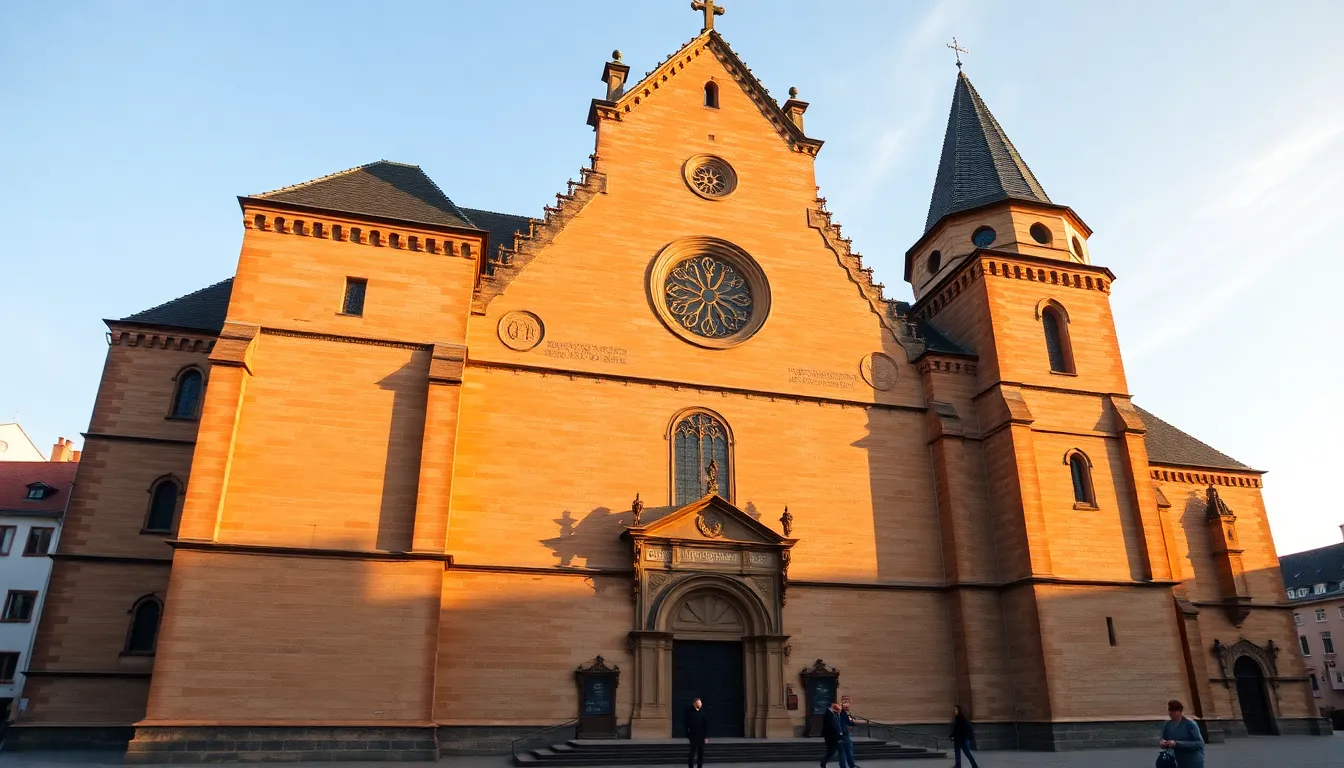
I have stood with a lot of groups in front of a lot of tombs over the years. Most of the time the conversation is about a saint, a reformer, a composer, someone who lived centuries after the New Testament closed. The Abbey of Saint Matthias in Trier is different, and I always tell groups so before we walk in. This is the resting place claimed for one of the Twelve. The apostle Matthias, the man chosen to replace Judas. It is, by tradition, the only grave of an apostle anywhere north of the Alps.
That claim alone makes the abbey worth the short walk south of Trier’s center. But the place itself, a working Benedictine monastery with monks who still pray the hours, gives the visit a quiet weight that surprises people. Let me walk you through what you will find and how to frame it for your group.
Who Was Matthias
Matthias enters the story in the first chapter of the Book of Acts. After Judas Iscariot betrays Jesus and dies, the eleven remaining apostles need to restore their number to twelve. Peter stands up among the believers, two candidates are put forward, and the community casts lots. The lot falls to Matthias, and he is “numbered with the eleven apostles.” That is essentially all the New Testament tells us about him directly.
I find this is one of the more interesting figures to discuss with a group, precisely because Scripture says so little. Matthias is the apostle of the empty space, the one called to fill the gap left by betrayal. For a pastor, that opens a real conversation about restoration, about how a community closes a wound and moves forward, about being chosen for a role someone else abandoned. Standing at his claimed tomb, those themes stop being abstract.
The Tradition That Brought Him to Trier
Early Christian tradition holds that the relics of Matthias were brought to Trier by Helena, the mother of Constantine, in the fourth century, the same Helena connected to the Holy Robe and to so much of Trier’s early Christian heritage. The relics were later rediscovered, according to the abbey’s history, in the twelfth century, and the church that stands today was built to house and honor them.
As with all relic traditions, I tell groups to hold the historical claim with an open hand. What is not in dispute is that for many centuries Christians have come to this exact spot believing they were near an apostle, and that current of devotion is real and continuous. The abbey has been a pilgrimage destination since the Middle Ages.
The Abbey Church
The church you walk into is a Romanesque building, begun in its present form in the twelfth century, with a broad and dignified west facade. Inside, the proportions are calm rather than overwhelming. This is not Cologne Cathedral reaching for the sky. It is a monastic church built for daily prayer, and it feels like one.
The focus of the interior is the tomb of Saint Matthias, set in the nave. Pilgrims have venerated it here for the better part of a thousand years. When I bring a group, I encourage them to slow down at the tomb rather than treat it as one more photograph. Whatever a person concludes about the relics, this is a place where the question “what does it mean to be sent” has been asked by Christians for centuries, and the apostle’s name carries that question.
A Living Benedictine Community
What sets Saint Matthias apart from a museum church is that it is still home to a community of Benedictine monks. They follow the Rule of Saint Benedict, structuring the day around prayer and work, the ancient ora et labora. The monks pray the Liturgy of the Hours, and if your group’s timing aligns with one of the services, you can experience monastic prayer in a space that has held it for centuries.
I always try to build in the possibility of attending a service or simply sitting through one of the prayer hours when I bring a group here. There is something about hearing the chant in that Romanesque nave that does more than any explanation I can offer. It connects the apostolic past to a living present in a single sound.
Framing the Visit for Your Group
For a Christian group leader, the Abbey of Saint Matthias works best as a moment of stillness inside a busy Trier day. The city center is loud with Roman grandeur, the Porta Nigra, the basilica, the cathedral. Saint Matthias, a short walk to the south, offers a deliberate change of register. It is quieter, more intimate, more devotional.
Here is how I usually structure it. Do the big Roman and imperial sites first, in the morning, when the group has energy for walking and scale. Then bring them to Saint Matthias in the early afternoon as a contrast. Let the quiet land after the grandeur. If you can align with a prayer hour, plan around it. Give the group time to sit, to reflect, to pray if that is part of your tradition.
The walk from the center to the abbey is flat and takes roughly twenty to thirty minutes at a group pace, and for groups that would rather not walk it, a short coach or taxi transfer is easy. The terrain is not difficult, but for mixed-age groups it is worth knowing the distance in advance.
One more practical note. As a working monastery, the abbey deserves a respectful approach. I brief my groups before we arrive: this is a house of prayer and a home, not a tourist attraction. Modest dress, quiet voices, and sensitivity during services go a long way, and the monks are gracious to groups that come in that spirit.
To see how Saint Matthias fits into a fuller day in the oldest city in Germany, read our guide to Trier’s Christian heritage. For the wider German Christian heritage route, start with our Germany spiritual sites guide, and for the Reformation country you might pair with the Rhineland, see the Reformation site-by-site guide.
You can learn more about how we structure these journeys on our Germany destination page, and our group heritage tours page explains the group leader experience, including that group leaders travel free with fifteen or more participants.
FAQ: St Matthias Abbey Trier
Why is St Matthias Abbey significant for Christian travelers?
The abbey claims the grave of the apostle Matthias, who was chosen in Acts 1 to replace Judas among the Twelve. By tradition it is the only apostle’s grave north of the Alps, which makes it a uniquely direct link to the New Testament for Christian groups traveling in Germany.
Who was the apostle Matthias?
Matthias appears in Acts 1, where the believers cast lots to choose a successor to Judas Iscariot, and the lot falls to him. Scripture says little else about him, but he is remembered as the apostle called to restore the Twelve to their full number after betrayal.
Is St Matthias Abbey still an active monastery?
Yes. It is home to a community of Benedictine monks who follow the Rule of Saint Benedict and pray the Liturgy of the Hours. Groups whose timing aligns with a prayer service can experience monastic worship in a Romanesque church that has held it for centuries.
How do groups get from central Trier to the abbey?
The abbey sits a short distance south of Trier’s historic center, roughly a twenty to thirty minute flat walk at group pace. Groups that prefer not to walk can reach it easily by coach or taxi. The route is not difficult, which makes it manageable for most mixed-age groups.
Should groups dress or behave any particular way at the abbey?
Yes. As a working monastery and a house of prayer, the abbey calls for modest dress, quiet voices, and sensitivity, especially during services. A brief word to your group before arrival sets the right tone, and the monks are welcoming to groups who come respectfully.