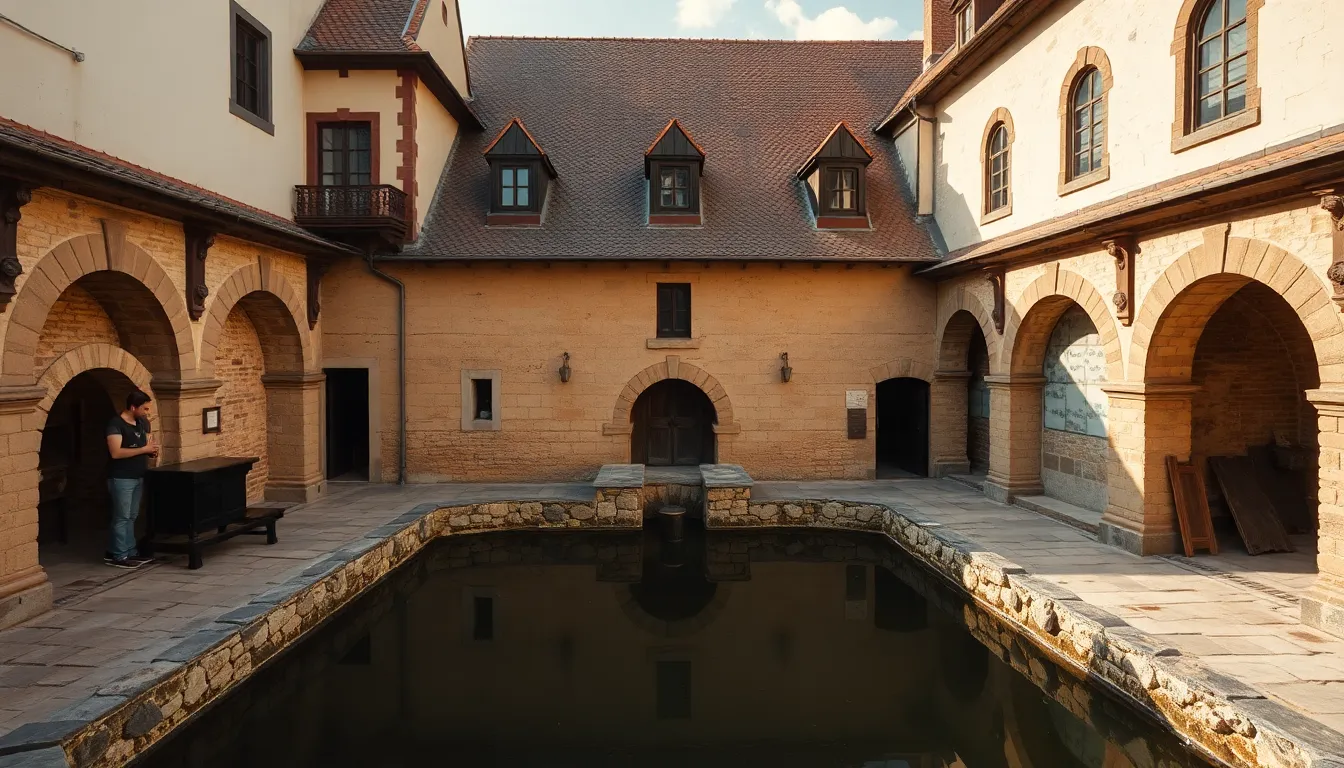
Going Down the Stairs
There is a moment on the Rhine itinerary that I never describe to a group in advance, because I want them to feel it cold. We are in Speyer, in the Judenhof, the old Jewish courtyard, and I lead them to a stone opening in the ground. Then we start down. The staircase turns and drops, the light fades, the air gets cool and damp, and after a long descent the group arrives at the bottom and looks down into still, dark groundwater that has been collecting in this shaft for nearly 900 years.
People go quiet on those stairs. By the time we reach the bottom, the medieval world is not an idea anymore. It is the stone under your hand and the cold on your face.
What the Speyer Mikveh Is
A mikveh is a Jewish ritual bath, used for purification according to Jewish law. The water in a kosher mikveh has to come from a natural source, not be drawn or carried, which is why this one was dug so astonishingly deep. The builders in Speyer sank a shaft straight down to the level of the groundwater fed by the Rhine, so the bath would always be filled by living water from the earth itself.
The Speyer mikveh, the Judenbad, was built around 1120 and is one of the oldest and best-preserved monumental mikvehs in Europe. It descends more than ten meters underground. The lower chamber, where the immersion pool sits, is built in dressed stone with Romanesque detailing, the same architectural language as the great churches of the period. Whoever paid for it spared no expense. They were building something meant to last and meant to be beautiful.
That detail matters when you stand there. This was not a makeshift basin. It was a deliberate, costly, carefully engineered piece of sacred infrastructure, built by a community that was confident, established, and intended to stay.
The dating is not an accident of timing either. In 1084 the bishop of Speyer formally invited Jews to settle in the city and granted them protections and privileges, hoping their trade would help the town grow. The mikveh, raised a generation later, is the physical proof that the invitation worked. A community does not sink a monumental stone shaft ten meters into the earth unless it believes it has a future in that place. Reading the charter and then standing at the bottom of the bath, you feel the optimism of it, and the weight of everything that came after.
Speyer, the S of ShUM
Speyer is the Shpira of ShUM, the Hebrew acronym formed from the medieval names of three Rhine cities, Shpira (Speyer), Warmaisa (Worms), and Magenza (Mainz). Together these communities were the spiritual and intellectual center of Ashkenazi Judaism from the 11th century onward. They shared rabbis, legal rulings, and communal law, and the decisions made among them shaped Jewish practice across Europe.
In 2021, the ShUM sites were inscribed as a UNESCO World Heritage Site. The Speyer Judenhof, with its mikveh and the remains of the medieval synagogue and women’s shul, is the core of what UNESCO recognized in the city. For a Jewish group, the mikveh is the most intact and most moving piece of that recognition, because it is not a reconstruction. The stone is original. The water is real.
The Faith and Heritage Significance
I find that the mikveh reaches people in a way that even synagogues sometimes do not. A synagogue speaks of community and prayer. A mikveh speaks of the most intimate rhythms of Jewish life, of marriage, of family, of the cycles a woman marks, of the laws of purity that ordered daily living. To stand at the bottom of this shaft is to stand inside the private religious life of a medieval community, not just its public face.
For a rabbi leading a group, that intimacy opens real conversation. The mikveh connects directly to halacha that is still practiced today. The continuity is the point. The same law that sent a woman down these stairs in 1150 sends people to a mikveh now. The community that built this was destroyed, scattered, and persecuted across the centuries, and the practice it served is still alive. That thread, broken and yet unbroken, is what groups carry away from the bottom of those stairs.
How Groups Visit and Practical Access
Speyer sits on the Rhine in southwestern Germany, between Heidelberg and the French border, and it anchors the southern end of a ShUM itinerary. The natural route runs Speyer, Worms, and Mainz along the river, and I build groups a one-to-two day stretch on the Rhine to do all three in sequence, because visiting them together tells a story no single site can tell alone.
The Judenhof and mikveh are in the old center of Speyer, a short walk from the city’s enormous Romanesque cathedral, which itself is a UNESCO site and worth seeing. Coaches drop off near the old town and the walk in is short and flat.
I have to be honest with group leaders about the descent. Reaching the immersion pool means going down a long medieval staircase, more than ten meters, with no elevator. The steps are stone and can be damp. Most groups manage it well with a little time and care, but for members who cannot do stairs, the upper level and the Judenhof courtyard still convey a great deal, and a good guide can describe what waits below. Plan about an hour at the Judenhof and mikveh.
For groups of fifteen or more, booking a guided visit in advance is the right call, both for access and because the history rewards a knowledgeable guide. Heritage Tours arranges the bookings, builds the three ShUM cities into one coherent Rhine route, and provides hotel pickup and dropoff by motor coach so your group never has to navigate trains.
FAQ: The Speyer Mikveh
What is a mikveh and why is the Speyer one so deep?
A mikveh is a Jewish ritual bath used for purification under Jewish law, which requires water from a natural source. The Speyer mikveh, built around 1120, was dug more than ten meters down to reach groundwater fed by the Rhine, so it would always be filled by living water from the earth.
Is the Speyer mikveh original or reconstructed?
It is original. The Speyer Judenbad is one of the oldest and best-preserved medieval mikvehs in Europe. The stone, the staircase, and the immersion chamber are the medieval structure, not a modern rebuild.
What is ShUM and how does Speyer fit in?
ShUM is a Hebrew acronym for Shpira (Speyer), Warmaisa (Worms), and Magenza (Mainz), three Rhine cities that formed the heart of medieval Ashkenazi Judaism. They were inscribed together as a UNESCO World Heritage Site in 2021. Speyer is the Shpira of the three.
Can groups with limited mobility visit the mikveh?
The immersion pool is reached by a long medieval staircase with no elevator, so members who cannot manage stairs will not reach the bottom. The upper level and the Judenhof courtyard still convey a great deal, and a guide can describe the lower chamber for anyone who stays above.
How long does a Speyer visit take and what pairs with it?
Plan about an hour at the Judenhof and mikveh. Speyer pairs naturally with Worms and Mainz for a full ShUM itinerary along the Rhine, and the Romanesque Speyer Cathedral nearby is worth adding.
The Speyer mikveh is one of those places where heritage stops being abstract and becomes physical. If you want to descend it with your group, explore our Germany destination page, read about the hidden heritage sites most tours skip and the broader spiritual sites of Germany, see how our group tours are built, and contact us to start planning your Rhine itinerary.