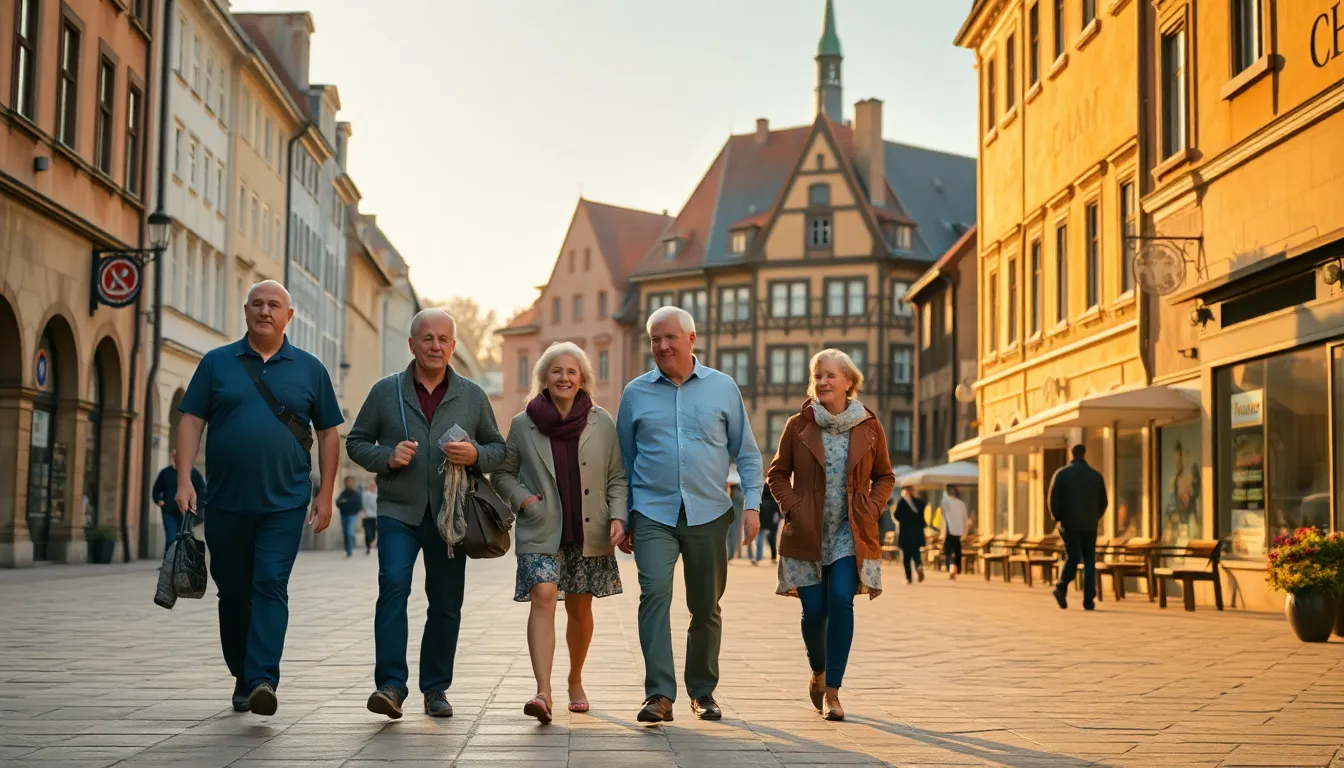
The hardest group I ever planned for was not a difficult group. It was a wonderful one. A congregation of forty people, ages eight to eighty-six, three generations of the same families traveling together. The grandfather wanted to spend the whole day in Worms. His granddaughter wanted to know if there was Wi-Fi on the bus. Both of them deserved a great trip.
That is the real challenge of a multigenerational heritage trip. You are not planning for one group. You are planning for three or four at once, and they are all wearing the same lanyard. The teenagers fade by mid-afternoon. The grandparents need shorter walking days and a chair when they reach the synagogue. The parents in the middle are trying to keep everyone fed and moving. After twenty years of leading these trips, I have learned that the secret is not energy. It is pacing.
What follows is a route I have built and rebuilt for family congregations. It moves more slowly than my standard ten-day plan, and that is on purpose. Every day has a built-in soft afternoon. Every site has been chosen because it works for an eight-year-old and an eighty-year-old standing side by side. If you want the faster, denser version, look at our 10-day Germany heritage itinerary. This one trades speed for everyone arriving home glad they came.
Days 1 and 2: Frankfurt, a Gentle Start
We always start in Frankfurt because the airport is easy and the city forgives jet lag. The first day is for nothing. A short walk through the reconstructed Old Town, coffee at Romerberg Square, and an early dinner so the youngest and the oldest can sleep. I do not schedule a single heritage site on arrival day. Tired people do not absorb meaning, and a child who is overtired on day one is a child who resists day three.
Day two we visit the Judengasse Museum, which sits on the site of one of Europe’s oldest Jewish ghettos. This is a strong opener for families because it is indoors, it is seated in places, and it tells a story children can follow: families lived in this narrow lane for three centuries. For the grandparents, it sets the emotional tone. For the kids, it is concrete and visual. We keep the morning to two hours, break for a real lunch, and leave the afternoon open.
Days 3 and 4: The Rhine Valley at a Slower Speed
The ShUM cities of Worms, Speyer, and Mainz are recognized by UNESCO as the cradle of Ashkenazi Jewish life, and they are the heart of this trip. For a multigenerational group, I split them across two unhurried days instead of one packed one.
Day three is Worms. The synagogue dates to the 11th century, and the Rashi Chapel beside it is where one of Judaism’s greatest scholars taught. Here is the access detail that matters: the old Jewish cemetery has uneven ground and some slope. I bring folding stools for anyone who needs to rest, and I keep the group together so no one feels rushed past a grave they wanted to stand at. Grandparents often want time at these stones. Give it to them. The teenagers can be sent ahead with a younger guide to the next stop and it works fine.
Day four is Speyer in the morning, with its medieval mikveh, one of the oldest surviving ritual baths in Europe, and then a calm Rhine Valley drive to Mainz. The drive itself is part of the plan. It gives older travelers a seated afternoon and gives families time to talk about what they saw. I have watched grandparents tell stories on that bus that their grandchildren had never heard. That is the trip working.
Day 5: Nuremberg, One Story at a Time
Nuremberg has two faces. The medieval old town is intact and easy to walk, with market squares and half-timbered houses that delight younger travelers. The Nazi Documentation Center, built into the unfinished Party Rally Grounds, is one of the best-curated exhibitions in Germany.
For a mixed-age group, I do not do both in full on the same day. We take the old town in the morning at a stroll, with time for an ice cream and a market square the kids actually enjoy. The Documentation Center comes after lunch, and I keep it to the core exhibition. For families with children under ten, I offer a quiet alternative: an adult can take the youngest back to the hotel garden while the rest of the group goes deeper. Nobody should feel they failed the trip by stepping out. Heritage is not an endurance test.
Days 6 and 7: Munich and Dachau, with Real Recovery
Munich is warm and walkable, and a morning in Marienplatz is a genuine break for everyone. But the reason heritage groups come is Dachau, the first concentration camp, opened in 1933 and about twenty minutes from the city.
This is the day where pacing matters most. Your group will need three to four hours at the memorial, and I never schedule anything heavy afterward. With a family group I am even firmer about this. Children feel the weight of Dachau even when they cannot name it. Grandparents may carry personal memory into that gate. The afternoon after Dachau is for a long, quiet lunch and free time at the hotel. A walk along the Isar River works well. Do not fill it.
For group leaders, this is the day your role matters most. With three generations present, you will see the full range of human response in one afternoon. A teenager may go silent. A grandmother may weep. A child may ask a question nobody knows how to answer. Your job is not to manage it. It is to be present, and to let the families be together in it.
Day 8: Wittenberg, a Walkable Reformation Day
For Christian families, Lutherstadt Wittenberg is the heart of the trip. This is where Martin Luther posted the 95 Theses on the Castle Church door in 1517. The town is small and flat, which makes it ideal for a multigenerational group. The Lutherhaus museum, the Town Church, and the Castle Church are all within an easy walk, and there are benches along the way.
I keep this day relaxed. We see the church door, we sit in the Town Church where Luther preached, and we leave time in the Luther Garden for the older travelers to rest while the children run. For Jewish families, I always raise the Judensau relief on the Town Church, a medieval antisemitic carving the city has chosen to keep with an explanatory memorial. Whether to include it with children present is a decision for each family, and we help you think it through before you arrive.
Days 9 and 10: Berlin, Choosing Depth Over Volume
Berlin is where everything converges, and it is also where a multigenerational group can get overwhelmed if you try to see it all. I pick three sites and we do them well.
The Memorial to the Murdered Jews of Europe is a field of 2,711 concrete pillars near the Brandenburg Gate. Children move through it differently than adults, and that is part of its power. The underground Information Center holds personal stories that older travelers find deeply moving. The New Synagogue on Oranienburger Strasse is Berlin’s most visible symbol of Jewish life. For the final morning, the Jewish Museum Berlin, designed by Daniel Libeskind, is one of the most powerful museum experiences in Europe, and it works for every generation if you give it three hours and do not rush.
I deliberately leave the last afternoon open. After ten days, families want a little time to just be together before they fly home. That open afternoon is not a gap in the plan. It is the plan.
FAQ: Planning a Multigenerational Germany Heritage Trip
How do you keep children and teenagers engaged on a heritage trip?
The trick is concrete stories and short site visits. Children connect to specific people and places, not abstractions, so we frame each site around a family who lived there or a person who walked there. We cap morning visits at around two hours, build in food and free time, and never schedule two heavy sites back to back. Bored teenagers are usually tired teenagers, and pacing fixes most of it.
Is this itinerary accessible for grandparents with limited mobility?
This route is chosen with older travelers in mind, but it still involves walking on cobblestones and some uneven ground, especially in the old Jewish cemeteries. We bring folding stools, keep the group together, and offer seated alternatives at every site. If your group includes wheelchair users or members who cannot manage stairs at all, tell us early and we will adapt further. We also have an accessible Germany itinerary built specifically for groups with limited walkers.
How long should a multigenerational heritage trip be?
Ten days is a good length for three generations traveling together, but it has to be ten slower days, not a compressed version of an adult trip. The pacing in this itinerary, with soft afternoons and recovery time after heavy sites, is what makes the difference between a group that arrives home tired and one that arrives home glad. If your group skews younger and more energetic, our youth group itinerary moves faster.
What happens if a young child or an older traveler needs to leave a site early?
Nothing bad. We build our family trips so that one adult can step out with a child or an older member without the whole group stopping. There is no penalty for needing rest, and there is no expectation that everyone completes every site. A heritage trip is not an endurance event, and we plan it so nobody feels they let the group down by listening to their own body.
Do you handle the bookings and logistics for a large family group?
Yes. Every day includes hotel pickup and dropoff, so you are never navigating a train station with forty people and their luggage. We handle group reservations at the Dachau Memorial and the Jewish Museum Berlin, both of which benefit from advance booking, so the group leader never chases a form. You focus on your families. We move them.
A multigenerational heritage trip is one of the most meaningful things a congregation can do together, and it is also one of the easiest to get wrong by trying to do too much. The right plan is the one that lets your eighty-six-year-old and your eight-year-old both come home saying it was worth it.
You can see how we structure these journeys on our Germany heritage destination page, or read about how the group leader experience works. Group leaders travel free with fifteen or more participants, which makes the family math easier than you might expect.
When you are ready to talk it through, contact us and we will build it around your families.