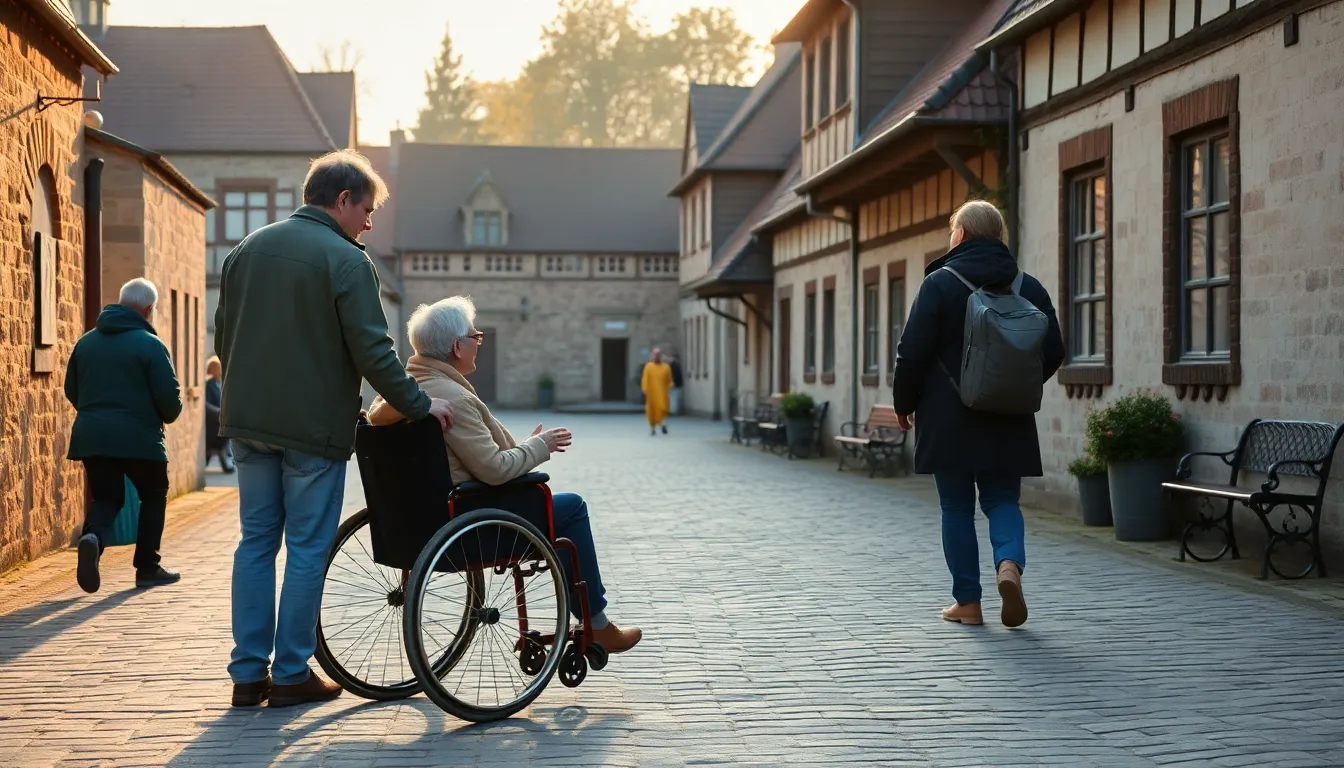
A woman called me once, near tears, because her synagogue’s heritage trip was three weeks away and her ninety-year-old mother had just been told she could not manage the walking. The mother had survived more than I will ever know, and now a tour company was telling her she was too frail to stand where her own history happened. I told the daughter what I will tell you: that is a planning failure, not a reason to stay home. We rebuilt the trip, the mother came, and she stood at the Worms synagogue in a wheelchair with her daughter’s hand on her shoulder. That is why this itinerary exists.
Accessibility on a heritage trip is not about lowering expectations. It is about removing the wrong obstacles so the right encounter can happen. A group with limited walkers, wheelchair users, or members who tire easily can absolutely do a meaningful Germany heritage trip. What it takes is honest planning: choosing sites with real access, building rest into every day, allowing more time between stops, and never pretending a cobblestone hill is fine when it is not. After twenty years, I have learned that the groups who plan for access have better trips, not lesser ones, because nobody is left behind and nobody is exhausted.
This route covers the heart of Germany’s heritage story while staying mobility-conscious throughout. It moves more slowly than my standard plan and favors sites with strong access and seated alternatives. If your group is mixed-age with both energetic and frailer members, our multigenerational Germany itinerary shares much of this thinking. If you have only a weekend, our weekend Berlin itinerary adapts well to limited walkers because Berlin is flat. This plan is for groups who want the fuller journey at a pace that includes everyone.
Days 1 and 2: Frankfurt, an Easy Beginning
We start in Frankfurt because the airport is large, modern, and fully accessible, and because the city center is relatively flat. The first day is for rest, with a short, optional walk through the reconstructed Old Town and an early dinner. Arrival day is never a heritage day on any of my trips, and on an accessible trip it matters double. Travel is tiring for everyone, and more so for older members and those managing health conditions.
Day two is the Judengasse Museum, on the site of one of Europe’s oldest Jewish ghettos. I choose it as the opener partly because it is indoors, climate-controlled, and has seating, which makes it a gentle and powerful first site. The museum is largely accessible, and the storytelling does not depend on long standing. We keep the visit to a comfortable length with breaks, and leave the afternoon open for rest.
Days 3 and 4: The Rhine Valley, with Honest Access Planning
The ShUM cities of Worms, Speyer, and Mainz are recognized by UNESCO as the cradle of Ashkenazi Jewish life, and they are the heart of this trip. They also require the most careful access planning, and I will be honest with you about where the challenges are.
Day three is Worms. The 11th-century synagogue is reachable, and the interior can accommodate seated visitors. The Rashi Chapel beside it is a short, manageable distance. The old Jewish cemetery, however, has uneven ground, grass, and some slope, which is difficult for wheelchairs and risky for unsteady walkers. Here is how we handle it: we position the group at the accessible edge of the cemetery where the oldest and most significant stones are visible and reachable, rather than forcing a route across rough ground. Members who can walk further may, with a guide, while others stay comfortably at the accessible vantage. Nobody misses the meaning of the place.
Day four is Speyer, with its medieval mikveh. The mikveh involves stairs down to the bath itself, which is not accessible, but the site has good viewing and interpretation at ground level, and we make sure seated members experience the history fully even if they cannot descend. Then a smooth, scenic Rhine Valley drive to Mainz, where the new synagogue building is accessible. The drive itself is a built-in rest, which is exactly why I pace the Rhine Valley over two unhurried days for this group rather than one.
Day 5: Nuremberg, a Strong Accessible Site
Nuremberg is a relief on an accessible trip, because the Nazi Documentation Center is modern, well-designed, and fully accessible, with lifts, ramps, and seating throughout. The exhibition is one of the best-curated in Germany, and it does not depend on standing or walking long distances. This is the site where I do not have to make a single compromise, and I plan a thorough visit here with confidence.
The medieval old town has cobblestones, which can be jarring for wheelchairs and tiring on foot, so we take it gently and by vehicle where possible, choosing a flat market square for a seated coffee rather than a long walk through the lanes. The day is structured so the heavy lifting happens at the fully accessible Documentation Center.
Days 6 and 7: Munich and Dachau, an Accessible Memorial
Munich’s center is walkable and largely flat, and a morning around Marienplatz works well at an easy pace. But the reason heritage groups come is Dachau, the first concentration camp, opened in 1933, about twenty minutes from the city.
Dachau is, importantly, one of the more accessible major memorial sites in Germany. The main paths are firm and level, the memorial buildings have ramp access, and wheelchairs are available on site. Distances within the grounds are significant, so we plan for rest stops and allow plenty of time, never rushing. Your group will need three to four hours, and I never schedule anything heavy afterward. On an accessible trip this is doubly true, because the emotional and physical day is full. The afternoon is for quiet recovery, a long lunch, and rest at the hotel.
For group leaders, this is the day your role matters most, and it is the same on an accessible trip as on any other. Your members will look to you. Some will weep. Being present is what matters, and it matters no less for someone in a wheelchair than for anyone else standing at that gate.
Day 8: Wittenberg, Flat and Walkable
Lutherstadt Wittenberg is a gift on an accessible itinerary, because the town is small, flat, and compact. For Christian groups, this is where Martin Luther posted the 95 Theses on the Castle Church door in 1517. The Lutherhaus, the Town Church, and the Castle Church are all within a short, level distance of one another, and the main sites have accessible entrances.
We take this day at a relaxed pace with benches and rest points along the way, and the flatness means wheelchair users and slower walkers can stay with the group throughout rather than being routed around obstacles. For Jewish groups, I raise the Judensau relief on the Town Church, a medieval antisemitic carving the city keeps with an explanatory memorial, and we help you decide whether to include it.
Days 9 and 10: Berlin, an Accessible Capital
Berlin is one of the most accessible major cities in Europe, which makes it a strong finish for this trip. The Memorial to the Murdered Jews of Europe, a field of 2,711 concrete pillars near the Brandenburg Gate, has level pathways through it, and the underground Information Center is reached by lift. The New Synagogue on Oranienburger Strasse is accessible, as is the Jewish Museum Berlin, designed by Daniel Libeskind, which is one of the most powerful and fully accessible museum experiences in Europe. Plan at least three hours there.
For the final afternoon, the Topography of Terror, on the site of the former Gestapo headquarters, is a modern, accessible site with level outdoor and indoor exhibitions. Berlin lets an accessible group end the trip on equal footing with any other, meeting the full weight of the history with none of the access barriers that smaller towns can pose. I leave the last afternoon open for rest before the flight home.
FAQ: Planning an Accessible Germany Heritage Trip
Can wheelchair users do a Germany heritage trip?
Yes, with honest planning. Many of Germany’s major heritage sites, including the Dachau Memorial, the Nuremberg Documentation Center, the Jewish Museum Berlin, and the Holocaust Memorial, are well designed for wheelchair access. The challenges are concentrated in the medieval towns, especially the old Jewish cemeteries, where ground is uneven. We plan around those obstacles, positioning the group at accessible vantage points so no one misses the meaning of a place they cannot physically cross.
How is this itinerary different from the standard Germany route?
It moves more slowly, allows more time between sites, and builds rest into every day. It favors sites with strong access and seated alternatives, and it is honest about the few places where full access is not possible, planning meaningful experiences for seated members at those sites rather than pretending the barrier is not there. The history covered is the same. The pace and the access planning are what differ.
What about members who can walk but tire easily?
This route is built for them as much as for wheelchair users. We cap site visits at comfortable lengths, build in seated breaks, use vehicle transport to minimize long walks, and pace heavier sites with recovery time after. We bring folding stools for places without enough seating. The goal is that someone who tires easily finishes each day with energy to spare, not depleted.
Are the older Jewish cemeteries and the mikveh accessible?
Partly, and we are upfront about it. The old Jewish cemetery in Worms has uneven, sloping ground that is difficult for wheelchairs, and the Speyer mikveh requires stairs to reach the bath itself. At both, we position seated and less mobile members where the history is visible and interpreted at ground level, so they experience the significance fully even when they cannot reach every corner. We never route an accessible group across ground that is unsafe for them.
Do you arrange accessible transport and accommodation?
Yes. We arrange accessible vehicles, hotels with accessible rooms, and on-site wheelchair availability where it exists, and every day includes hotel pickup and dropoff so no one navigates a station. We handle the advance group bookings at the Dachau Memorial and the Jewish Museum Berlin, including any access arrangements. Tell us your group’s specific needs early, in detail, and we build the whole trip around them.
A member’s mobility should never be the reason a congregation leaves them behind. With honest planning and the right pace, a group with limited walkers can stand where their history happened, meet the full weight of it, and come home glad they went. That ninety-year-old at the Worms synagogue is the reason I plan these trips the way I do.
You can see how we structure these journeys on our Germany heritage destination page, or read about the group leader experience. Group leaders travel free with fifteen or more participants.
When you are ready to plan an accessible journey for your group, contact us and we will build it around every member, not just the able-bodied ones.