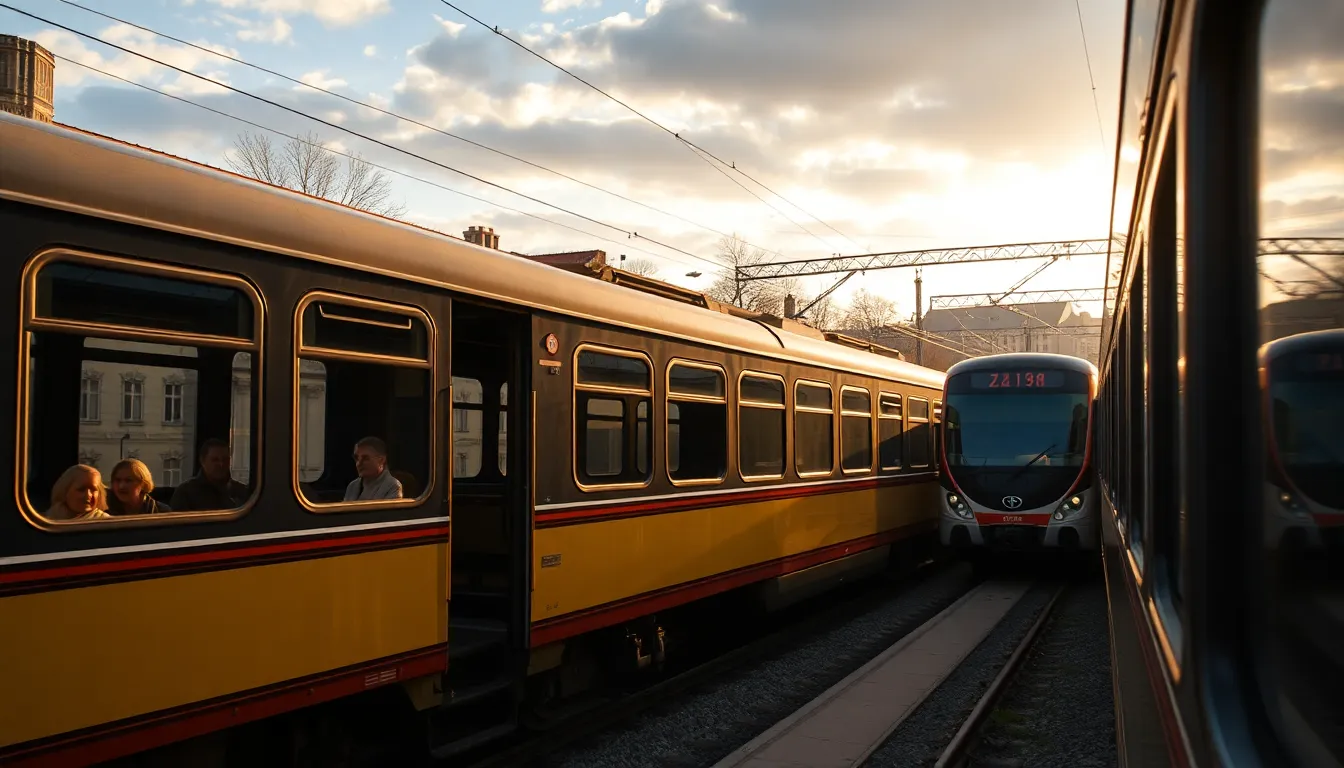
Moving Forty People Is Its Own Kind of Pastoral Work
The thing nobody tells a first-time group leader is how much of the trip is logistics. You picture the moment at the memorial. You do not picture the forty-five minutes beforehand spent getting thirty-eight people, several of them with mobility needs, off a platform and onto the right train with all their luggage before the doors close. I have learned that how you move your group between sites shapes the trip almost as much as the sites themselves. A smooth transfer leaves people rested and present. A chaotic one leaves them frazzled before they even arrive.
Germany makes this easier than most countries. The infrastructure is genuinely excellent. But excellent infrastructure still requires decisions, and the train-versus-coach question is the first one you will face. Let me walk you through how I think about it.
The Honest Comparison: Trains Versus Private Coach
For a heritage group, this is the core logistical choice, and the answer is usually some blend of both.
Deutsche Bahn: Fast, Comfortable, and Not Quite as Simple as It Looks
The German rail network, Deutsche Bahn, is fast and far-reaching. The high-speed ICE trains connect the major cities at real speed. Berlin to Frankfurt in about four hours, Frankfurt to Munich in three. The trains are comfortable, the seats are spacious, and an older member who tires on a long coach ride can stretch out, walk to the dining car, and use a proper restroom. For long city-to-city legs, the train is genuinely the better experience.
But there are catches for a group. German trains are punctual to a fault, which means the doors close on schedule whether your slowest member is aboard or not. Boarding a group of forty with luggage in the two or three minutes a train sits at a platform is a real exercise, and it requires everyone knowing their car number in advance and moving with purpose. Reserved seating for a group needs booking ahead, or your people end up scattered through the train. And Deutsche Bahn’s on-time reputation has slipped in recent years, so connections that look tight on paper sometimes are not.
Trains also only get you to the station. The heritage sites you care about, a small cemetery in a Rhine village, a memorial outside a town center, are often not a short walk from the platform, which means a second transfer at each end.
Private Coach: Door to Door, but a Different Trade-off
A private coach with a driver picks your group up at the hotel and delivers them to the front gate of every site. No platform sprint, no scattered seating, no second transfer. The luggage rides underneath and your members do not touch it between cities. For a group with mobility needs, this door-to-door simplicity is worth a great deal. The coach also becomes a kind of mobile home base, a place to debrief after a heavy site, where your guide can talk through what the group just saw while it is fresh.
The trade-offs are real. A coach is slower than the ICE on long legs. Traffic happens. And a long day on a coach is more tiring for some older members than the same distance by train, where they can get up and move.
How I Actually Build It
For most heritage itineraries I use a private coach as the spine. The door-to-door access to sites that trains cannot reach, and the simplicity for a group with older members, usually wins. Then, for a long efficient city-to-city leg where speed matters and both ends are well-connected, Berlin to Munich, say, I will sometimes put the group on an ICE train to save half a day. The coach meets us at the destination station. Blend the two to their strengths rather than committing to one.
Luggage, the Quiet Logistics Killer
Luggage is where group transport quietly goes wrong. Thirty-eight people times one suitcase plus a carry-on is a lot of bags, and how you handle them differs completely by mode.
On a coach, luggage lives in the hold and your members do not see it from hotel to hotel. Simple. On a train, every person manages their own bag onto the train, into a luggage rack, and off again at the stop, in the few minutes the doors are open. For an older group this is the single biggest argument for the coach.
Whichever mode, brief your group to pack light. One manageable suitcase they can lift themselves, because there is not always a porter, and a single carry-on with medications, documents, and a layer. I say this in writing before the trip and again the night before we move cities, because the overpacked suitcase that one member cannot lift becomes everyone’s problem on a train platform.
Getting Around Within Cities
Between cities is one problem. Within a city is another. Berlin is large, and its memorial sites are spread across the city. The public transit system, the U-Bahn and S-Bahn, is excellent and cheap, but navigating it with a group of forty is more trouble than it is worth. In cities I keep the coach for the spread-out sites and walk the group for the clustered ones. Central Berlin’s memorial district, the Holocaust Memorial, the Topography of Terror, the Brandenburg Gate, is walkable as a cluster, and walking lets the group absorb the city between stops in a way no vehicle allows.
In the smaller heritage towns, Worms, Speyer, Wittenberg, the historic centers are compact and walkable, which is part of their character. The coach drops you at the edge and you walk in. Just account for cobblestones, which are charming and also a genuine hazard for older members and anyone using a cane or walker. Our accessibility guide goes deeper on the site-by-site mobility realities.
A Few Practical Notes
Build in more transfer time than seems necessary. A group of forty moves at the pace of its slowest member, and that is exactly as it should be on a heritage trip. The rushed transfer is the one that loses a passport or a person.
Keep the daily driving distances reasonable. A heritage itinerary that hops across the whole country every day exhausts the group and leaves no room to absorb the sites. I cluster the trip geographically, the Rhine cities together, then Berlin, then Bavaria, with longer transfers only between regions.
And give your group the day’s transport plan each morning. Which mode, what time, how long, what to carry. People who know the plan move calmly. People who do not create the bottleneck.
For the broader picture of what a Germany heritage journey involves, our Germany heritage travel guide covers the on-the-ground realities, the Germany destination page lays out the routes and sites, and our group tour page explains how we handle transport for congregations of fifteen and up.
FAQ: Getting Around Germany for Heritage Groups
Is it better to take trains or a private coach for a Germany heritage group?
For most heritage groups, a private coach as the backbone works best, because it delivers your group door to door, reaches the sites that trains cannot, and spares older members the platform sprints and luggage handling that trains require. Trains win on long, fast city-to-city legs where both ends are well-connected. The strongest itineraries blend the two, using the coach for site access and an ICE train for the occasional long efficient leg.
How reliable is Deutsche Bahn for group travel?
The German rail network is fast and comfortable, but its punctuality has slipped in recent years, so tight connections can be risky for a group. The trains run to schedule at the platform, meaning doors close on time whether your whole group is aboard or not. Book reserved group seating in advance, know your car numbers, and avoid connections with little buffer.
How do you handle luggage when moving a heritage group between cities?
On a private coach, luggage rides in the hold and your members do not touch it between hotels, which is the simplest option for an older group. On a train, each person manages their own bag on and off in the few minutes the doors are open. Either way, ask your group to pack one liftable suitcase plus a carry-on, because porters are not guaranteed and the overpacked bag becomes a group problem on a platform.
Can older travelers manage German trains?
Many can, especially since trains let people get up, walk, and use a proper restroom on long legs, which a coach does not. The challenge is the boarding window, the luggage handling, and the second transfer from station to site. For a group with several members who use canes, walkers, or who tire easily, a private coach removes most of that friction.
How should we get around within German cities?
Walk the clustered sites and use the coach for the spread-out ones. Central Berlin’s memorial district is walkable as a group, and the smaller heritage towns like Worms and Wittenberg have compact historic centers meant to be walked. Skip the public transit for a group of forty, since navigating the U-Bahn and S-Bahn with that many people is more trouble than it saves. Watch for cobblestones, which are a real hazard for older members.
If you are mapping out how to move your community through Germany and want help building a transport plan that fits your group’s pace, reach out and let us work through it with you.