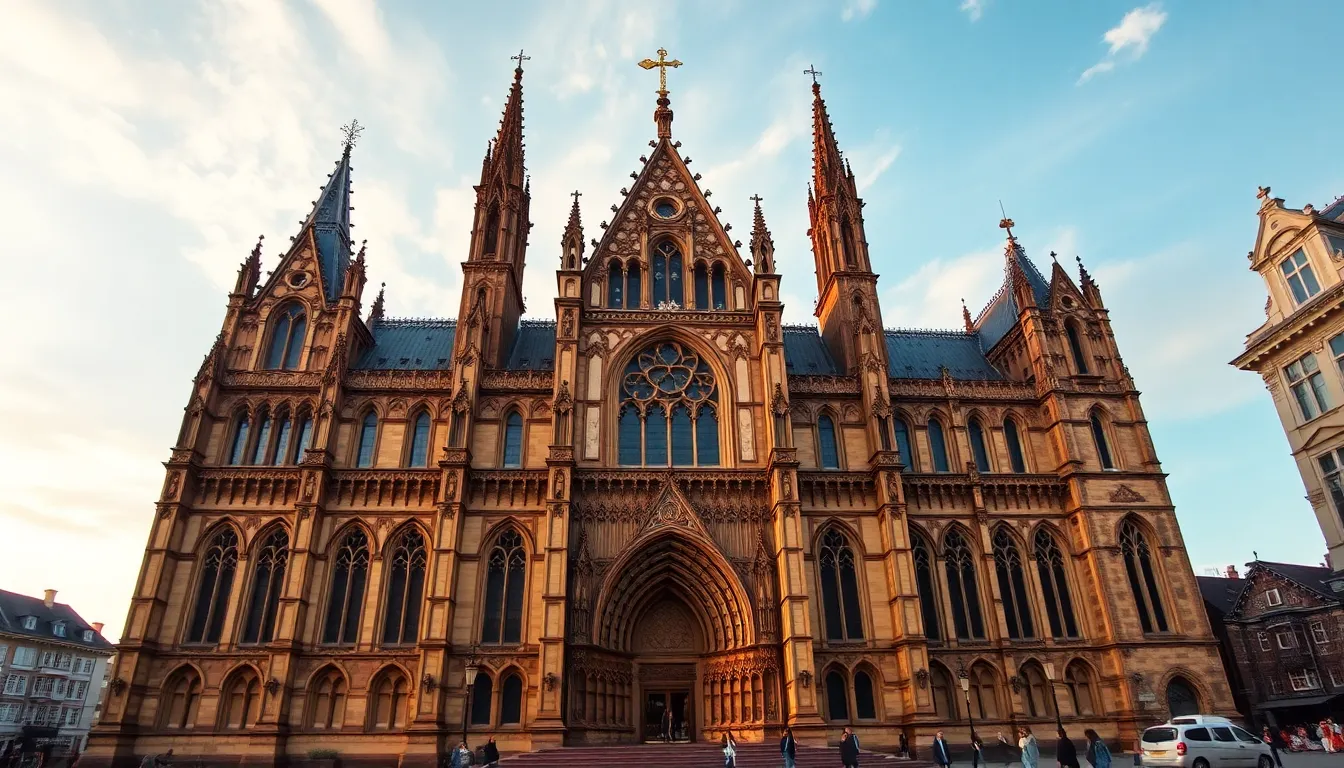
The First Time I Walked Into the Octagon
I have taken groups into a lot of churches over the years. Most of them, however grand, follow a shape you already know. Aachen does not. The first time I led a group through the bronze doors into the Palatine Chapel, I watched a row of pastors stop mid-sentence and just look up. The space curves around you in eight sides, gold mosaic glowing overhead, and you realize you are standing in something built more than 1,200 years ago by a man who was trying to recreate heaven on earth.
That man was Charlemagne. And Aachen Cathedral is the closest thing we have to standing inside his mind.
What Charlemagne Built and Why It Still Matters
Charlemagne, king of the Franks and the first Holy Roman Emperor, made Aachen the center of his empire around the year 790. He wanted a palace chapel worthy of a Christian ruler who saw himself as the heir of Rome and the protector of the Western church. So he built the Palatine Chapel, an octagon ringed by a sixteen-sided ambulatory, modeled on the churches he had seen in Ravenna and on imperial buildings in Constantinople.
When it was consecrated around 805, it was the largest dome north of the Alps. For a continent that had largely forgotten how to build at that scale after Rome fell, this was an astonishing statement. It said that a new Christian empire had arrived and that it intended to last.
It did last, in a sense. For roughly 600 years, from 936 to 1531, thirty German kings were crowned in this chapel. Charlemagne himself was buried here in 814. The cathedral was the first German site ever added to the UNESCO World Heritage list, in 1978, and it has held that status as a founding entry ever since.
The Throne of Charlemagne
Up in the gallery sits a plain marble throne. No carving, no gold, just six steps and a stone seat. This is the Königsstuhl, the throne on which those thirty kings sat after their coronation. The marble slabs may have come from the Holy Sepulchre in Jerusalem, which would mean a king of Germany sat on stone carried from the place of the Resurrection.
I always tell groups to slow down here. It is easy to walk past a simple chair. But the restraint is the point. The power was in the room and the ritual, not in the ornament.
There is a worn detail people miss unless you point it out. Scratched into the marble of the throne are the lines of an old board game, probably cut by guards or builders centuries ago during the long hours of waiting. A king’s coronation seat, marked up by bored hands. I love showing groups that, because it punctures the grandeur for a second and reminds everyone that real people, not just emperors, lived their whole lives in this building.
The Faith and Heritage Significance
For a Christian group, Aachen is layered. It is a working Catholic cathedral, still holding Mass, still the seat of a bishop. It is the burial place of the emperor who did more than anyone to bind together church and political power in early medieval Europe, for better and for worse. And it holds relics that drew pilgrims for centuries.
The Aachen relics are part of why the city mattered. Tradition holds that the cathedral keeps four great textiles connected to the Gospel story, including the swaddling clothes of Jesus and the cloth that held the head of John the Baptist. Every seven years, in the Heiligtumsfahrt pilgrimage, these are shown publicly. The next showing is scheduled for 2028. Even outside those years, the Shrine of Charlemagne and the Shrine of Mary, both masterpieces of medieval goldsmithing, sit in the choir hall for groups to see.
For Protestant groups, the conversation is different and just as rich. This is the world the Reformation grew out of and reacted against. Standing under that gold dome, you can feel the medieval church at the height of its claim to authority. It gives context to everything Luther later challenged.
How Groups Visit Aachen
A focused group visit to the cathedral runs about ninety minutes to two hours, and I would not rush it. The chapel itself is compact, which means crowds matter. I bring groups early in the day when possible, before the larger tour buses arrive, so the octagon stays quiet enough to actually take in.
The treasury, the Domschatzkammer, sits beside the cathedral and is worth a separate forty-five minutes. It holds some of the most important church treasures in northern Europe, including the Cross of Lothair and a bust reliquary of Charlemagne. For groups that care about medieval art and faith, this is not an add-on. It is half the visit.
Photography inside the chapel is limited, and the gallery with the throne is accessible only on a guided tour, which has to be booked. I tell group leaders this early because it changes the plan. You cannot just walk up to the throne on your own.
Practical Access for Your Group
Aachen sits in the far west of Germany, near the borders with Belgium and the Netherlands. That location is a gift for itinerary building. It pairs naturally with Cologne, about an hour east by coach, where many faith groups are already heading for the cathedral there. A group can do Cologne and Aachen across two days without backtracking.
The cathedral is in the pedestrian heart of the old city, so coaches drop off and pick up at designated points rather than at the door. The walk is short and flat. The chapel has steps up to the throne gallery, which is the one part of the site that is not step-free, so for groups with members who cannot manage stairs, the main floor still delivers the full experience of the octagon.
For groups of fifteen or more, booking a guided tour in advance is essential, both for access to the gallery and to avoid waiting at the entrance. Heritage Tours handles those bookings as part of the itinerary so your group walks in on schedule.
FAQ: Visiting Aachen Cathedral
Why is Aachen Cathedral important?
It is the oldest cathedral in northern Europe in continuous use, built by Charlemagne around 805 as his palace chapel. Thirty German kings were crowned here over six centuries, Charlemagne is buried here, and it was the first German site named a UNESCO World Heritage Site, in 1978.
Can groups see Charlemagne’s throne?
Yes, but only on a guided tour. The Königsstuhl sits in the upper gallery, which is not open for free walk-in access. For groups of fifteen or more, the gallery tour should be booked ahead, which Heritage Tours arranges as part of your itinerary.
How long does a group need at Aachen Cathedral?
Plan ninety minutes to two hours for the cathedral and gallery, plus another forty-five minutes if you add the treasury. The chapel is small, so an early visit before the day’s crowds makes a real difference.
Does Aachen work for both Christian and Jewish heritage groups?
Aachen is primarily a Christian heritage site and speaks most directly to Christian groups studying the medieval church and the roots of the Reformation. Jewish groups touring the Rhineland usually center on the ShUM cities of Worms, Speyer, and Mainz, though Aachen can be a meaningful stop for anyone studying medieval European history.
What else can we visit near Aachen?
Cologne Cathedral is about an hour east by coach and pairs naturally with Aachen. Groups heading into the Rhine Valley can continue on toward the ShUM cities for a fuller medieval itinerary.
Aachen rewards groups that come ready to slow down and look up. If you want it on your Germany itinerary, see what is possible on our Germany destination page, read more about spiritual sites across Germany and the hidden heritage sites most tours skip, learn how our group tours come together, and then contact us to start planning your group’s journey.