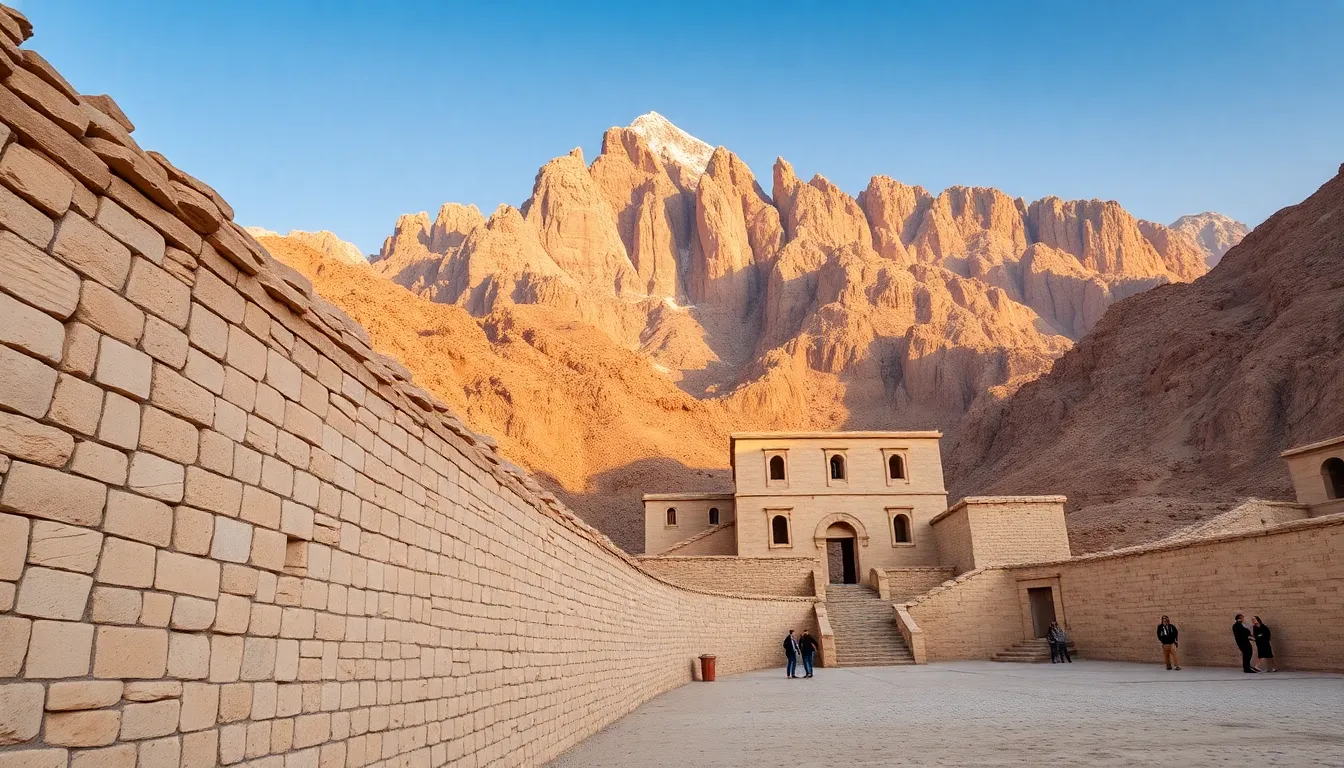
You come around the last bend in the road and the monastery appears below you, a cluster of stone walls and towers tucked into a dry valley, with the granite mass of Mount Sinai rising behind it. I have seen that view dozens of times and it still stops me. And I always say the same quiet thing to the group: monks have prayed in those walls every single day for fifteen hundred years, without a break, through empires that rose and fell around them. Let that sit for a second.
Saint Catherine’s Monastery is the oldest continuously operating Christian monastery in the world. It sits at the foot of the mountain where, by long tradition, Moses received the Law, on the site where he is said to have stood before the burning bush. For a Christian heritage group, and for Jewish groups too, it is one of the most extraordinary places in Egypt. This is my guide to what is here and how a group experiences it well.
A Monastery Fifteen Centuries Old
The monastery was built in the sixth century by the Emperor Justinian, who fortified an earlier chapel that the Empress Helena had established two centuries before at the site of the burning bush. Justinian’s massive granite walls still stand, which is part of why so much inside has survived. While much of the ancient world was sacked and burned, this remote fortress in the Sinai desert was protected by its isolation, its walls, and, remarkably, by centuries of respect from the surrounding communities.
Because it was never destroyed, Saint Catherine’s holds treasures found nowhere else. Its library is second only to the Vatican’s in the number and antiquity of its Christian manuscripts. Its collection of early icons is the finest in the world, including images that survived the period when icons were being destroyed everywhere else. For a group with any interest in church history, knowing this before you walk through the gate changes how you see every stone.
Who Was Saint Catherine
Groups often ask, and it is worth knowing. Saint Catherine of Alexandria was an early Christian martyr, a young woman of learning who, by tradition, was killed for her faith in the early fourth century. Tradition holds that angels carried her body to the summit of the nearby peak that now bears her name, where monks later found her remains and brought them to the monastery. Her relics are kept here, and the monastery took her name in the medieval period. The mountain of Moses and the monastery of Catherine share one sacred landscape.
What to See Inside the Walls
The Chapel of the Burning Bush
This is the heart of it. At the eastern end of the complex stands the Chapel of the Burning Bush, built over the spot where tradition says Moses stood before God in the flame that did not consume the bush. You remove your shoes to enter, just as Moses was told to do: “Put off thy shoes from off thy feet, for the place whereon thou standest is holy ground.”
I have watched that small act of obedience land on people in a way they did not expect. Standing barefoot in that chapel, reading Exodus 3 aloud, is one of the quiet high points of any group’s time in the Sinai. A living bush grows in the courtyard nearby, said to be descended from the original, and groups often gather around it before or after.
The Basilica of the Transfiguration
The main church, Justinian’s sixth-century basilica, is one of the best preserved early Byzantine churches anywhere. Inside, hanging lamps, ancient icons, and a famous sixth-century mosaic of the Transfiguration fill the space with the atmosphere of a worship that has not changed in fifteen centuries. The wooden doors and roof beams are original. Groups move through quietly. There is a weight to a room that has held continuous prayer for that long.
The Icon Collection and the Library
Saint Catherine’s holds the world’s most important collection of early Christian icons, some of the only surviving examples from before the eighth century. A selection is on display. The library, though not generally open to visitors, is part of what gives the monastery its standing, holding thousands of manuscripts in many languages. This was the home, for centuries, of the Codex Sinaiticus, one of the oldest near-complete Bibles in existence. I make sure groups understand they are standing in one of the great repositories of the Christian textual tradition.
The Well of Moses and the Charnel House
In the courtyard is a well that tradition links to Moses, where he is said to have met the daughters of Jethro. And for groups who choose to see it, the charnel house holds the bones of monks who have died here over the centuries, a stark and honest reminder of the unbroken chain of men who gave their whole lives to prayer in this place. I let groups decide on that one. Some find it deeply moving. It is not for everyone.
A Place Holy to More Than One Faith
I always make a point of this, because it matters. Saint Catherine’s is a Christian monastery, but the ground it stands on is sacred to Jews and to Muslims as well. This is the mountain of Moses, central to the Torah. Inside the walls there is even a small mosque, and the monastery has historically been protected by a document of safe passage attributed to the Prophet Muhammad himself.
For the Jewish groups I bring here, I frame it this way: here is a Christian community that has treasured and protected a Jewish sacred site, the place of the giving of the Law, for fifteen hundred years. The monks who lived and died here held this ground holy for the same reason your tradition does. That shared reverence is part of why I treat Egypt as one connected landscape across the spiritual sites of Egypt.
How Groups Visit, and the Mountain Above
Most groups pair the monastery with the climb of Mount Sinai itself, since they share the same valley. The usual rhythm is an overnight stay in the village of Saint Catherine, the pre-dawn ascent of the mountain for sunrise, then a visit to the monastery later that same morning after coming down. The ascent deserves its own preparation, which I cover fully in the guide to climbing Mount Sinai.
A few practical notes for the monastery itself. It keeps limited visiting hours and closes to visitors on Sundays and major feast days, so timing has to be planned carefully. Modest dress is required. Photography is restricted inside the churches. The site can get crowded mid-morning when the day groups arrive, so I aim to have my groups there early. We coordinate all of it in advance.
For groups whose hearts are drawn to the desert monastic tradition, the monastery connects naturally to the monasteries of Wadi Natrun on the other side of the country, where the same way of life was born. You can see how Saint Catherine’s fits the full journey on our Egypt heritage destination page, and how we structure the group experience on our group heritage tours page.
FAQ: Saint Catherine’s Monastery
Is Saint Catherine’s really the oldest monastery in the world?
It is the oldest continuously operating Christian monastery, with monks praying within its walls without interruption since the sixth century. Justinian built the present fortress in the 500s on a site that had already drawn pilgrims and hermits for two centuries before that. Other monastic communities are old, but none has maintained unbroken operation on the same site for as long.
What is the Burning Bush at Saint Catherine’s?
A living bush in the monastery courtyard, said to be descended from the bush where Moses encountered God in Exodus 3. Beside it stands the Chapel of the Burning Bush, built over the traditional spot. Visitors remove their shoes to enter the chapel, echoing God’s instruction to Moses that he stood on holy ground. Reading Exodus 3 there is a meaningful moment for many groups.
Do you have to climb Mount Sinai to visit the monastery?
No. The monastery and the mountain are two separate experiences in the same valley. You can visit the monastery without climbing, and some members of a group choose to do exactly that while others make the ascent. Most heritage groups do both, with the climb at dawn and the monastery later that morning.
What are the visiting hours and rules at Saint Catherine’s?
The monastery keeps limited morning hours and is closed to visitors on Sundays and major feast days, so the visit must be timed carefully. Modest dress is required, with shoulders and knees covered. Photography is restricted inside the churches. We plan the timing of every group visit around these limits to make sure you actually get in and are not rushed.
Is Saint Catherine’s appropriate for Jewish groups as well as Christian?
Yes. While it is a Christian monastery, it stands at the foot of the mountain of Moses, central to the Torah, and the monks have protected this Jewish sacred site for fifteen centuries. For Jewish groups it offers a powerful encounter with the place of the giving of the Law, seen through a community that has held it holy for the same reasons. We approach it with that shared reverence in mind.
Saint Catherine’s has a way of collapsing the distance between a congregation and the oldest layers of their faith. They walk in as visitors and stand barefoot in a chapel where Moses is said to have met God. I would be glad to help you plan a visit that gives your group the time and stillness this place deserves. When you are ready, reach out to our team and we will start with your community’s story.