I’ve stood at the base of Mount Sinai before the sun came up, watching a group of pastors from Texas go completely quiet. No one told them to. They just stopped talking. That happens in Egypt in a way I haven’t seen anywhere else, and I’ve been doing this work for more than twenty years.
Egypt holds a spiritual weight that is genuinely different from every other heritage destination I know. Israel moves people deeply. Jordan is profound. But Egypt does something else. It reaches into the oldest, most foundational layers of Jewish and Christian faith, and it holds them together in a single landscape. This is where Moses was born and raised, where the Israelites labored in bondage, where God spoke from a burning bush, where the Holy Family fled with a newborn to survive. These are not abstract stories. When you are standing in the places where they happened, something shifts.
What follows is my honest guide to the spiritual sites in Egypt that matter most, written for the rabbi or pastor who wants to understand not just what these places are, but what your group will actually experience there.
Why Egypt Is Unlike Any Other Sacred Destination
Most sacred destinations anchor to one tradition. Jerusalem is the center of three faiths, but even there, the different faiths tend to occupy different quarters, different holy days, different layers. Egypt is unusual because the core spiritual geography is genuinely shared. The Exodus story belongs to Judaism. It also belongs to Christianity, deeply and permanently. Coptic Christianity was born here, and it has been present in Egypt without interruption since the first century. The land itself holds both traditions with equal weight.
That overlap is something I try to be honest with groups about before they arrive. Jewish groups coming to Egypt are not stepping into foreign territory spiritually. Christian groups are not visiting sites that belong only to another faith. At Mount Sinai, at the Red Sea, at Ben Ezra Synagogue and the Coptic churches of Old Cairo, the stories are layered and intertwined. That layering is part of what makes Egypt so powerful.
Mount Sinai: The Mountain Where God Spoke
If I had to choose one site in all of Egypt to protect, to make sure every faith traveler experienced fully, it would be this one. Mount Sinai is not just historically significant. It is spiritually alive in a way that surprises even experienced travelers.
What the Torah Says, What the Gospels Say
For Jewish travelers, Sinai is the place of the most direct divine encounter in the entire Torah. God appeared to Moses in the burning bush nearby. God descended onto the mountain and spoke the Ten Commandments. Elijah fled here, exhausted and broken, and heard the still small voice. The Torah returns to Sinai again and again as the place where heaven and earth met.
For Christian travelers, Sinai carries equal weight. Paul writes in Galatians about the covenant given at Sinai. The early church fathers treated Sinai as holy ground. The monastery at its base, Saint Catherine’s, was built by the Emperor Justinian in the sixth century and has been a pilgrimage destination for Christians since before most of Europe was Christian. The site of the burning bush, preserved inside Saint Catherine’s, is one of the most venerated places in all of Christianity.
The Dawn Ascent: What Groups Experience
The traditional way to approach Mount Sinai is the climb that begins around 2 a.m. and arrives at the summit in time for sunrise. I want to be honest with you about what this involves: it is a 7.5 kilometer trail on stone steps, in the dark, at altitude. It is not easy. But the groups I have brought here across twenty years are unanimous. Almost no one wishes they had stayed at the hotel.
What happens at the top, as the sun rises over the Sinai Peninsula and the light comes across the mountains and down into the valleys, is something I cannot fully describe in a blog post. Groups have recited Shema on that summit. They have read the Beatitudes. They have stood in complete silence for ten, fifteen minutes, without anyone prompting them to. They have prayed in ways they later told me they hadn’t prayed in years.
We build your group’s time on the summit around what your community needs. A Torah reading. A Gospel reading. A prayer. A period of reflection in silence. The mountain holds all of it.
Saint Catherine’s Monastery at the Base of the Mountain
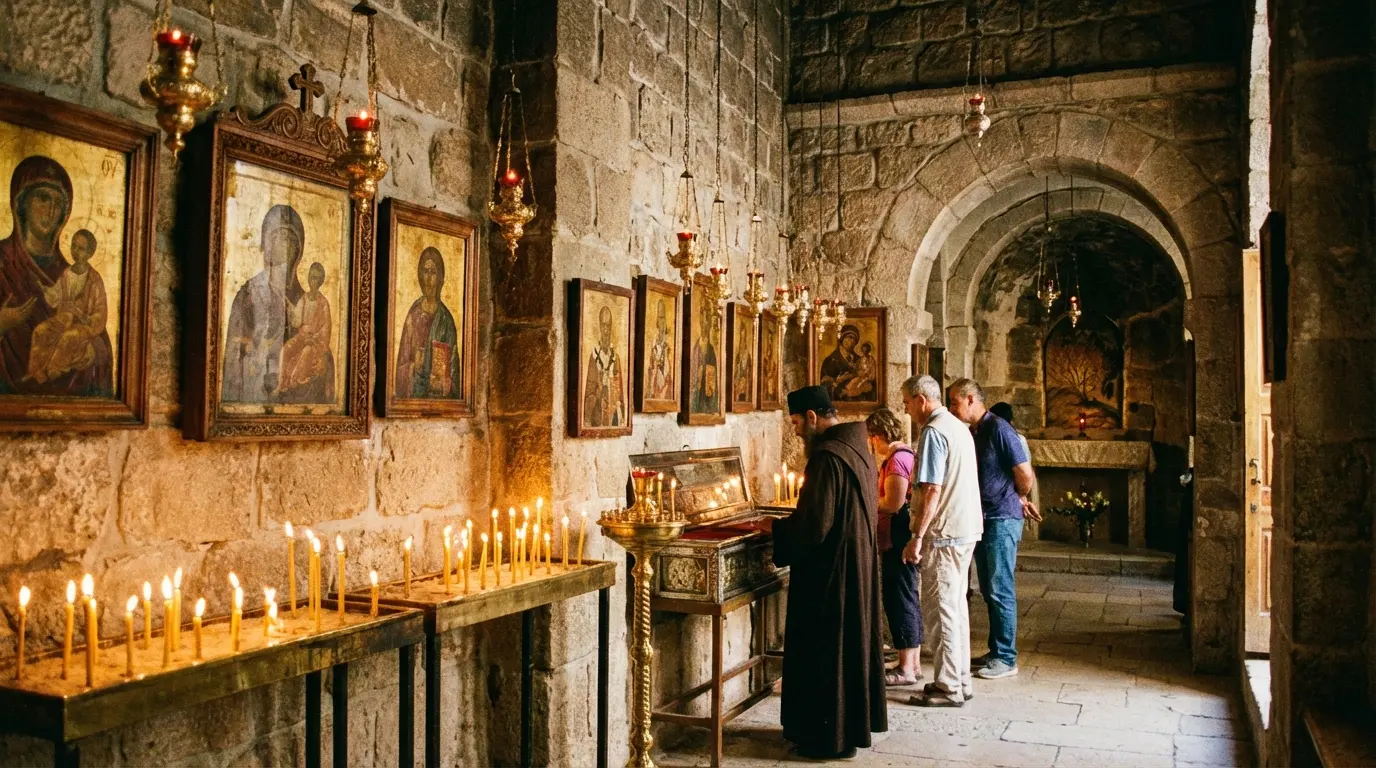
Before or after the ascent, Saint Catherine’s deserves its own time. It is the oldest continuously occupied Christian monastery in the world, and it holds an extraordinary collection of ancient icons, manuscripts, and relics. The Chapel of the Burning Bush stands on the site where tradition says Moses stood before God. You remove your shoes to enter, as Moses did. That small act of obedience, standing barefoot in that chapel, lands differently than you expect.
For Jewish groups, Saint Catherine’s is worth visiting with that dual lens: here is a Christian community that has treasured and preserved a Jewish sacred site for fifteen hundred years. The monks who have lived and died here regarded this ground as holy for the same reason.
The Nile Delta and the Land of Goshen: Where the Story Began
Before the Exodus, there was the sojourn. The Israelites did not arrive in Egypt as slaves. They came as refugees, as the family of Joseph, welcomed into the land of Goshen in the eastern Nile Delta during a famine. They lived here for four hundred years before the generation that knew Joseph died, before a new Pharaoh rose who saw them as a threat, before the oppression began.
Why Standing Here Changes How You Read the Torah and Bible
Goshen today is agricultural land in the northeastern Delta, not far from the modern city of Zagazig. It does not look the way people expect. There are no dramatic ruins. But that is, in a way, the point. This is ordinary land. Farmland. The kind of place where a family settles, builds houses, raises children, and loses track of where they came from.
Standing in Goshen, I invite groups to do something simple: read the opening verses of Exodus. “A new king arose over Egypt, who did not know Joseph.” When you are standing on the land where the Israelites actually lived for four centuries, those words do something to you. The comfort and prosperity that preceded the enslavement feels real. The sudden reversal feels real. The whole arc of the Exodus narrative becomes more human, more painful, more miraculous by contrast.
For Christian groups, Goshen is also where the Holy Family passed through on their journey into Egypt, following the same ancient roads southward into the Delta. The geography of the flight into Egypt maps onto a land that now feels familiar, not foreign.
Ben Ezra Synagogue: A Sacred Witness to 2,000 Years of Jewish Life
In the heart of Old Cairo’s Coptic quarter stands a synagogue that has been a center of Jewish life in Egypt since at least the ninth century. The Ben Ezra Synagogue is not a museum. It is a place of prayer, restored and maintained as a living heritage site. But it is also one of the most important discoveries in the history of Jewish scholarship.
The Cairo Geniza and Its Meaning for Jewish Heritage
In 1896, scholars discovered that the storeroom of Ben Ezra Synagogue, the geniza, contained hundreds of thousands of documents that had been placed there over more than a thousand years. In Jewish tradition, sacred texts containing the name of God cannot be destroyed. They are stored, and eventually buried. The Cairo Geniza had not yet been buried. What was found there included biblical manuscripts, legal documents, personal letters, commercial contracts, and liturgical texts dating back to the tenth century. The collection changed what historians knew about Jewish life in the medieval world more than almost any other single find.
For Jewish groups visiting Ben Ezra today, the geniza is more than a historical curiosity. It is evidence of a living, breathing Jewish community that prayed here, argued here, grieved here, did business here, for a thousand years. The community is largely gone now, the vast majority having emigrated to Israel after 1948. But the synagogue stands, restored and open, a witness.
We arrange a quiet gathering in the sanctuary. There is a Torah reading there that I find particularly moving. The acoustics are beautiful.
Coptic Cairo: The Holy Family’s Egypt
Old Cairo, the neighborhood known as Coptic Cairo, holds a concentration of ancient churches, monasteries, and holy sites that is unlike anywhere else in the world. The Coptic Christian community has lived here continuously since the first century. This is not mythology. It is documented, layered, and very much alive.
The Hanging Church (Al-Muallaqah)
The Hanging Church, so called because its nave is built over the gatehouse of an old Roman fortress, is the oldest church in Egypt and one of the oldest in the world. Parts of the structure date to the third century. The interior is extraordinary: ancient wooden screens, Coptic icons, a pulpit supported on thirteen columns representing Christ and his apostles. Services are still held here. On Friday morning, the Coptic faithful gather in this space exactly as their ancestors did seventeen centuries ago.
For Christian groups, the Hanging Church is more than a sight to see. It is a place to worship. We arrange, where possible, for your group to be present during a Coptic service, or to hold your own devotional in the ancient nave. The Coptic church’s liturgy is close to what the early church would have sounded like. Hearing it in that space is an experience that pastors tell me stays with them.
The Church of St. Sergius: Built Over the Cave of the Holy Family
A few minutes’ walk from the Hanging Church, the Church of Abu Serga (St. Sergius and St. Bacchus) stands over a cave that Coptic tradition holds was the resting place of Mary, Joseph, and the infant Jesus during their sojourn in Egypt. The church itself dates to the fourth or fifth century. The cave is below the nave, accessible by stairs, small and dark and cool and very still.
Whether or not your group approaches this as literal holy ground, the experience of descending into that cave is profound. People become quiet. They sit. They pray. I have seen pastors weep there who told me they hadn’t expected to feel anything. The antiquity of the Christian presence in Egypt is not an abstract fact when you are sitting in a cave that Christians have treated as sacred since before the Roman Empire became Christian.
The Tree of the Virgin in Matariya
A short drive from Coptic Cairo, in the suburb of Matariya, stands a sycamore fig tree on the site where tradition holds that Mary rested with Jesus during the flight into Egypt. The original tree is long dead, but a descendant tree marks the spot, surrounded by a garden maintained by the Coptic church. It is a quiet place. Easy to miss on a busy itinerary. Worth not missing.
I suggest pausing here long enough to read Matthew 2:13-15 together. “He remained there until the death of Herod, to fulfill what the Lord had spoken through the prophet: Out of Egypt I have called my son.” Standing under that tree, those words land in the body, not just the mind.
Wadi Natrun: Where Christian Monasticism Was Born
About two hours west of Cairo, in a shallow desert depression called Wadi Natrun, stand four ancient Coptic monasteries that are still fully inhabited and active. This is where the Desert Fathers came in the third and fourth centuries to pray, fast, and wrestle with God. Antony, Pachomius, Macarius: these are the names Christian monasticism begins with, and they began here.
Visiting Wadi Natrun is not for every itinerary. It is a different kind of stop. There are no dramatic ruins and no spectacular views. What there is: silence, extreme antiquity, and a kind of continuity with early Christian practice that cannot be replicated. The monks living in these monasteries today follow the same rule of life as the monks who founded them seventeen hundred years ago. They are genuinely glad to welcome visitors who come in a spirit of reverence.
For Christian groups with any interest in contemplative tradition, church history, or early Christianity, Wadi Natrun belongs on the itinerary. We allow at least half a day.
Abu Simbel: Pharaoh’s Temple and the Scale of Ancient Power
Six hundred miles south of Cairo, on the shore of Lake Nasser near the Sudanese border, the temples of Abu Simbel confront you with something that no amount of photographs prepares you for: the scale of ancient Egyptian power. Four seated colossi of Ramesses II, each sixty-five feet tall, cut directly into the sandstone cliff. The temple behind them runs ninety meters into the rock.
For faith travelers, Abu Simbel is not primarily a spiritual site in the way that Sinai or Ben Ezra Synagogue is. But it matters in a different way. This is the world the Israelites lived inside. These temples, this scale of royal power, this demand for absolute submission from subject peoples: this is what the Torah means when it describes Pharaoh. Understanding Egyptian imperial power helps you understand why the Exodus was miraculous, not just dramatic.
I ask groups to sit quietly in front of those colossi and read the opening chapter of Exodus. The two things, the text and the stones, illuminate each other.
The Red Sea Coast: The Crossing That Changed Everything
The precise location of the Exodus crossing of the Red Sea has been debated by scholars for centuries, and I won’t pretend to resolve it here. What I can tell you is that standing at the shore of the Sinai Peninsula, looking across the water toward the mountains of the Egyptian mainland, is an experience that needs no resolution.
For Jewish groups, this is where the Torah says God parted the waters. The Song of the Sea, one of the oldest poems in the Hebrew Bible, was sung here. For Christian groups, Paul writes in 1 Corinthians that the crossing was a kind of baptism. The image of coming through water from slavery into freedom has structured Christian baptismal theology for two thousand years.
We hold a gathering at the shore. There is a reading of the Song of the Sea. There is time to stand quietly and let the moment settle. And then, usually, someone in the group begins to sing.
How to Build a Spiritually Intentional Egypt Itinerary
The sites above span a large geography: Cairo, the Nile Delta, the Sinai Peninsula, the south near the Sudanese border. Not every group has the same amount of time, and not every community is drawn to the same spiritual thread.
When I work with a rabbi or pastor on building an Egypt itinerary, I usually start with one question: what is the heart of this journey for your community? For some groups, it is the Exodus trail, Goshen, the Red Sea, Sinai. For others, it is the encounter with the earliest Christian church, the Coptic sites, Wadi Natrun. For others, it is the full Jewish heritage story: Goshen, Ben Ezra, the layers of Jewish life in Egypt across three thousand years.
Each of those threads produces a deeply different trip, and a deeply meaningful one. Our Egypt heritage destination pages walk through the itinerary options in detail. You can also look at our complete 8-day Egypt heritage itinerary for a sense of how we build these journeys from the ground up, or explore the full Egypt heritage travel guide for context on the destination. If Jewish heritage is the primary focus for your group, our guide to Jewish heritage sites in Egypt goes deeper into that thread specifically.
The most important thing I can say is this: Egypt is worth doing slowly. Not every site on every day. Some mornings need to be just one place, one reading, one hour of quiet. The groups that leave Egypt most changed are the ones who made room for the experience to land.
FAQ: Spiritual Travel to Egypt
Can you climb Mount Sinai as a faith pilgrim?
Yes, and it is one of the defining experiences of any Egypt pilgrimage. The climb begins in the middle of the night to reach the summit at sunrise. The trail is rocky and uneven but manageable for most reasonably fit adults. We assign guides for the ascent and prepare your group in advance for what to expect physically and spiritually. The summit allows for prayer, readings, and devotional time before the descent.
What is the most sacred site in Egypt for Jewish travelers?
Different rabbis I have worked with would give different answers, and I think they would all be right. Mount Sinai, for the Torah’s most direct account of divine encounter. Ben Ezra Synagogue and the Cairo Geniza, for what they reveal about Jewish life over a thousand years. Goshen, for standing on the land where the Israelite story in Egypt actually began. I usually say: bring your group to all three, and let your community decide for themselves.
What is the most sacred site in Egypt for Christian travelers?
Again, this depends on your tradition and your community’s particular hunger. For evangelical and Protestant groups, Sinai usually moves people most. For Catholic and Orthodox groups, the Coptic churches of Old Cairo, and particularly the cave of the Holy Family under St. Sergius, tend to be the most profound. For groups with an interest in contemplative tradition, Wadi Natrun is transformative. Many Christian groups find that the Cave of the Holy Family is the moment their whole trip crystallizes.
Is the Hanging Church in Cairo still an active church?
Yes. The Hanging Church continues to hold regular Coptic Orthodox services. It is not a museum, even though it functions as a heritage site for visitors. The Coptic community in Cairo worships here on Fridays and Sundays. We can arrange for faith groups to attend a service, or to hold a private devotional in the church outside of service hours, depending on the group’s tradition and preference.
What worship practices are possible for faith groups visiting Mount Sinai?
Quite a few, and we plan them deliberately. At the summit, groups can hold a Torah reading or Gospel reading, recite prayers in English or Hebrew or any language, observe a period of silence, sing, or simply stand together and watch the sunrise. Saint Catherine’s Monastery below the summit has specific protocols for visiting the Chapel of the Burning Bush, including the removal of shoes. We coordinate all of this in advance so that your group’s time at Sinai feels spiritually prepared, not improvised.
If you are considering bringing your congregation or community to Egypt and want to talk through what a spiritually grounded itinerary might look like, we would be glad to have that conversation. There is no sales pitch here. Just a genuine belief, built over twenty years of doing this work, that Egypt has something to offer your community that no other place on earth quite does. When you are ready, reach out to our team. We will start with your group’s story.