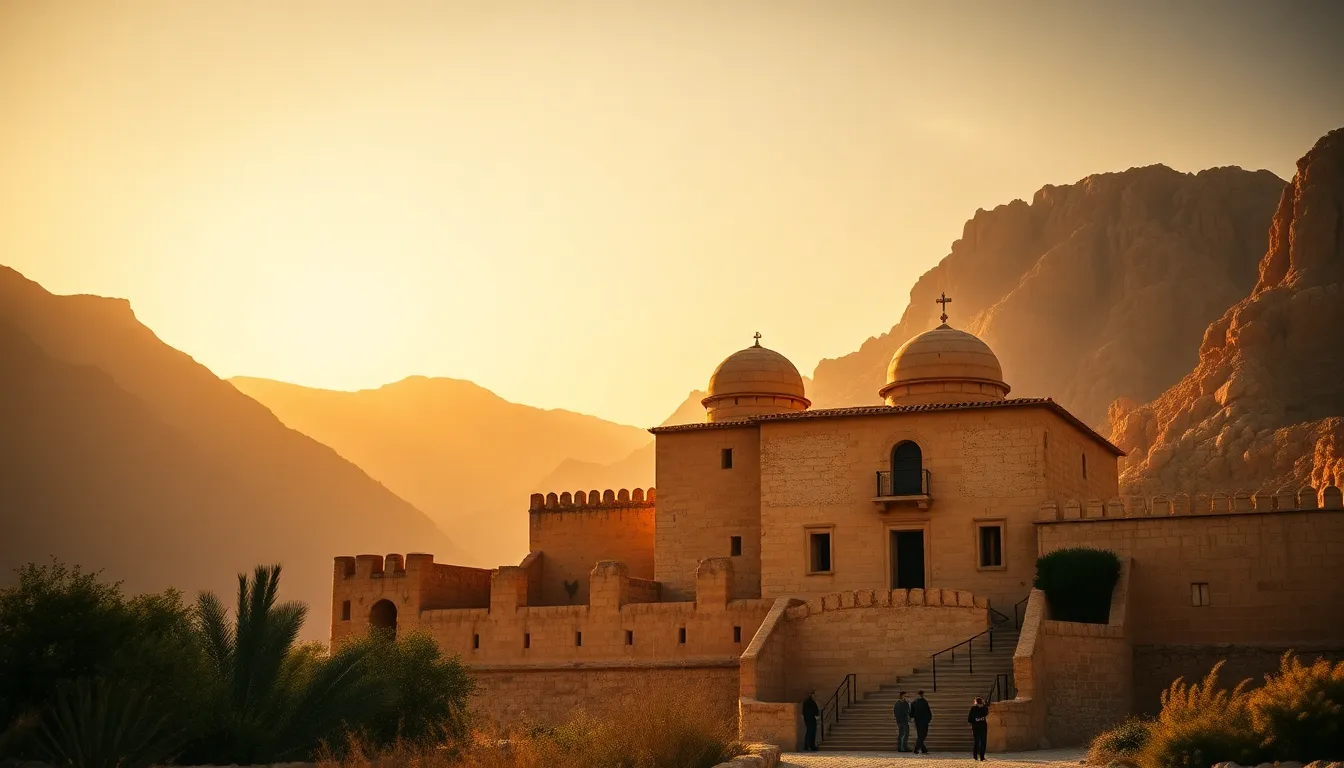
The first time I brought a group to Saint Anthony’s Monastery, we drove for hours through empty desert, and one of the pastors leaned over and asked me, half joking, whether we had taken a wrong turn. Then the mountains opened up, and there it was: a walled fortress of a place tucked against the cliffs, gardens green inside ancient stone walls, in the middle of nothing. He stopped joking. He just looked.
That drive is part of the experience, and I tell groups so before we leave. You do not stumble onto Saint Anthony’s. You go there on purpose, the way the man it is named for did seventeen hundred years ago, when he walked away from everything he owned and into the Eastern Desert to be alone with God. This is the place where Christian monasticism was born. Not where it spread, not where it was formalized. Where it started. For a faith community that cares about church history, standing here is standing at a beginning.
Let me walk you through who Anthony was, what the monastery actually is, and what your group will encounter when you make the trip.
Who Was Saint Anthony?
Anthony was born around 251 in a village in Middle Egypt, into a prosperous Christian family. The story, as his biographer Athanasius tells it, is simple and severe. Anthony walked into a church one morning and heard the Gospel reading where Jesus tells the rich young man to sell everything, give it to the poor, and follow him. Anthony took it literally. He gave away his land, arranged for his sister’s care, and went out to live a life of prayer and discipline.
The Father of the Desert
He was not the first Christian to seek solitude, but he went further than anyone before him. Over the years he moved deeper and deeper into the desert, eventually settling at the foot of the mountain where the monastery now stands, near the Red Sea. He lived to be over a hundred years old, by the traditional account, and during his lifetime something remarkable happened. People followed him into the wilderness. They wanted what he had found.
That is the seed of monasticism. Anthony did not set out to start a movement. He set out to be alone. But his way of life, prayer, fasting, manual labor, silence, struggle against temptation, became the pattern that thousands and then millions of Christians would follow. When you hear the phrase “Desert Fathers,” Anthony is the father they are named after. Athanasius wrote his biography, and that book spread across the Christian world and pulled people toward the desert for centuries.
Why Athanasius Matters Here
I always mention Athanasius to groups, because his Life of Anthony is one of the most influential books in church history that most people have never read. Athanasius was the bishop of Alexandria, a towering figure in the early church, and he knew Anthony personally. His account turned a desert hermit into a model for the whole Christian world. Augustine credits reading about Anthony as part of his own conversion. The thread runs directly from this desert to the shape of Western Christianity.
The Monastery Itself: A Living Place, Not a Ruin
Here is what surprises groups most. Saint Anthony’s Monastery is not a museum or a ruin. It is a working Coptic Orthodox monastery, fully inhabited, with monks living the same rhythm of prayer that has continued on this site since the fourth century. The community founded after Anthony’s death has never fully disappeared. That continuity is the heart of what you come here to feel.
Inside the Walls
The monastery is enclosed by high defensive walls, built and rebuilt over the centuries to protect the monks from raids. Inside, it is its own small world: churches, a refectory, a garden, a spring that has watered this community for over a millennium, monks’ cells, and a bakery. The oldest church, the Church of Saint Anthony, holds wall paintings from the thirteenth century that are among the finest medieval Coptic art anywhere. When conservators cleaned them a few decades ago, they uncovered colors and faces that had been hidden under centuries of soot.
I bring groups into that church slowly. The paintings are not behind glass in a gallery. They are on the walls of a church the monks still use. You are standing where prayer has not stopped for sixteen hundred years.
The Cave of Saint Anthony
Above the monastery, up a long flight of steps cut into the mountainside, is the cave where Anthony himself withdrew to pray in his final decades. The climb is real, about three hundred meters of elevation, and not everyone in a group makes it. But those who do reach a small opening in the rock where the man who started all of this sought his deepest solitude. There is a view back down the valley that goes on forever.
I am honest with groups about the climb. If you have members who cannot manage steep stairs in desert heat, the monastery itself at the base is the full experience. The cave is a gift for those who can make it, not a requirement. We plan around what your group can actually do.
What a Visit Means for a Faith Group
For some of the pastors and educators I work with, Saint Anthony’s is the most unexpected highlight of an Egypt journey. They come for the Exodus story or the Holy Family sites, and they leave talking about a desert monastery they had barely heard of before the trip.
The Encounter with Continuity
Most of us live in a Christianity that is a few generations deep where we stand. Saint Anthony’s is sixteen centuries deep, unbroken. The monks who welcome you are not reenacting anything. They are living it. For a group from a young congregation, or a denomination only a couple of centuries old, this kind of continuity does something. It widens the sense of what the church is and how long it has been faithful in hard places.
A Word on Reverence
I prepare groups for the fact that this is a holy site for the people who live here, not a tourist attraction. Modest dress, quiet voices, and following the lead of the monks who guide visitors. The community is genuinely warm to people who come in a spirit of respect. I have watched monks light up when they realize a group has actually come to pray and learn, not just to photograph. That warmth is part of the encounter.
We build in time for your group to gather quietly, read together, and pray inside the walls. The Desert Fathers left behind sayings, short and sharp pieces of spiritual wisdom, and reading a few of those in the place they came from lands differently than reading them at home.
Getting There: The Practical Picture
Saint Anthony’s sits in the Eastern Desert, between the Nile Valley and the Red Sea coast. It is a serious drive from Cairo, several hours each way, and that shapes how we build it into an itinerary. Some groups visit on a long day trip. Others fold it into a route that includes the Red Sea coast or pairs it with Saint Paul’s Monastery, which lies in the same desert range and is connected to Anthony’s story.
Pairing with Saint Paul’s
Saint Paul the Hermit lived in this same desert and, by tradition, was visited by Anthony near the end of Paul’s life. Their two monasteries are a few hours apart by road, and groups with a real interest in monastic origins often visit both. The two together tell the fuller story of how the desert became the cradle of Christian monasticism.
For the wider context of Egypt’s monastic and Coptic heritage, our guide to spiritual sites in Egypt lays out how these sites fit together across the country. If you want to understand the people behind the movement, our introduction to the Desert Fathers of Egypt goes deeper into who they were, and our Coptic Christianity primer explains the living tradition that carries their legacy today.
One thing I always tell group leaders: with Heritage Tours, the leader travels free when you bring fifteen or more. For a long-distance destination like Saint Anthony’s, where the logistics take some coordinating, that math helps the planning conversation with your church.
You can see how we structure these journeys on our Egypt heritage destination page, and our group heritage tours page explains how the group leader experience works from start to finish.
FAQ: Visiting Saint Anthony’s Monastery
Is Saint Anthony’s Monastery still active today?
Yes. It is a fully functioning Coptic Orthodox monastery with monks living there year-round, following a rhythm of prayer that has continued on this site since the fourth century. You are not visiting a ruin or a reconstruction. You are visiting a living community that welcomes respectful visitors and pilgrims.
How far is the monastery from Cairo?
Saint Anthony’s lies in the Eastern Desert, several hours’ drive from Cairo. Most groups visit on a long day trip or build it into a route that includes the Red Sea coast or the nearby Monastery of Saint Paul. We plan the timing carefully so the drive feels like part of the pilgrimage rather than a burden.
Can our whole group visit the cave of Saint Anthony?
The cave sits high above the monastery, reached by a long climb of steep stone steps in desert conditions. Reasonably fit members usually manage it, but it is not for everyone. The monastery at the base offers the full heritage experience on its own. We plan the visit so members who cannot do the climb miss nothing essential.
What should our group wear and how should we behave?
This is a holy site for the monks who live here, so modest dress and quiet, reverent conduct are expected. Shoulders and knees covered for everyone. We brief your group in advance and coordinate with the monastery so your time inside the walls is welcomed and unhurried.
Why is Saint Anthony’s important to Christian history?
Anthony is regarded as the father of Christian monasticism. His withdrawal into this desert around the turn of the fourth century, and the biography written by Athanasius of Alexandria, inspired the entire monastic movement that followed across the Christian world. This monastery stands at the literal birthplace of that tradition.
If your community cares about where the church came from and how it endured, Saint Anthony’s Monastery offers something few places can. I have watched groups arrive curious and leave quiet, carrying something they did not expect to find in the middle of the desert. When you are ready to talk through whether this belongs on your Egypt itinerary, reach out to our team. We will start with what your community is hungry for.