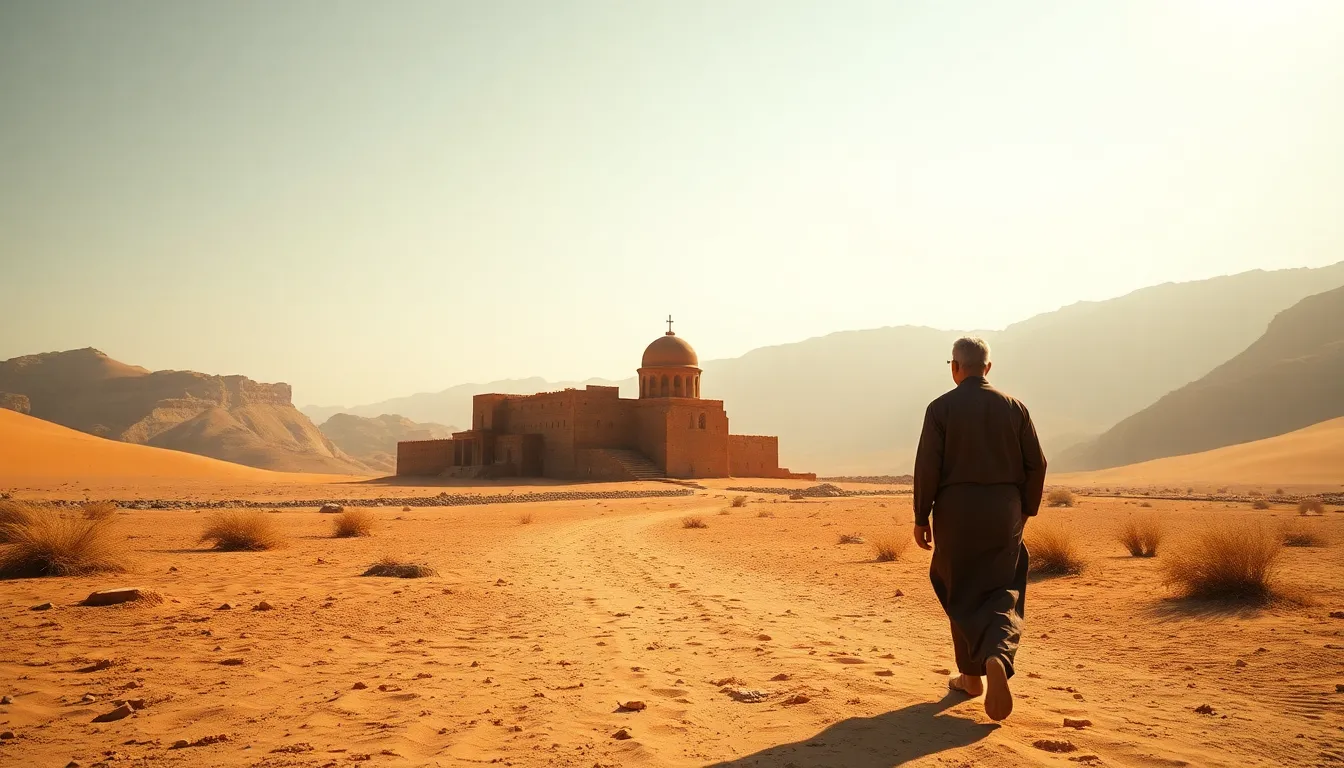
A few years ago, a Bible teacher on one of my Egypt groups read aloud a saying from the Desert Fathers while we sat in the courtyard of a Coptic monastery. It was something Abba Moses said: “Go, sit in your cell, and your cell will teach you everything.” The group went quiet. Then someone asked, “Wait, who actually were these people?” Most of them had heard the phrase. None of them could have told you a single name.
That is exactly why I love bringing groups to the places where the Desert Fathers lived. These were real men and women, in a real desert, who made choices so radical that the whole shape of Christian spirituality bent around them. They are not legends. We know their names, their sayings, the deserts they fled to, and in some cases the very monasteries they founded, which are still standing and still inhabited.
This is a heritage introduction, written for the pastor, rabbi, or educator who wants to understand who the Desert Fathers were before standing where they prayed. Once you know the story, the Egyptian desert reads very differently.
Who Were the Desert Fathers?
In the third and fourth centuries, as the Roman persecution of Christians eased and then ended, a strange thing happened. Just as it became safe to be a Christian, thousands of Christians walked into the Egyptian desert to live lives of extreme simplicity, prayer, and self-denial. They are called the Desert Fathers, and the Desert Mothers, the women among them.
The Context: Why the Desert, Why Then?
For two hundred years, being a serious Christian had often meant being willing to die for the faith. Martyrdom was the high calling. When the persecutions ended under the Emperor Constantine, that intensity needed somewhere to go. The desert became the new arena. Instead of dying for Christ in a single moment, these men and women chose a slower offering: a whole life given over to prayer, stripped of comfort, possessions, and distraction.
Egypt was the natural place. It had vast, accessible deserts right beside the fertile Nile Valley, and it already had a strong, ancient Christian community in Alexandria and the towns along the river. The desert was close enough to flee to and harsh enough to be serious.
Three Patterns of Desert Life
I explain to groups that the desert movement was not one thing. It took roughly three shapes, and you can still trace all three on the ground in Egypt today.
The first was the hermit, the solitary, like Anthony the Great, who lived almost entirely alone. The second was the loose community, where hermits lived in scattered cells but gathered for worship, the pattern you find in places like Scetis, today’s Wadi Natrun. The third was the organized monastery, where monks lived a fully shared common life under a written rule, a pattern pioneered by Pachomius further south. Hermit, semi-hermit, and community. Those three patterns shaped all of Christian monasticism that followed.
The Names Worth Knowing
You do not need to memorize a roster to appreciate these sites, but a few names anchor the whole story, and I find groups connect far more deeply once these people are real to them.
Anthony the Great
Anthony is the one everyone means when they say “the father of monasticism.” A wealthy young man from Middle Egypt who gave everything away around the year 270 and went into the Eastern Desert. His biography, written by Athanasius of Alexandria, became one of the most influential books in Christian history. The monastery that bears his name, near the Red Sea, is still active. Our guide to Saint Anthony’s Monastery walks through that site in full.
Pachomius and the Common Life
While Anthony went into solitude, Pachomius did something different in southern Egypt. Around 320 he founded the first true monastery, a walled community where monks lived, worked, ate, and prayed together under a shared rule. If Anthony is the father of the hermits, Pachomius is the father of the community life that most monasteries, East and West, would eventually follow. The Rule of Saint Benedict, which shaped Western monasticism for fifteen hundred years, owes a real debt to what Pachomius started in Egypt.
Macarius and the Monks of Scetis
Macarius the Great settled in the desert valley of Scetis, today’s Wadi Natrun, and gathered around him one of the most important monastic communities of the age. The monasteries of Wadi Natrun trace their roots to him and his contemporaries. Several are still inhabited today, which makes the area one of the most direct living links to the Desert Fathers anywhere in the world.
The Desert Mothers
I always make a point of naming the women, the Ammas. Amma Syncletica, Amma Sarah, Amma Theodora. Their sayings sit right alongside the men’s in the collected wisdom of the desert. Amma Syncletica’s teaching on the inner struggle is as sharp as anything Anthony said. For groups that include women in leadership, and for educators teaching church history honestly, the Desert Mothers matter.
The Sayings of the Desert Fathers
The Desert Fathers did not write systematic theology. What they left behind is something more intimate: the Apophthegmata, the Sayings. Short exchanges, usually a younger monk asking an elder for “a word,” and the elder answering in a single sharp sentence that could take a lifetime to absorb.
Why the Sayings Still Land
These sayings have an honesty that cuts through. A monk asks how to be saved, and the answer is to mind your own faults and leave other people’s alone. Another asks about anger, and the elder answers by example rather than lecture. The wisdom is practical, hard-won, and almost completely free of religious jargon. That is why it has survived sixteen hundred years and why people who have never heard of monasticism still find these words speaking directly to them.
I keep a small collection of these sayings on hand for every Egypt trip. Reading two or three of them aloud in the courtyard of a desert monastery, in the silence and the heat, is one of the simplest and most moving things we do. The words came out of that exact landscape. Hearing them there returns them to their home.
Where the Story Still Lives Today
This is the part that surprises groups most. The Desert Fathers are not only history. Their movement never died in Egypt. The Coptic Orthodox Church carries it forward, and several of the monasteries founded in the fourth century are inhabited right now by monks living a recognizably similar life.
Wadi Natrun
About two hours northwest of Cairo, the desert valley of Wadi Natrun holds four ancient, active monasteries descended from the community of Macarius. For a group that wants to encounter the living legacy of the Desert Fathers without a long expedition, this is the place. The monks welcome respectful visitors, the antiquity is overwhelming, and the continuity is unbroken. Our Coptic Christianity primer explains the church that keeps this tradition alive.
The Red Sea Monasteries
Further out, in the Eastern Desert, Saint Anthony’s and Saint Paul’s monasteries sit near the Red Sea. These take more effort to reach but reward it with a deeper sense of the original solitude the first hermits sought.
How We Build It Into a Journey
For most faith groups, I recommend Wadi Natrun as the accessible heart of the Desert Fathers experience, with the Red Sea monasteries as an option for groups with the time and interest to go deeper. Our spiritual sites in Egypt guide shows how these stops fit alongside the rest of an Egypt heritage itinerary.
And a practical note for the planning conversation: with Heritage Tours, the group leader travels free with fifteen or more participants. You can see how we structure these trips on our Egypt heritage destination page and learn how group travel works on our group heritage tours page.
FAQ: The Desert Fathers of Egypt
Who were the Desert Fathers in simple terms?
They were Christian men and women who, in the third and fourth centuries, left ordinary life behind to live in the Egyptian desert in prayer, simplicity, and self-discipline. Their movement gave birth to Christian monasticism and produced a body of spiritual wisdom, the Sayings, that the church has treasured ever since.
Where did the Desert Fathers live in Egypt?
Mainly in three areas: the Eastern Desert near the Red Sea, where Anthony lived; the valley of Scetis, today’s Wadi Natrun, northwest of Cairo, where Macarius gathered a community; and southern Egypt, where Pachomius founded the first organized monasteries. Several of these sites are still active monasteries.
Can our group still visit places connected to the Desert Fathers?
Yes, and that is what makes Egypt special for this story. The monasteries of Wadi Natrun and the Red Sea monasteries of Saint Anthony and Saint Paul are still inhabited by Coptic monks living a recognizably similar life. Respectful groups are genuinely welcomed.
What are the Sayings of the Desert Fathers?
They are short, recorded exchanges between younger monks and their spiritual elders, usually a request for “a word” answered in a single piercing sentence. Collected as the Apophthegmata, they remain among the most quoted spiritual writings in Christianity for their honesty and practicality.
Were there Desert Mothers too?
Yes. Women known as the Ammas lived the same desert life, and several, including Amma Syncletica, Amma Sarah, and Amma Theodora, left sayings that sit alongside the men’s in the collected wisdom of the desert. Their voices are an essential part of the story.
The Desert Fathers feel distant until you are standing in their desert, reading their words, with a monastery wall at your back that has stood for sixteen centuries. Then they feel like family. If you want to bring your community into that encounter, reach out to our team and we will talk through how to build it into your Egypt journey.