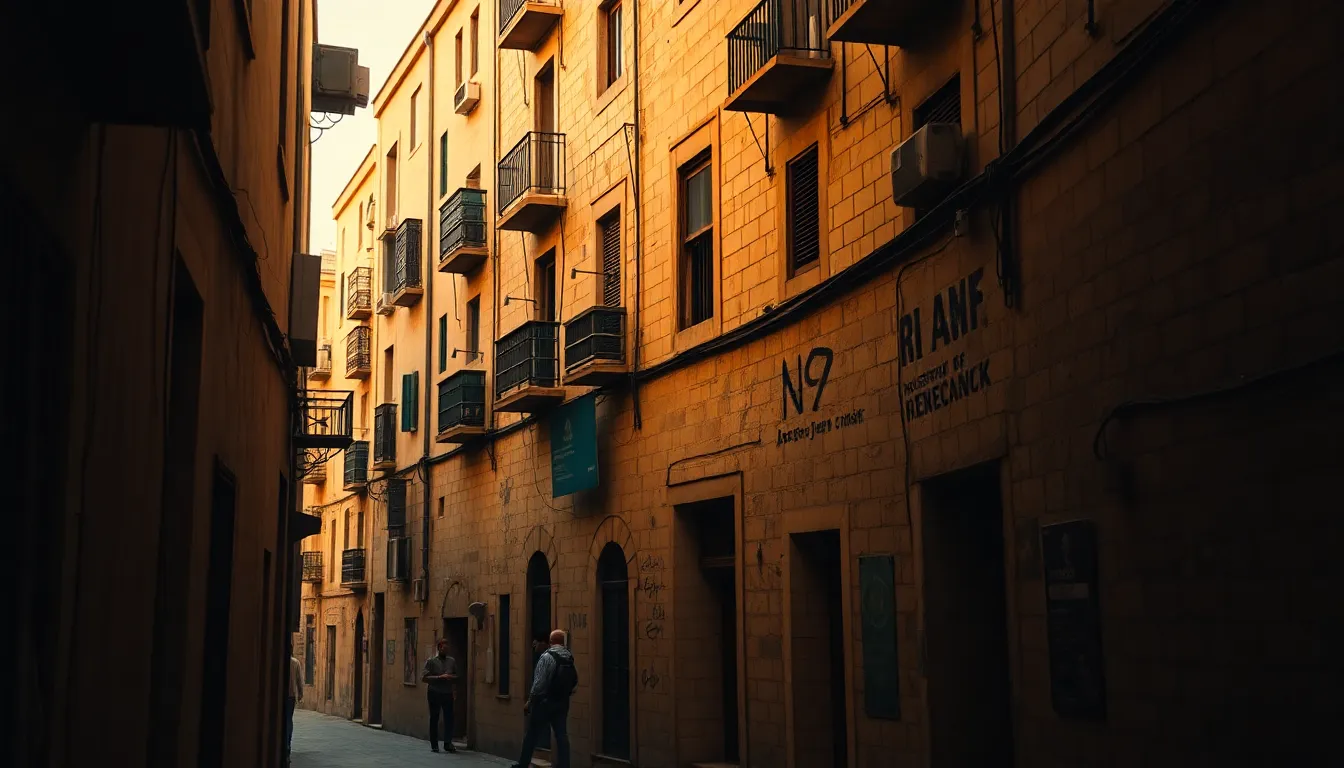
There is a moment on every group walk through Harat al-Yahud that I have learned to wait for. We turn a corner into a narrow lane, ordinary in every visible way, laundry overhead and shopfronts and the noise of the city, and I stop the group and tell them: a hundred years ago, this lane was the beating heart of Jewish Cairo. And every time, somebody looks up and down the street and says, almost to themselves, “There’s nothing here.” And I tell them the truth, which is that the nothing is exactly what we came to feel.
I have walked Jewish groups through the old quarter of Cairo for more than two decades. It is one of the hardest stops to lead well, because there is so little to point at and so much to hold. This guide is for rabbis, educators, and Jewish heritage travelers who want to understand what Harat al-Yahud was, what remains, and how a group can walk it today with honesty and reverence.
What Harat al-Yahud Was
Harat al-Yahud, the Jewish quarter, was for centuries one of the most densely Jewish neighborhoods in the Middle East. It sat in the medieval heart of Cairo, near the great markets and the old city gates, and it held a community that traced its presence back through the medieval period and, in some form, far earlier. This was not a ghetto in the European sense of a forced enclosure. It was a quarter where Jewish life concentrated by choice and custom, with synagogues, schools, ritual baths, kosher butchers, courts, and the dense web of institutions that a self-sustaining community builds.
At its height, the quarter was crowded and loud and fully alive. Families had lived in the same buildings for generations. The streets had Hebrew on the signs and Judeo-Arabic in the air. Children ran between the synagogues. Maimonides himself lived and served the community in this part of Cairo in the twelfth century, and the memory of his presence lingered in the quarter for centuries after.
A Community of Many Layers
The Jews of Cairo were never a single uniform group. There were Rabbanite and Karaite communities, each with their own synagogues and traditions, living near one another in the old quarter. Over the centuries the population absorbed Jews from Spain after the expulsion, from across the Ottoman world, from the Maghreb. By the early twentieth century, Cairo’s Jewish life had spread well beyond Harat al-Yahud into the modern downtown districts, where a prosperous, cosmopolitan Jewish professional class built grand synagogues like Sha’ar Hashamayim. But the old quarter remained the ancestral root, the place the community had come from.
Walking the Quarter Today
Here is the honest picture of what you will see. Harat al-Yahud today is a quiet, working-class residential neighborhood of Cairo with very few visible markers of its Jewish past. The synagogues that survive are mostly closed, some derelict, a few maintained. There is no museum quarter, no row of restored heritage facades, no plaque on every corner. The community that gave the place its name and its meaning is gone.
And yet the quarter speaks, if you walk it with someone who knows what to look for.
Reading the Streets
The street plan itself is the artifact. The lanes follow the same configuration they followed a century and more ago. The buildings, changed and rebuilt, sit on the same footprints. When I walk a group through, I show them where the synagogues stood, where the community courts met, where the markets ran. I read the old maps against the present streets, and slowly the group begins to see the ghost of the quarter laid over the living neighborhood. It is a kind of double vision, and once people have it, they cannot stop seeing it.
We move slowly and respectfully. This is a residential neighborhood where people live their daily lives, not a tourist set. I ask groups to be quiet, to be courteous, to remember that we are guests in a place that is somebody’s home now. That respect is part of the practice, and the people of the quarter are generally warm to visitors who come with it.
The Synagogues of the Old Quarter
Several historic synagogues survive in and around the old Jewish areas of Cairo, in varying states. Some are locked and waiting on restoration funds. A handful have been the focus of preservation work in recent years, part of a broader effort by Egyptian authorities and international partners to stabilize the country’s Jewish heritage sites before they are lost entirely.
The most famous synagogue connected to old Jewish Cairo sits a little apart, in the Coptic Quarter: Ben Ezra, the oldest of them all, home to the Cairo Geniza. We cover Ben Ezra in full in its own visitor’s guide, and most groups pair the two on the same itinerary, because together they tell the long story of Jewish Cairo from its medieval depth to its twentieth-century twilight.
Sha’ar Hashamayim and the Modern Downtown Community
Beyond the old quarter, in the modern downtown, stands Sha’ar Hashamayim, also called the Adly Street Synagogue. Built in 1905 in a grand Moorish Revival style, it served the prosperous Sephardic community of early-twentieth-century Cairo, the bankers and lawyers and merchants of a confident, cosmopolitan moment. It is maintained today by Egypt’s tiny remaining Jewish community and is open for visits with advance coordination. Standing inside it, after walking the worn lanes of the old quarter, gives groups the full arc: from the medieval root to the modern flowering, and then the silence that followed.
Holding the Loss
I want to be plain about the emotional weight of this walk, because it is the heart of the experience. The Jewish quarter of Cairo is, in the end, a place of absence. A community that lived here for many centuries, that built and prayed and argued and raised generations of children in these lanes, was reduced to almost nothing within a single lifetime.
The unraveling came fast. After the establishment of Israel in 1948 and the Suez Crisis of 1956, pressure on Egypt’s Jews intensified sharply. Property was seized, businesses nationalized, families pushed toward emigration. The 80,000 to 100,000 Jews of early-twentieth-century Egypt became a few hundred, and then fewer than ten. The old quarter emptied. The synagogues fell quiet.
When I lead groups through, I do not rush this. We stop somewhere along the walk and I let people stand with it. Many groups choose to say a few words together, a kaddish, a psalm, a moment of remembrance for a community that was. To walk Harat al-Yahud honestly is to bear witness, and that act of witness is itself a kind of return. The community is gone, but we came back, and we stood where they stood, and we remembered them. That matters more than any restored facade could.
How Heritage Tours Leads the Quarter
Walking Harat al-Yahud well takes more than a map. It takes a guide who knows which lane held which synagogue, who can read the old quarter into the new streets, and who can hold the emotional register of the place without letting it tip into either tourism or despair. That is what we provide.
For every group, we arrange the route, coordinate access to the synagogues that can be entered, handle the contact with custodial authorities, and pace the visit so that the old quarter and Ben Ezra and Sha’ar Hashamayim flow together into one coherent story rather than three disconnected stops. We also brief groups beforehand on how to walk respectfully through a living neighborhood, because that respect shapes how the whole experience feels.
To see how the quarter fits into the wider journey, read our main guide to Jewish heritage in Egypt and our guide to the Cairo Geniza, then look at how a full visit comes together on our Egypt heritage destination page.
FAQ: Walking Jewish Old Cairo
What is Harat al-Yahud?
Harat al-Yahud is the historic Jewish quarter of Old Cairo, for centuries one of the most densely Jewish neighborhoods in the Middle East. It held synagogues, schools, ritual baths, courts, and the full institutional life of a self-sustaining Jewish community, with roots reaching back through the medieval period. Maimonides lived and served the community in this part of Cairo in the twelfth century.
What can you actually see in the Jewish quarter today?
Harat al-Yahud today is a quiet residential neighborhood with very few visible markers of its Jewish past. Several historic synagogues survive in varying states, some closed and some maintained. The main artifact is the street plan itself, which follows the same configuration as a century ago. A knowledgeable guide can read the old quarter into the present streets, which is what gives the walk its power.
Which synagogues are connected to old Jewish Cairo?
The most famous is Ben Ezra Synagogue in the nearby Coptic Quarter, the oldest in Egypt and home to the Cairo Geniza. In the modern downtown stands Sha’ar Hashamayim, also called the Adly Street Synagogue, built in 1905 for the prosperous Sephardic community and still maintained today. Several smaller historic synagogues survive in and around the old quarter, some being restored.
Is the Jewish quarter of Cairo safe to visit?
Yes. Heritage groups walk the old quarter regularly with knowledgeable guides. It is a working residential neighborhood, so groups move through respectfully and quietly as guests, and the people of the area are generally warm to visitors who come with that courtesy. Heritage Tours arranges the route, access, and pacing for every group.
Why visit a place where so little remains?
Because the absence is the point. The Jewish quarter is a place of profound loss, where a centuries-old community nearly vanished within a single lifetime after 1948 and 1956. Walking it honestly is an act of witness and remembrance. Groups often say a few words together, a kaddish or a psalm, for the community that was. The act of returning and remembering is itself meaningful in a way no monument could replace.
If you are thinking about bringing your community to walk the old streets of Jewish Cairo, I would be glad to talk with you about what that experience can be. It is one of the most quietly powerful stops we lead, and it asks for a guide who understands both the history and the weight of it. Reach out through our contact page and let’s talk it through.