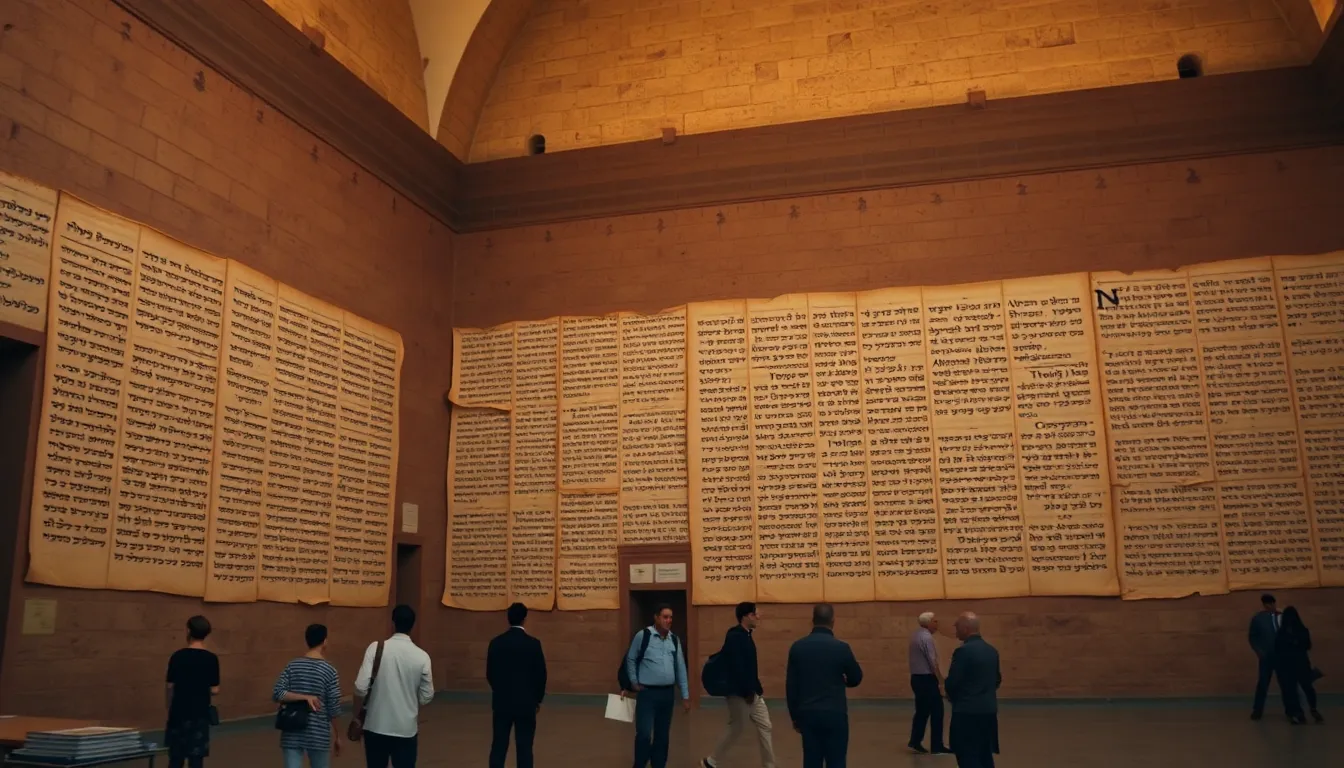
I have a habit, when I stand with a group inside Ben Ezra Synagogue, of asking people to imagine a thousand years of grocery lists. They laugh, and then I explain, and the laughter stops. Because that is part of what was found in the chamber above us: not only sacred texts and brilliant letters, but the ordinary debris of ordinary Jewish lives, a shopping list, a child’s writing practice, a note from a worried mother, all of it preserved by accident for ten centuries. There is no other archive like it in the Jewish world, and once a group understands what passed through this building, they never look at the room the same way again.
I have been bringing Jewish groups to Cairo for more than twenty years, and the Geniza is one of the stories I most love to tell, because it changes how people understand their own past. This guide is for rabbis, educators, and heritage travelers who want to understand what the Cairo Geniza was, why it matters so profoundly, and how to connect a group to its story on the ground in Egypt.
What a Geniza Is
Start with the word, because most people have never encountered it. A geniza is a storage place where a Jewish community deposits worn or damaged sacred texts rather than throwing them away. Jewish law forbids the destruction of any document bearing the name of God, so when a prayer book wears out or a Torah scroll becomes unusable, it is not discarded. It is set aside, traditionally to be buried later in a cemetery.
Most genizas are temporary. They fill up, and the community buries their contents and starts again. The geniza at Ben Ezra Synagogue in Old Cairo was different in one crucial way: for roughly a thousand years, the community kept depositing documents into a chamber and almost never cleared it out. And because the Cairo climate is extraordinarily dry, the paper and parchment did not rot. They simply accumulated, layer on layer, century on century.
Why It Held So Much More Than Sacred Texts
Here is the detail that makes the Cairo Geniza unique. This community treated almost any written Hebrew, and much written in Hebrew script even in other languages, as potentially sacred, because the same script carried both holy texts and daily business. So into the chamber went not only worn prayer books and Bible pages, but personal letters, business contracts, marriage agreements, court records, medical notes, poetry, schoolbooks, and the everyday paperwork of life, much of it written in Judeo-Arabic, the Arabic language written in Hebrew letters that the community spoke. The result was an accidental archive of an entire civilization, preserved not by design but by reverence and dry air.
The Discovery
For centuries the chamber filled, unknown to the wider world. Then, in 1896, two Scottish sisters and scholars, Agnes Lewis and Margaret Gibson, brought some fragments they had acquired in Egypt to Solomon Schechter, a scholar at Cambridge. Schechter recognized one fragment as the lost Hebrew original of the book of Ben Sira, a text known for centuries only in Greek translation. He understood immediately that something extraordinary was sitting in Cairo.
Schechter traveled to Ben Ezra, secured permission from the synagogue’s leadership, and arranged for the bulk of the chamber’s contents, close to 300,000 fragments, to be brought to Cambridge University Library, where the Taylor-Schechter Genizah Collection forms the heart of Geniza scholarship to this day. Other portions of the material made their way into collections around the world, but the largest single body is at Cambridge.
What Was In It
This is the part that takes people’s breath away, so I lay it out slowly for groups.
The Geniza held biblical manuscripts and liturgical poetry, some of it previously unknown. It held the lost Hebrew Ben Sira. It held writings in the hand of Maimonides himself, who lived and served in Cairo in the twelfth century, including drafts of his work with his own corrections. It held the responsa of great rabbis answering questions sent from across the Jewish world.
And then it held the ordinary, which is in some ways the greater treasure. Letters between merchants trading across the medieval Mediterranean and as far as India, tracking shipments of flax and silk and spices. Marriage contracts that record what a bride brought into a household. Divorce papers. Court testimony. Bills of sale. Letters home from travelers. A father writing about his children. A businessman complaining about a partner. A community appeal to ransom captives. Schoolbooks with a child’s wobbly letters. Even amulets and folk remedies.
How It Rewrote Jewish History
For a long time the picture of medieval Jewish life was one of isolation, poverty, and persecution, communities sealed off behind walls and waiting out the centuries. The Cairo Geniza shattered that picture.
The scholar S.D. Goitein spent decades reading these documents and reconstructed from them a world he described across five volumes titled “A Mediterranean Society.” What emerged was a medieval Jewish community that was cosmopolitan, mobile, literate, commercially sophisticated, and woven deeply into the economic and cultural life of the wider Islamic world. Jewish merchants in Cairo did business with partners in Spain, Tunisia, Sicily, and India. Women ran businesses and went to court. Communities supported the poor, ransomed captives, and maintained networks of charity and mutual aid across the whole Mediterranean.
The Geniza did not just add facts to the old picture. It replaced it. It gave the Jewish people back a medieval world far richer, more connected, and more fully human than anyone had imagined. When I tell a group that the dusty chamber above their heads is the reason we know all of this, the room goes quiet.
Where the Geniza Is and Where the Story Lives
I want to be honest with groups about something, because it prevents disappointment. You cannot go to Egypt and read the Cairo Geniza. The fragments themselves are at Cambridge and in other collections around the world, conserved and digitized, accessible to scholars and increasingly online to anyone. What you can do in Egypt is stand at the source.
And standing at the source matters enormously. The chamber is at Ben Ezra Synagogue, the building covered in full in our Ben Ezra visitor’s guide. When a group stands in that synagogue understanding what passed through it, the abstraction becomes physical. This room, these walls, this exact building held the everyday writings of a thousand years of Jewish Cairo. The merchants whose letters Goitein read prayed here. The families whose marriage contracts survived gathered here. The story does not live in the stones, exactly, but the stones are where the story happened, and that proximity does something real to people.
Connecting a Group to the Story
The way I bring the Geniza alive for a group is to make it personal and concrete. I do not lecture about archival significance. I read them a single letter, a real one, a mother writing to a son, a merchant fretting over a delayed shipment, and I let them feel how immediate and recognizable it is across a thousand years. Then I tell them it was found here, in this chamber, and watch the connection land. The Geniza is most powerful not as a statistic about 300,000 fragments but as a doorway into individual human lives that suddenly feel close.
For groups that want to go deeper, the Cairo Geniza connects naturally to the wider story of Jewish Cairo and its old quarter, the community that produced and preserved all those documents, and to the broad arc told in our main Jewish heritage guide to Egypt.
How Heritage Tours Connects Groups to the Geniza
The Geniza is a story that lives or dies on the telling, and that is precisely what we do well. Our guides know the Geniza in genuine depth, not as a date and a number but as a living archive of human lives, and they can stand in Ben Ezra and bring it to your group in a way that makes the visit unforgettable. We coordinate the access to Ben Ezra that a group visit requires, pace the day so the Geniza story has room to breathe, and connect it to the surrounding Jewish Cairo so it lands as part of a whole.
To see how the Geniza and Ben Ezra fit into a full journey, look at our Egypt heritage destination page.
FAQ: The Cairo Geniza
What is the Cairo Geniza?
The Cairo Geniza is a collection of close to 300,000 Jewish manuscript fragments that accumulated over roughly a thousand years in a storage chamber at Ben Ezra Synagogue in Old Cairo. A geniza is a place where a Jewish community deposits worn sacred texts rather than destroying them. The dry Cairo climate preserved the documents, and because the community treated nearly all Hebrew writing as worthy of preservation, the chamber captured everything from sacred texts to ordinary daily paperwork.
Why is the Cairo Geniza so significant?
It fundamentally rewrote the understanding of medieval Jewish life. Where the old picture showed isolated, persecuted, impoverished communities, the Geniza revealed a Jewish world that was cosmopolitan, literate, mobile, commercially sophisticated, and deeply woven into the wider Islamic Mediterranean. The scholar S.D. Goitein reconstructed this world in his five-volume “A Mediterranean Society,” based almost entirely on Geniza documents.
What was found in the Geniza?
An astonishing range. Biblical and liturgical manuscripts, the lost Hebrew original of the book of Ben Sira, writings in the hand of Maimonides, and the responsa of great rabbis. Alongside these were the ordinary documents of life: merchant letters spanning the Mediterranean and India, marriage and divorce contracts, court records, medical notes, business accounts, personal letters, and even children’s schoolbooks.
Can you see the Cairo Geniza in Egypt?
Not the documents themselves. The bulk of the collection is held at Cambridge University Library, with other portions in collections around the world, and much of it is now digitized online. What you can do in Egypt is stand at the source, the chamber at Ben Ezra Synagogue where the fragments accumulated for a thousand years. Visiting Ben Ezra with an understanding of the Geniza makes the history physical and immediate.
How was the Cairo Geniza discovered?
In 1896, Scottish scholars Agnes Lewis and Margaret Gibson brought fragments acquired in Egypt to Solomon Schechter at Cambridge, who recognized one as the lost Hebrew Ben Sira. Schechter traveled to Ben Ezra, secured permission, and arranged for the bulk of the chamber’s contents to be brought to Cambridge University Library, where they remain the heart of Geniza scholarship today.
If the Geniza story moves you the way it moves me, and you are thinking about bringing your community to stand at its source, I would love to talk with you. With Heritage Tours the group leader travels free with fifteen or more participants, which makes a journey like this far more reachable than people assume. Reach out through our contact page whenever you are ready to begin.