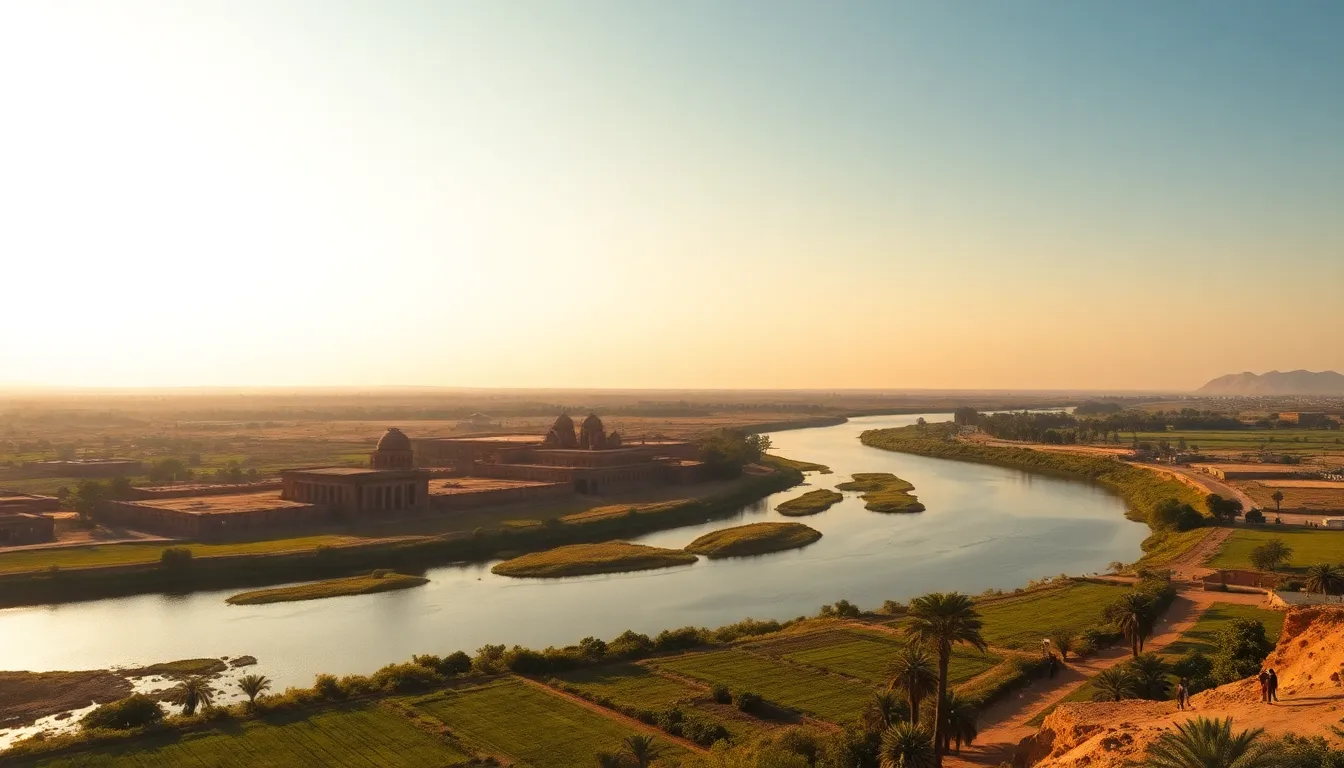
People are always surprised when I tell them how often Egypt shows up in the Bible. Not a handful of times. Hundreds. Egypt is the second most mentioned nation in all of Scripture, after Israel itself. It is the land of refuge for Abraham, the place where Joseph rose from a prison to a throne, the house of bondage, the stage of the Exodus, the refuge of the Holy Family, and a recurring presence in the words of the prophets. When a group grasps that, the whole country opens up as a Bible you can walk through.
I built this guide for the pastor, educator, or rabbi who wants the map. Below I have laid out the major biblical references to Egypt and tied each one to a place your group can actually stand. Not every site is preserved, and I will be honest about which are stones you can touch and which are landscapes you read into. But taken together, they let a group trace Egypt straight through the biblical story, from Genesis to the Gospels.
Egypt in Genesis: Refuge and the Joseph Story
Egypt enters the Bible early, as a place of refuge in famine.
Abraham Goes Down to Egypt
In Genesis 12, Abraham, driven by famine, goes down to Egypt with Sarah. It is the first of many times the Bible sends its people to Egypt for survival when the land of promise fails them. The episode sets a pattern that runs through the whole of Scripture: Egypt as the place you go when there is no bread at home.
There is no single site that marks Abraham’s sojourn, but I open the theme of Egypt-as-refuge here, because it frames everything that follows, including the Holy Family centuries later.
Joseph: From the Pit to Pharaoh’s Court
The Joseph narrative, Genesis 37 through 50, is one of the longest sustained stories in the Bible, and it unfolds almost entirely in Egypt. Sold into slavery by his brothers, imprisoned on a false charge, raised by God to interpret Pharaoh’s dreams, Joseph becomes the second most powerful man in Egypt and saves the region from famine, including the very family that betrayed him.
To bring Joseph’s world to life, I take groups to the great sites of pharaonic Egypt. The temples, the tombs, the monuments of royal power along the Nile let a group feel the scale of the court Joseph rose to serve. Standing before that grandeur, the story of a Hebrew slave lifted to stand beside Pharaoh stops being a flannel-board tale and becomes staggering.
Goshen: Where Israel Settled
Joseph brings his father Jacob and the whole family down to Egypt and settles them in the land of Goshen, in the eastern Nile Delta. There Israel lived and multiplied for generations. Goshen today is ordinary Delta farmland near modern Zagazig, with no dramatic ruins, and that plainness is exactly its power. This is where a family became a nation. I read the closing chapters of Genesis here, and the long welcome before the bondage feels real.
Egypt in Exodus: The House of Bondage and Deliverance
This is the heart of Egypt’s role in the Bible, and the spine of any faith journey here.
The Bondage
After Joseph’s generation died, a new Pharaoh enslaved the Israelites. The opening of Exodus describes the bricks, the labor, the bitter lives. The monuments your group sees along the Nile were raised by exactly this kind of conscripted labor, and standing before them gives the text a body.
The Burning Bush and Sinai
Moses, a fugitive in the wilderness, meets God at the burning bush at Horeb and is sent to deliver the people. Later, after the Exodus, he receives the Law on Mount Sinai. Both are anchored at Saint Catherine’s Monastery and Mount Sinai in the Sinai Peninsula, among the most powerful sites in the whole of Scripture and very much places you can stand. Our guide to the burning bush at Saint Catherine’s goes deeper on the site, and the pre-dawn ascent of the mountain is, for most groups, the emotional summit of the trip.
The Red Sea Crossing
Trapped between Pharaoh’s army and the water, Israel passes through the sea on dry ground. The Sinai coast lets a group stand at the water’s edge and read the Song of the Sea where the deliverance is remembered. The exact crossing point is debated, and we say so, but the encounter does not depend on settling it. For a fuller treatment of the whole journey, our guide to tracing the Exodus walks the arc stop by stop.
Egypt in the Prophets and Wisdom Books
Egypt does not leave the Bible after the Exodus. It runs through the prophets as a recurring temptation and a recurring judgment. Isaiah, Jeremiah, and Ezekiel all warn Israel not to trust in Egypt, not to lean on Pharaoh like a broken reed. Jeremiah himself is taken down to Egypt after the fall of Jerusalem and prophesies there.
There is also a startling note of hope. Isaiah 19 prophesies a day when there will be an altar to the Lord in the midst of Egypt, when Egypt will be called “my people,” blessed alongside Israel. For a Christian group, the long Coptic Christian presence reads as an echo of that promise, and standing in the ancient churches of Cairo, that verse takes on flesh. I weave these texts into the Cairo days, especially among the Coptic sites, where the theme of God’s reach into Egypt is everywhere.
Egypt in the New Testament: The Holy Family
The biblical story of Egypt does not end with the Old Testament. One of the most tender episodes in the Gospels takes place here.
The Flight into Egypt
In Matthew 2, an angel warns Joseph in a dream to take the child Jesus and his mother and flee to Egypt to escape Herod’s slaughter of the infants. The Holy Family lives in Egypt until Herod’s death, fulfilling, Matthew writes, the prophecy “out of Egypt I called my son,” the very words first spoken of Israel’s Exodus.
Coptic tradition preserves a detailed route of the Holy Family’s journey through Egypt, and a remarkable number of sites are venerated along it. In and around Cairo, the Church of Saint Sergius in Coptic Cairo is built over a cave where tradition says the family sheltered. The sycamore tree at Matariya marks a place they are said to have rested. Many more sites stretch down into the Delta and beyond. These are real places your group can visit, and they make the infancy of Jesus tangible in a way few other destinations can.
The Symmetry of the Two Exoduses
I always draw this out for a group. Israel came out of Egypt under Moses. Jesus came out of Egypt as a child. Egypt is the one land that holds both great departures of the Bible, the same word, exodus, spanning the Testaments. That symmetry is one of the deepest reasons Egypt rewards a faith group, and it is unique to this country.
The Coptic Chapter: The Church Egypt Built
Beyond the explicit biblical references, Egypt holds the living continuation of the biblical story in the Coptic Church, founded by tradition by Saint Mark and unbroken since the first century. For groups who want to follow that thread, our guides to early Christian Alexandria and the cave churches of Mokattam carry the story from the New Testament into the church that grew out of it, and our overview of spiritual sites in Egypt ties the whole map together.
A Quick Reference Map
Here is the biblical story of Egypt at a glance, with the places your group can stand.
- Abraham’s sojourn (Genesis 12): the theme of Egypt as refuge, opened on the Nile.
- Joseph in Egypt (Genesis 37 to 50): the pharaonic monuments and temples that show the scale of his rise.
- Goshen and the settling of Israel (Genesis 46 to 47): the eastern Nile Delta farmland near Zagazig.
- The bondage (Exodus 1): the great monuments raised by conscripted labor.
- The burning bush and the Law (Exodus 3 and 19 to 20): Saint Catherine’s Monastery and Mount Sinai.
- The Red Sea crossing (Exodus 14 to 15): the Sinai coast and the Song of the Sea.
- The prophets on Egypt (Isaiah, Jeremiah, Ezekiel): woven into the Cairo and Coptic days.
- The flight into Egypt (Matthew 2): the Holy Family sites of Coptic Cairo, Matariya, and the Delta.
How to Use This Map as a Group Leader
You will not visit every reference in one trip, and you should not try. The gift of this map is that it lets you choose the thread that fits your community. Some groups follow the Exodus spine. Some follow the Holy Family. Some want the full sweep from Joseph to the Coptic Church. Each makes a different and complete journey. Read on location, always, and read in the Bible’s own order where the geography allows. Your job as the leader is to put the group in front of the text and then leave room for the silence afterward.
You can see how we build these journeys on our Egypt heritage destination page, and our guide to the best time to visit Egypt helps you choose a season. To understand how the group leader experience works, see our group heritage tours, where group leaders travel free with fifteen or more participants.
FAQ: Egypt in the Bible
How many times is Egypt mentioned in the Bible?
Egypt appears hundreds of times across both Testaments, making it the most frequently mentioned foreign nation in all of Scripture. It is the land of Abraham’s refuge, Joseph’s rise, the bondage and the Exodus, repeated prophetic oracles, and the flight of the Holy Family. That sheer frequency is why Egypt can be experienced as a Bible you walk through.
Which biblical sites in Egypt can you actually visit?
Many. Saint Catherine’s Monastery and Mount Sinai for the burning bush and the Law, the Sinai coast for the Red Sea crossing, the land of Goshen in the Nile Delta, the pharaonic monuments that frame the Joseph and bondage narratives, and the Holy Family sites in Coptic Cairo and Matariya. Some are stones you touch and some are landscapes you read into, and we are clear with groups about which is which.
Is Egypt mostly an Old Testament destination?
No. Egypt spans both Testaments. The Old Testament holds Abraham, Joseph, the Exodus, and the prophets, while the New Testament holds the flight of the Holy Family into Egypt to escape Herod. Egypt is the one land that contains both of the Bible’s great departures, which makes it rich for Christian groups as well as Jewish ones.
What is the connection between the Exodus and Jesus going into Egypt?
Matthew applies the words first spoken of Israel’s Exodus, “out of Egypt I called my son,” to the infant Jesus returning from Egypt after Herod’s death. Israel came out of Egypt under Moses, and Jesus came out of Egypt as a child. The same word, exodus, spans both, and many groups trace both threads on a single trip.
Can a group cover all the biblical sites in one trip?
Not comfortably, and we do not recommend trying. The references span a large geography from the Delta to the Sinai to the Nile Valley. We help group leaders choose the thread that fits their community, whether the Exodus spine, the Holy Family route, or the full sweep from Joseph to the Coptic Church, so the journey has depth rather than a rushed checklist.
If you want to lead your community through Egypt as a Bible they can walk, this map is where it begins. We will help you choose the thread that fits your people and build a journey that lets the text meet the place. When you are ready to start, reach out to our team.