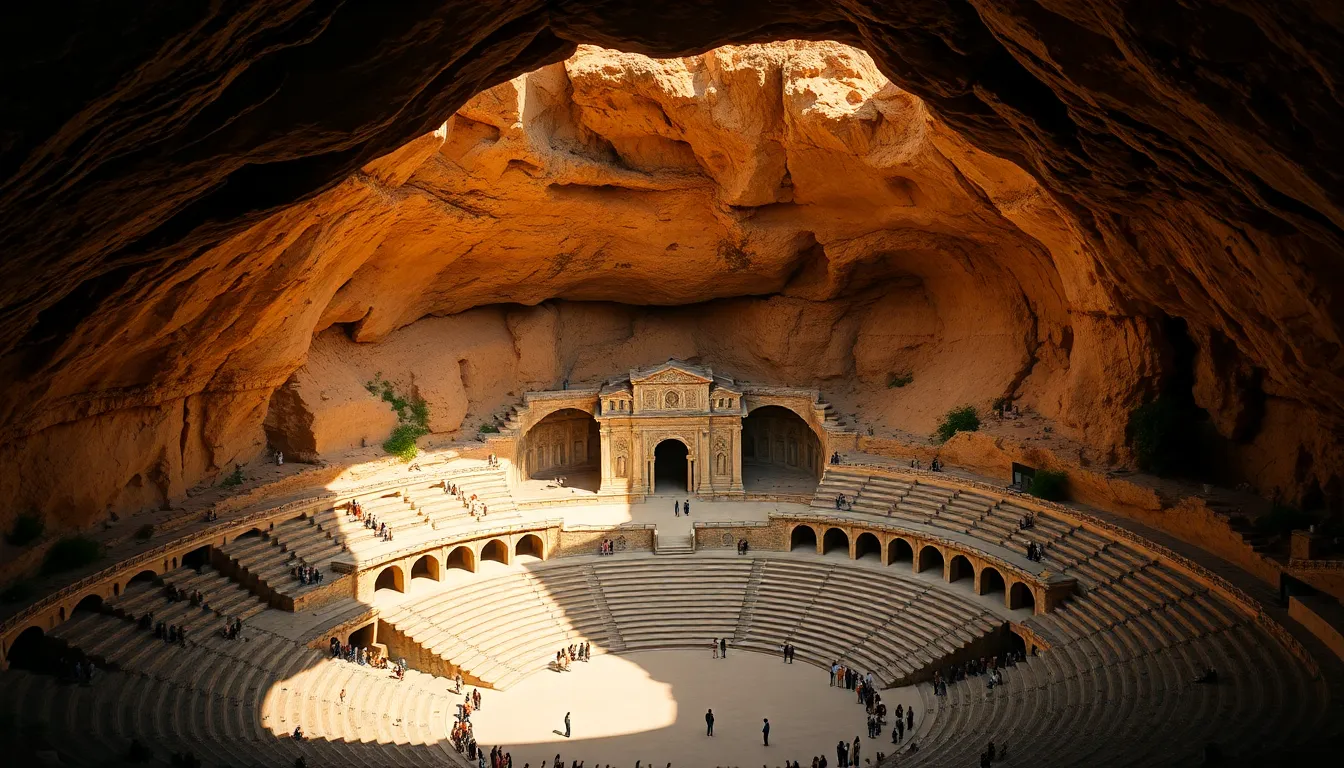
I will be honest about how groups react to this one, because no glossy itinerary photo prepares them. The drive up into Mokattam takes you through Manshiyat Naser, the neighborhood Cairo calls Garbage City. The smell reaches the bus before the buildings do. I watch faces tighten. And then we round the cliff, the largest church in the Middle East opens up out of the bare rock in front of us, and the whole mood of the group changes inside a minute. I have done this trip many times. That turn never stops working.
The cave churches of Mokattam are not a place you visit for comfort. They are a place you visit because they tell you something true about how faith survives, who carries it, and what God does in the parts of a city most people would rather not see. For a pastor or educator who wants their group to encounter living Christianity in Egypt rather than only ancient stones, there is no stop quite like it.
Garbage City and the Zabbaleen
To understand the cave church, you have to understand the community that built and fills it. The neighborhood of Manshiyat Naser, on the eastern edge of Cairo below the Mokattam cliffs, is home to the Zabbaleen, an Arabic word that means, plainly, the garbage people.
For generations, the Zabbaleen have collected Cairo’s waste by hand, hauled it home, and sorted it in the streets and rooms of their own neighborhood. They recycle an astonishing share of what they gather, far more than most industrial systems manage. They are also, overwhelmingly, Coptic Christians. A largely Christian community doing the work no one else wanted, living among the refuse of a city of more than twenty million.
I ask groups not to look away from this and not to romanticize it either. The conditions are hard. The work is hard. And the faith of this community is not a sentimental story. It is a stubborn, daily thing, lived in a place that the rest of Cairo treats as invisible.
A Story of Transformation
What makes Mokattam more than a hard story is what grew out of it. In the 1970s, a Coptic community organized around the garbage collectors began to take shape, and with it came a renewal of faith, schools, clinics, and the churches carved into the cliff. The neighborhood is still poor and still does the same work. But it is also home to one of the most vibrant Christian communities in Egypt, and the cave churches are its spiritual center.
The Monastery of Saint Simon the Tanner
The complex carved into the Mokattam cliff is named for Saint Simon the Tanner, and the name carries a medieval Coptic legend that your group should know before they arrive.
The Legend of the Moving Mountain
The tradition goes back to the tenth century, to the reign of the Fatimid caliph al-Muizz. In a debate at the caliph’s court, the challenge was raised against the Christians from the Gospel of Matthew: if you have faith, you can say to this mountain, move, and it will move. The Coptic pope, Abraham, was given a deadline to prove it or face disaster for his community.
The pope, the tradition says, was directed in a vision to a one-eyed man carrying water, a humble tanner named Simon, known for his piety and his refusal to look on temptation. Through Simon’s prayer and the fasting of the Christian community, the Mokattam mountain is said to have lifted at each recitation, rising and settling, until the caliph was convinced and the community spared. Simon, by the account, slipped away afterward and was never publicly known again.
Whether your group reads this as history, legend, or something in between, it is the reason this cliff carries this name, and the reason a community built its great church into this particular mountain. The story of faith moving a mountain, told on the side of the very mountain in question, is not lost on anyone who stands here.
The Cave Church of Saint Simon
The main church, the Monastery of Saint Simon the Tanner, is the largest church in the Middle East. It seats many thousands. And it is carved directly into the natural amphitheater of the Mokattam rock, an open-air cathedral of stone with the cliff face rising as its back wall.
Polish artist Mario, who worked here for years, carved enormous scenes from Scripture directly into the cliff faces around the complex: the creation, the crucifixion, biblical figures, all reliefs cut into living rock. Your group walks among them. The scale is hard to convey in words. You stand at the bottom of the amphitheater and the rows of seats climb up into the cliff above you, and the carved Christ looks down from the stone.
There are several churches and chapels in the complex, not only the great amphitheater. Smaller cave chapels are tucked into the rock nearby, each with its own character.
Standing in the Space
I give groups room here. The great cave church can be empty and silent when we arrive, and the silence in a space that large, cut into a mountain, is its own kind of sermon. When it is full, during a Coptic service or a gathering, the singing fills the rock and rolls back down from the walls.
For Christian groups, I often suggest a reading here. Matthew 17:20, the verse the whole legend hangs on: “If you have faith as small as a mustard seed, you can say to this mountain, move from here to there, and it will move.” Reading those words inside a mountain that a community believes moved, in a church carved by the poorest people in Cairo, lands differently than reading them in a sanctuary at home.
Why This Site Matters for Faith Groups
Most of the Christian heritage your group will see in Egypt is ancient. The Coptic churches of Old Cairo, the desert monasteries, the Holy Family sites all reach back many centuries. Mokattam is different. It is recent, it is alive, and it is hard.
That combination is exactly why it matters. Your group will encounter a Christianity that is not preserved behind glass but lived right now, by people whose circumstances most of your congregation can barely imagine. It complicates the comfortable picture. It also, in my experience, does more to shift how a group thinks about their own faith than almost any ancient site.
I have had educators tell me Mokattam was the stop their students could not stop talking about on the flight home. I have had pastors tell me they preached on it for a month. The contrast of squalor and glory, of the largest church in the region built by the people sorting the city’s garbage, says something about the Gospel that no lecture quite reaches.
For groups building a fuller picture of the country’s Christian story, our overview of spiritual sites in Egypt places Mokattam alongside the ancient sites, and the Eastern Desert monastery of Saint Paul shows the older tradition of carving worship into rock that Mokattam carries forward.
Practical Notes for Group Leaders
A few honest words on logistics.
Prepare your group for the approach. I always brief people on the drive through Garbage City before we leave the hotel, so the conditions do not shock them into judgment. Frame it as encounter, not spectacle. How your group carries themselves through this neighborhood matters.
Dress modestly. This is an active Coptic site and a conservative community. Shoulders and knees covered for everyone.
Photography needs sensitivity. The cave churches themselves are fine to photograph. The neighborhood and its people are not a photo op. I ask groups to put cameras away on the drive in and to never photograph residents or their homes without clear welcome.
Go with a guide who knows the community. The relationship matters. A guide who is known and trusted here changes the welcome your group receives and ensures you move through respectfully.
Allow more time than you think. Groups consistently want to stay longer than the schedule allows. Build a comfortable window so people can sit in the amphitheater rather than rush through.
FAQ: Visiting the Mokattam Cave Church in Cairo
What is the cave church in Cairo?
It is the Monastery of Saint Simon the Tanner, a complex of churches carved directly into the Mokattam cliffs on the eastern edge of Cairo. The main church is an open-air amphitheater cut into the natural rock and is the largest church in the Middle East, seating many thousands. It is the spiritual center of the Zabbaleen Christian community of Manshiyat Naser.
Why is the area called Garbage City?
The neighborhood below the cliffs, Manshiyat Naser, is home to the Zabbaleen, the largely Coptic Christian community that has collected and recycled Cairo’s waste by hand for generations. The work is done in the streets and homes of the neighborhood itself, which is how it came to be called Garbage City. It is hard, and the faith of the community living there is remarkable.
Who was Saint Simon the Tanner?
By Coptic tradition, Simon was a humble one-eyed tanner from tenth-century Cairo whose prayer and faith, with the fasting of the Christian community, caused the Mokattam mountain to move during a challenge before the Fatimid caliph. The church is named for him, and the legend of the moving mountain is the reason the community built into this cliff.
Is it safe and appropriate to bring a group here?
Yes, when you go with a guide who knows the community and you prepare your group beforehand. The visit is an encounter with a living Christian community in difficult circumstances, so it asks for respect, modest dress, and sensitivity with cameras. Handled well, it is one of the most moving stops on an Egypt itinerary.
What should we read or reflect on at the cave church?
Many Christian groups read Matthew 17:20, the verse about faith moving a mountain, which is tied directly to the legend of the site. Reading it inside the amphitheater carved into the Mokattam rock, surrounded by Scripture scenes cut into the cliff, gives the words a weight that is hard to find anywhere else.
If you want your group to meet the living, working Christianity of Egypt and not only its ancient stones, Mokattam belongs on your itinerary. It is hard, and it is unforgettable, and groups come home changed by it. When you are ready to build a journey that includes it, reach out to our team.