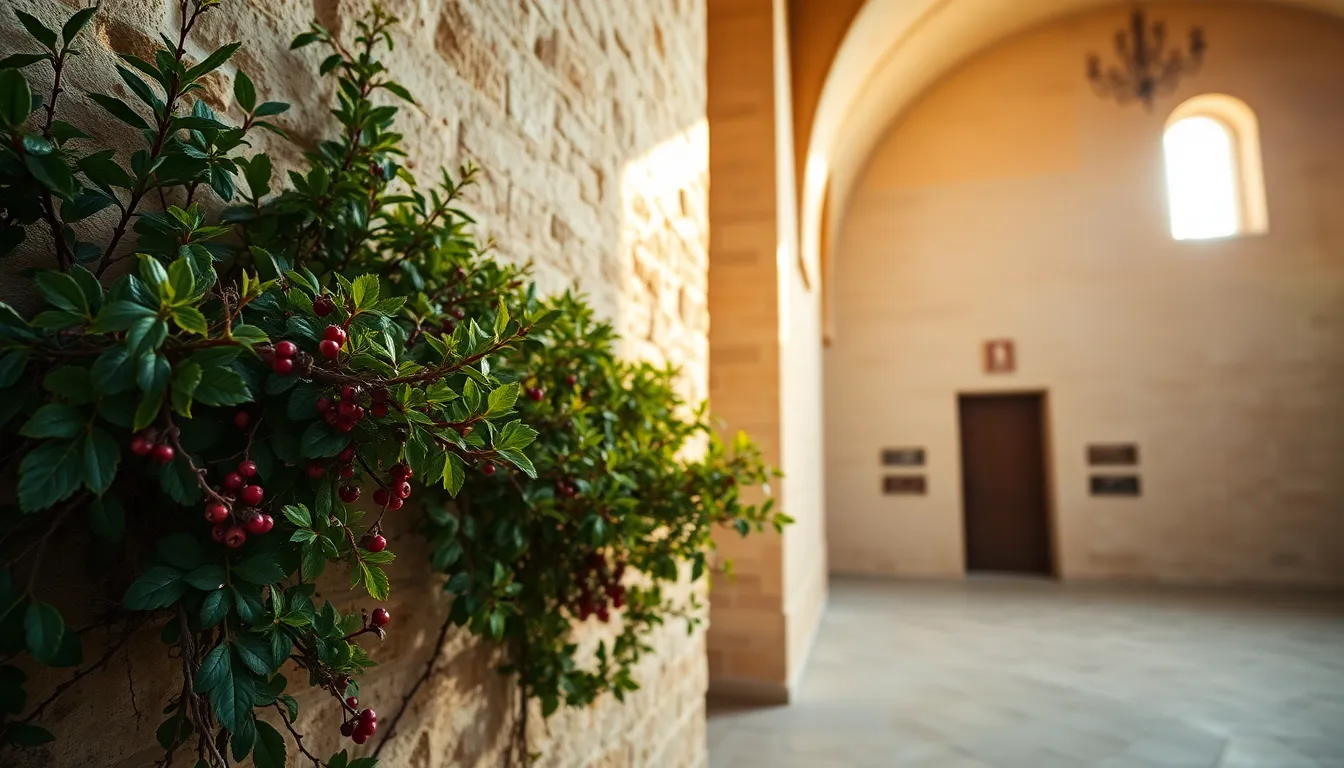
You take your shoes off to approach it. That is the first thing I tell a group, and the first thing that changes the air around them. We are standing in the courtyard of Saint Catherine’s Monastery, at the foot of Mount Sinai, in front of a living bramble bush growing against an ancient stone wall, and the instruction is the same one God gave Moses: take off your sandals, for the place where you are standing is holy ground. Groups go quiet doing it. They always do.
The burning bush is one of those sites where the question of literal location matters less than people expect once they are actually there. I will be honest with you about what we know and what we do not. But I will also tell you that in more than twenty years of leading faith travel, few moments move a Christian group the way this one does. Let me walk you through it.
The Burning Bush in Scripture
The story is in Exodus 3. Moses, a fugitive from Egypt tending his father-in-law’s flock in the wilderness, leads the sheep to Horeb, the mountain of God. There the angel of the Lord appears to him in a flame of fire out of a bush. The bush burns but is not consumed. Moses turns aside to look, and God calls to him out of the bush by name: “Moses, Moses.” God tells him to remove his sandals, because the ground is holy. And then God gives Moses the commission that sets the entire Exodus in motion: go to Pharaoh and bring my people out of Egypt.
This is one of the hinge moments in all of Scripture. It is where God reveals the divine name, “I am who I am.” It is where a broken, exiled man is called to lead a nation out of slavery. For Christian readers, it is also a passage Jesus himself cites, pointing to the God of the burning bush as the God of the living. The early church fathers read the bush that burns without being consumed as an image of the Virgin who bore God without being destroyed by the fire of divinity, which is why you will see the burning bush in so much Eastern Christian art.
So when your group stands before this bush, they are standing before one of the richest single images in the Bible. I make sure they arrive knowing that.
The Site Tradition
Saint Catherine’s Monastery was built around this very spot. According to the tradition, the bush growing here is the descendant of the original bush from which God spoke to Moses. The Emperor Justinian had the monastery’s great fortified walls constructed in the sixth century, but the site was venerated and occupied by hermits long before that, drawn precisely because they believed this was the place of the burning bush.
The Chapel of the Burning Bush stands at the heart of the monastery, built over the roots of the bush. The bush itself was transplanted a few meters from its original location to make room for the chapel, and it grows there still, an evergreen bramble that the monks say has never been successfully grown from a cutting anywhere else.
What We Can and Cannot Know
I do not pretend to my groups that we can prove this is the bush, or even the exact spot. We cannot. The geography of the Exodus is debated, the centuries are long, and certainty of that kind is not available here. What I can say is this. This is among the oldest continuously venerated holy sites in the world. Christians have prayed at this spot, believing it to be the place of God’s call to Moses, for at least seventeen centuries without a break. The monastery that guards it has never closed. That unbroken witness is itself something to stand inside.
I find that groups do not need the certainty as much as they think they will. Standing barefoot before a living bush at the foot of Sinai, reading Exodus 3 aloud, the weight of the moment does not depend on a survey marker. It comes from the encounter the text describes, and the place gives that encounter a body.
Saint Catherine’s Monastery
The monastery is far more than the bush, and your group should have time for all of it. Saint Catherine’s is the oldest continuously inhabited Christian monastery in the world, a UNESCO World Heritage Site, and a treasury of early Christian heritage that has no equal.
The Living Bush in the Courtyard
The bush you see today grows on the wall in the monastery courtyard, transplanted from the chapel site. It is a real, living plant, green and tangled, and people are often surprised by how ordinary and how moving it is at the same time. There is no spectacle. Just a bush, an old wall, hard Sinai light, and the story.
The Treasures of the Monastery
Saint Catherine’s holds one of the most important collections of ancient icons in the world, including encaustic icons that survived the iconoclastic controversy because the monastery was so remote. Its library is second only to the Vatican’s in its holdings of early manuscripts. This is where the Codex Sinaiticus, one of the oldest near-complete manuscripts of the Bible, was found in the nineteenth century. For a group of educators or pastors who care about the text of Scripture, standing where that manuscript was preserved is its own quiet thrill.
The relics of Saint Catherine of Alexandria, the learned young martyr after whom the monastery is named, are kept here as well. Tradition holds that angels carried her body to the peak now called Mount Catherine after her martyrdom in Alexandria. For groups tracing her story, our guide to early Christian Alexandria follows it back to the city of her birth.
Pairing the Bush with the Mountain
Most groups come to this corner of Sinai for the famous pre-dawn ascent of Mount Sinai, the climb that begins in the dark and reaches the summit at sunrise. The burning bush and the summit belong together. One is the place of the call, the other the place of the Law. Moses meets God at the bush and is sent. Moses climbs the mountain and receives the commandments. Reading them as a pair, in the order Scripture gives them, deepens both.
I usually structure it so the group visits the monastery and the burning bush either the afternoon before the climb or the morning after, so the two encounters frame each other. Our broader guide to spiritual sites in Egypt sets the whole Sinai experience in context, and for groups tracing the larger journey out of Egypt, our guide to tracing the Exodus connects the bush to the road that led here.
Practical Notes for Group Leaders
A few things I have learned bringing groups to Saint Catherine’s.
The Chapel of the Burning Bush has specific protocols. Shoes are removed to enter, as Moses did. The chapel is small, so groups move through in turns rather than all at once. The monks keep it as a place of prayer, not a tourist photo stop, and access can vary, so we confirm and coordinate in advance.
Dress is modest and required. Shoulders and knees covered, for everyone. The monastery is a working religious community.
Visiting hours are limited and tied to the monastic schedule. The monastery is open to visitors only during certain hours, and it closes on Sundays and major feast days. Plan around that. We always confirm the current schedule before the trip.
The Sinai is remote and the climate is its own. The mountains around Saint Catherine’s get genuinely cold at night, especially in winter, even when the coast is warm. If your itinerary includes an overnight for the climb, prepare your group to pack warmly.
Give the bush its moment. The temptation is to treat it as a quick photo and move on to the icons and the library. Resist it. The barefoot pause in front of the bush, with Exodus 3 read aloud, is the heart of why your group is here.
FAQ: The Burning Bush at Saint Catherine’s
Is the burning bush at Saint Catherine’s the actual bush from Exodus?
Tradition holds that the bush growing in the monastery is a descendant of the original burning bush, and the site has been venerated as the place of God’s call to Moses for at least seventeen centuries. We cannot prove it is the exact bush or spot, and we are honest with groups about that. What is certain is the unbroken history of prayer at this place, which gives the encounter real weight regardless.
Where is the burning bush located?
It grows in the courtyard of Saint Catherine’s Monastery, at the foot of Mount Sinai in Egypt’s Sinai Peninsula. The bush was transplanted a few meters from its original spot to allow the Chapel of the Burning Bush to be built over the original roots. Both the living bush and the chapel are part of the monastery visit.
Do you have to take your shoes off at the burning bush?
Yes, to enter the Chapel of the Burning Bush, following the instruction God gave Moses in Exodus 3 to remove his sandals on holy ground. Many group leaders find this small act of obedience is one of the most affecting moments of the whole trip. The monks maintain the chapel as a place of prayer with specific protocols.
Can we visit the burning bush and climb Mount Sinai on the same trip?
Yes, and we recommend it. The two belong together: the bush is the place of God’s call to Moses, and the summit is the place of the Ten Commandments. We usually arrange the monastery and burning bush visit just before or after the pre-dawn summit climb so the two encounters frame each other.
What else is there to see at Saint Catherine’s Monastery?
A great deal. It is the oldest continuously inhabited Christian monastery in the world, holding one of the most important collections of ancient icons anywhere, a library second only to the Vatican’s in early manuscripts, the site where the Codex Sinaiticus was found, and the relics of Saint Catherine of Alexandria. We give groups time for all of it, not only the bush.
If your group is drawn to the place where God called Moses and the faith of seventeen unbroken centuries of prayer, Saint Catherine’s and the burning bush belong on your journey. The barefoot moment in front of that living bush stays with people long after they go home. When you are ready to plan it, reach out to our team.