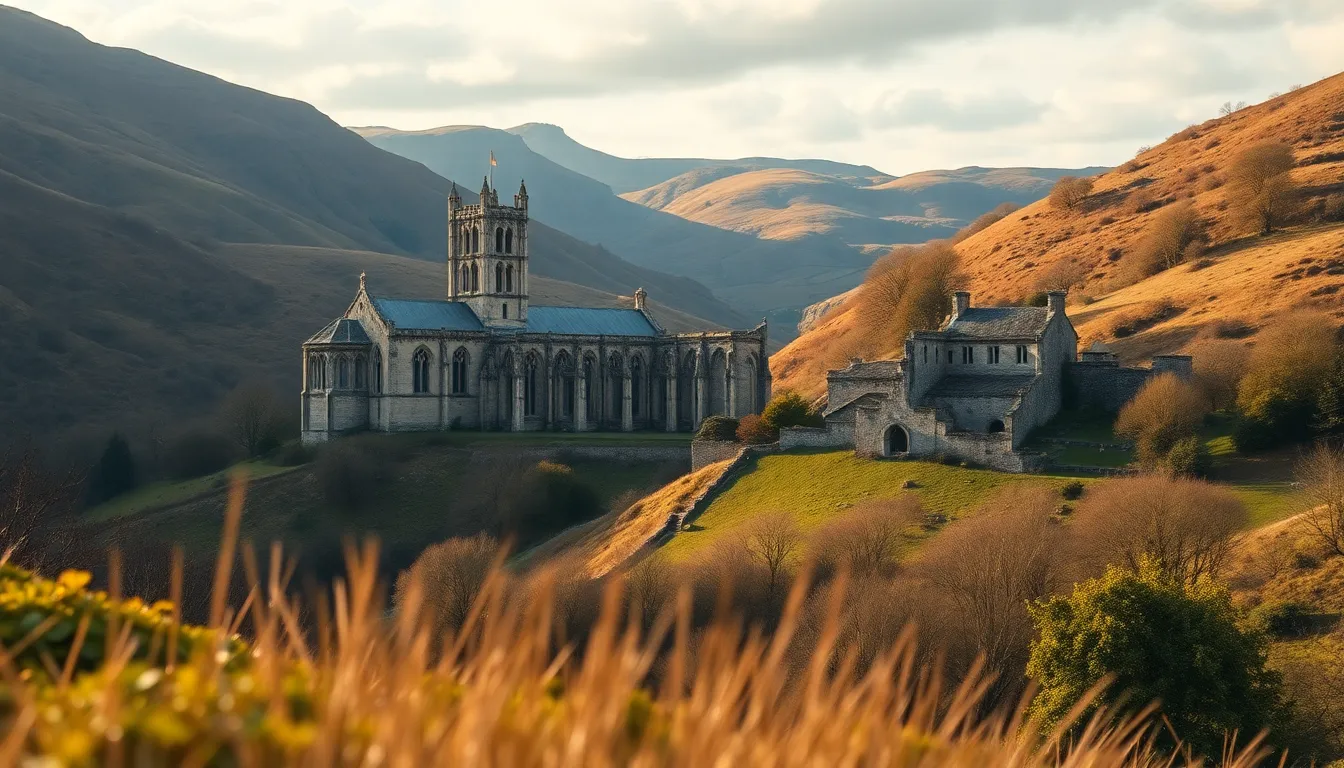
You do not see St Davids Cathedral until you are almost on top of it. We drive out to the far western tip of Wales, through Pembrokeshire lanes that get narrower the closer we get, and arrive in what looks like a small market town. Then we walk through an old gate, the ground drops away, and the whole cathedral is suddenly there below us, lying in a green hollow with a ruined palace beside it.
Groups always stop walking at that point. They came expecting a church on a hill in the smallest city in Britain, and instead they are looking down into a valley at a thousand years of Welsh Christian history sitting quietly out of sight. St Davids rewards the long journey every time, and here is why it matters and how to visit it well.
Why the Cathedral Sits in a Hollow
The cathedral was built down in the valley of the little River Alun on purpose. Set low, below the line of the surrounding land, it was harder to spot from the sea. This coast was raided hard by Vikings across the ninth and tenth centuries, and a great church on the skyline would have been a target visible from miles offshore. Tucking it into the hollow was a defensive choice as much as a spiritual one.
You descend to it rather than climb to it, down a flight of steps known to generations of pilgrims as the Thirty-Nine Articles, with the whole cathedral opening up beneath you as you go. For a faith group it is worth pausing at the top of those steps and letting people take it in before you start down.
St David, Dewi Sant, Patron Saint of Wales
The reason a cathedral stands in this remote spot at all is the man buried here. David, Dewi Sant in Welsh, was a sixth-century monk and bishop who founded a monastic community on this site. Tradition places his death on the first of March, with the year usually given as 589. He became, in time, the patron saint of Wales, and the first of March is St David’s Day, marked across Wales and by Welsh communities worldwide. If your itinerary can land near that date, the city and the cathedral are at their liveliest.
What we know of David comes mostly from a life written around 1095 by Rhygyfarch, a Welsh cleric, which describes a severe ascetic whose monks drank only water and worked the land by hand without oxen. I tell groups about David’s plainness because it shapes how you read the building. The grand medieval cathedral is not what David built. It is what later generations raised over the memory of a man who would probably have found it far too magnificent. Holding both pictures at once, the simple founder and the great shrine, is part of understanding the place.
Two Pilgrimages to St Davids Equaled One to Rome
St Davids became one of the major pilgrimage destinations of medieval Europe, and there is a specific reason it carried such weight. Tradition holds that Pope Calixtus II, in the twelfth century, recognized St Davids as a place of pilgrimage and declared that two journeys to St Davids equaled one to Rome, with three said to equal one to Jerusalem.
For ordinary people in Britain and Ireland, a pilgrimage to Rome or Jerusalem was the journey of a lifetime, costly and for most simply impossible. St Davids put the same spiritual reward within reach. You could walk to the western edge of Wales and earn what others crossed a continent to gain. That is why the steady stream of pilgrims came, and why the cathedral was built on the scale it was. Kings came too, William the Conqueror among them. When you explain that one detail to a group, the remoteness suddenly makes sense. People did not come here by accident. They came across hard country because of what this shrine was understood to be worth.
The Restored Shrine of St David
At the heart of the cathedral is the shrine of St David, on the north side of the presbytery. A focus of devotion for centuries, it was stripped and largely destroyed during the Reformation in the sixteenth century, like so many English and Welsh shrines, and for a long time only a bare stone base remained.
In recent years the shrine has been restored and brought back into use as a place of prayer, with new icons of David and the saints associated with him, and candles burning before it once more. The relics traditionally connected with David and his teacher Justinian are kept nearby. Whatever a group’s own tradition, standing here is a strong moment. It is the actual point around which everything else, the pilgrimages, the papal recognition, the great church, was built. I usually give groups quiet time rather than talking through it.
The Purple-Grey Stone and the Building Itself
The first thing many visitors notice inside is the color. The cathedral is built largely of a local purple-grey sandstone that takes on a violet cast in certain light, something you do not see in other British cathedrals. The great Norman nave, begun in the late twelfth century, leans and tilts with age and unstable ground, and the floor slopes noticeably as you walk east toward the altar. That is not a flaw to apologize for. It is the honest settling of a building that has stood on difficult ground for over eight hundred years.
Above the nave is an intricately carved Irish oak ceiling from the early sixteenth century, worth pointing out since people tend to look ahead and miss what is over their heads. Norman stone, late-medieval woodwork, Victorian restoration, and the modern shrine all sit together, telling the whole long story at once.
The Bishop’s Palace Ruins
Right beside the cathedral, across the little river, stand the ruins of the medieval Bishop’s Palace, and you should not treat them as an afterthought. In its day this was one of the grandest residences of any bishop in medieval Wales, a statement of how wealthy the see had become on the back of all those pilgrims. Most of what survives was built in the fourteenth century under Bishop Henry de Gower, and even roofless it is impressive, with its distinctive arcaded parapet running along the top of the walls.
Walking the cathedral and the palace together gives a group the full picture, the spiritual heart and the worldly power that grew up around it, a few steps apart. One thing to plan for: the palace is managed separately by Cadw, the Welsh historic environment service, with its own admission ticket and opening hours. It does not come with the cathedral, so build the Cadw ticket and a separate time slot into the schedule. We handle the booking when we arrange a visit.
How Groups Visit, and Practical Access
St Davids is remote, and that is the main thing to plan around. It sits at the far western end of Pembrokeshire, a long drive from the main Welsh cities, with no nearby motorway and only country roads for the final stretch. Coaches reach the city, but the approach is slow, so build generous travel time into the day.
The cathedral itself is welcoming to groups. Entry is by donation rather than a fixed ticket, and we make sure a group gives generously, since this is a living church that depends on visitors to maintain it. It is an active place of Anglican worship, so service times shape the day, and it is worth coordinating a visit around them.
On accessibility, the steps down into the valley are the main consideration, but an alternative vehicle route into the close avoids them and can be arranged in advance for members who cannot manage stairs. Inside, the sloping, uneven medieval floor calls for steady footing. We flag all of this when we plan.
If you are bringing a group of fifteen or more, the group leader travels free, which makes St Davids a realistic anchor for a wider Pembrokeshire and Wales itinerary rather than a stretch on the budget.
FAQ: St Davids Cathedral for Faith Travel Groups
Why is St Davids Cathedral built in a valley instead of on a hill?
The cathedral sits low in the valley of the River Alun so it could not be seen easily from the sea. This coast was raided repeatedly by Vikings in the ninth and tenth centuries, and a church on the skyline would have been an obvious target. Today visitors descend to it down a flight of steps, with the whole building opening up below them.
Who was St David and when did he die?
David, known in Welsh as Dewi Sant, was a sixth-century monk and bishop who founded the monastic community on this site and became the patron saint of Wales. Tradition gives his death as the first of March, usually dated to 589, now marked as St David’s Day across Wales. He was remembered as a strict ascetic whose monks lived simply on water, bread, and hard labor.
Why was St Davids such an important pilgrimage site?
Tradition holds that Pope Calixtus II in the twelfth century recognized St Davids and declared that two pilgrimages to St Davids equaled one to Rome, with three equaling one to Jerusalem. For people who could never reach Rome or Jerusalem, this put the same reward within walking distance, which is why pilgrims and even kings came to this remote corner of Wales for centuries.
Do we need a separate ticket for the Bishop’s Palace?
Yes. The ruined Bishop’s Palace next to the cathedral is run by Cadw, the Welsh historic environment service, and has its own admission and opening hours, separate from the cathedral, which is entry by donation. If you want your group to walk the ruins, plan for the Cadw ticket and a dedicated time slot. We arrange the booking in advance.
How accessible is the cathedral for older group members?
The long flight of steps into the valley is the main barrier, but an alternative vehicle route into the cathedral close avoids the steps and can be arranged ahead of time for members who cannot manage stairs. Inside, the medieval floor slopes and is uneven, so steady footing helps. We plan all of this in advance so the whole group can visit comfortably.
St Davids is one of the great anchor sites for a faith journey through Wales, and it sits inside a much wider story. Start with our United Kingdom spiritual sites guide, then read about Iona Abbey and Celtic Christianity, the hidden heritage sites of the UK, and Melrose Abbey in the Scottish Borders to see how the wider network of British holy places fits together. Our United Kingdom destination page and group heritage tours page explain how we build these journeys.
When you want to plan a St Davids and Pembrokeshire visit for your community, contact us and we will help you shape it.