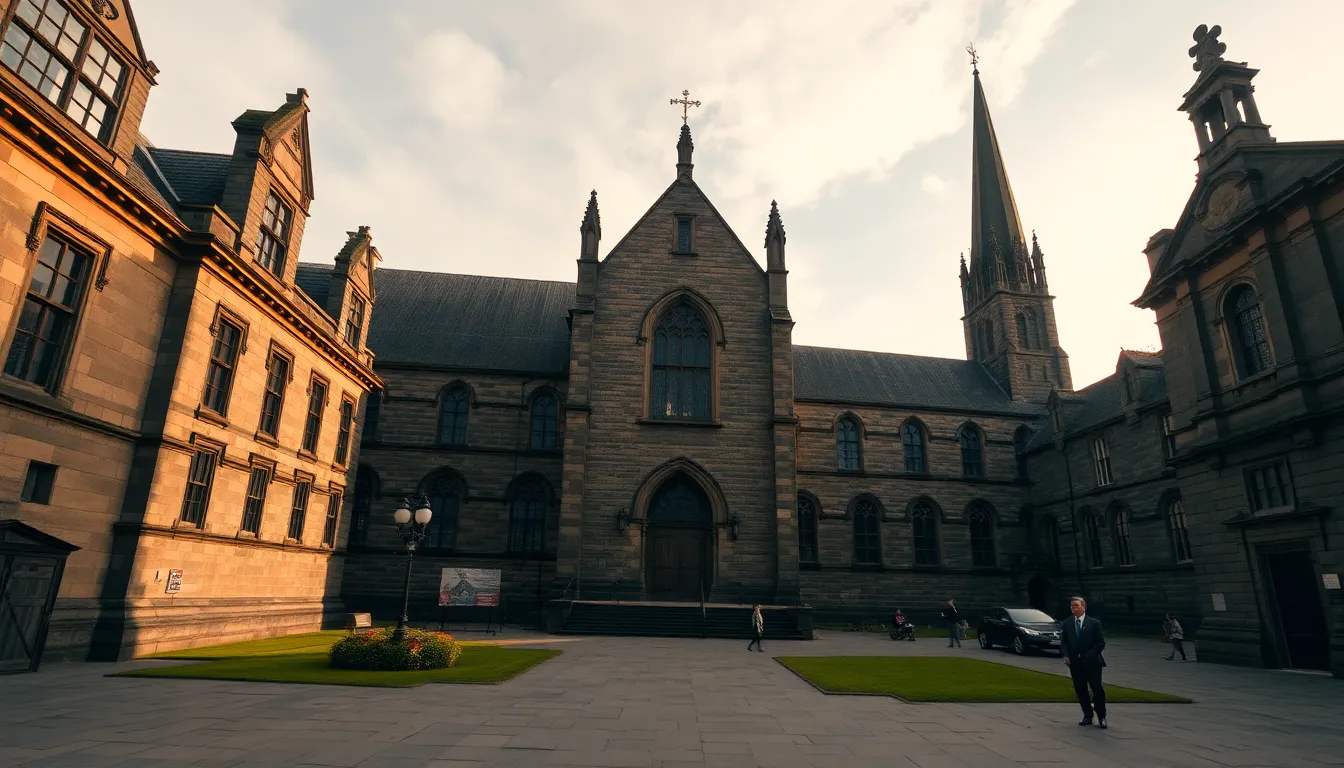
Where a Nation Put Its Name to a Promise
In the churchyard of Greyfriars Kirk in Edinburgh, on a day in late February 1638, hundreds of Scots gathered to sign a document that would change the course of their nation’s history. The National Covenant pledged its signers to defend the Reformed Presbyterian faith of Scotland against the attempts of King Charles I to impose bishops and an English-style prayer book on the Scottish church. Tradition holds that some signed in their own blood. I bring groups into this churchyard and tell them that the quiet space they are standing in was once filled with people putting their names, and in some cases their lives, on the line for the freedom to worship as conscience demanded.
Greyfriars Kirk is not the grandest church in Edinburgh. St Giles, up on the Royal Mile, carries more of the city’s ceremonial weight. But for a group that cares about religious liberty and the cost of conscience, Greyfriars is the more powerful site, because here the abstract idea of standing for your faith became a concrete act signed by ordinary people. The story that began with the Covenant in this churchyard runs through fifty years of struggle, persecution, and the grim Covenanters’ Prison that still stands within these very walls.
The National Covenant of 1638
To understand Greyfriars, a group needs the story behind the Covenant. The Scottish Reformation of 1560 had established a Presbyterian church, governed by elders and ministers rather than bishops, and many Scots held this form of church government as a matter of deep conviction. When Charles I tried to bring Scottish worship into line with the English church, introducing a new prayer book in 1637, the reaction was furious. Riots broke out in Edinburgh, and the opposition crystallized into the National Covenant.
The Covenant was first signed in Greyfriars Kirk on 28 February 1638, then copied and circulated across Scotland, where thousands more added their names. It was both a religious and a national statement, a declaration that the Scottish people would defend their church and their faith against royal interference. The signing set Scotland on a collision course with the crown that would feed into the wars of the three kingdoms and shape British history for a generation. For Protestant groups especially, the Covenant stands as one of the great moments in the long story of religious conscience.
The Covenanters and the Killing Time
The decades that followed were brutal. After the restoration of the monarchy in 1660, the crown again moved against Presbyterian worship, and those who held to the Covenant, the Covenanters, were hunted, fined, imprisoned, and killed. The worst years, the 1680s, became known as the Killing Time, when Covenanters were shot on the moors for refusing to abandon their open-air services. Greyfriars sits at the center of this story, both as the birthplace of the Covenant and as the site of one of its darkest chapters.
The Covenanters’ Prison
In 1679, after the Covenanter defeat at the Battle of Bothwell Bridge, around twelve hundred prisoners were held in an open field at Greyfriars, in conditions of terrible hardship, through the months that followed. Many died of exposure, starvation, and disease. Others were eventually shipped off, some to be lost at sea. The section of the churchyard where they were held is known to this day as the Covenanters’ Prison, a narrow walled enclosure that survives within the cemetery.
I take groups into the Covenanters’ Prison quietly, because it asks for a different mood than the rest of the churchyard. There is a memorial nearby, the Martyrs’ Monument, raised to those who died for the Covenant. Standing in that enclosed space, knowing what happened there, brings the cost of religious freedom home in a way that no lecture can. For many in a group, this is the moment the whole Reformation and Covenanter story stops being history and becomes something they feel.
Why Greyfriars Matters for a Christian Group
Greyfriars draws together the high ideal and the hard price of religious conscience in one place. The churchyard holds the spot where a nation pledged itself to defend its faith, and the prison where men paid for that pledge with their lives. For a group reflecting on religious liberty, on the freedoms many take for granted today, few sites speak more directly. I have watched groups grow very quiet here, and the conversations afterward are often the deepest of the whole trip.
The kirk itself, completed in 1620 as the first new church built in Edinburgh after the Reformation, is a working Church of Scotland congregation and welcomes visitors with a warmth that matches its history. Greyfriars sits within easy reach of the other great Reformation sites of Edinburgh, and it pairs naturally with the wider Covenanter story we trace in our guide to hidden heritage sites, with the Church of the Holy Rude in Stirling where James VI was crowned, and with Glasgow Cathedral. Together they let a group follow the Reformed faith from the Reformation itself through to the suffering of the Covenanters.
How Groups Visit Greyfriars Kirk
Greyfriars is one of the most accessible heritage sites in this whole story, which makes it a natural inclusion in any Edinburgh itinerary. The kirk and its churchyard sit just off the Grassmarket and Candlemaker Row, a short walk from the Royal Mile and the city’s other great sites, in the heart of the old town. A group can reach it on foot as part of a walking route through historic Edinburgh, with no remote roads or ferries to navigate.
Practical Access
The churchyard is open and free to enter, and the Covenanters’ Prison can usually be visited, though access to the enclosure itself is sometimes restricted and best confirmed in advance. The kirk is open to visitors and welcomes groups, with the congregation offering a genuine welcome to those who come to learn the story. The terrain is generally level within the churchyard, with some uneven ground underfoot as in any historic cemetery, so sensible footwear helps. Because the site lies in the busy heart of Edinburgh, I plan group visits with the timing in mind, and a little advance contact with the kirk ensures the building is open and any access to the prison is arranged. For a group, the combination of a free, central, deeply significant site is hard to better.
FAQ: Visiting Greyfriars Kirk and the National Covenant
What was the National Covenant?
The National Covenant was a document signed at Greyfriars Kirk in Edinburgh on 28 February 1638, pledging its signers to defend Scotland’s Reformed Presbyterian faith against King Charles I’s attempt to impose bishops and an English prayer book. It was copied and signed across Scotland by thousands. The signing set the nation on a collision course with the crown and stands as a landmark in the history of religious conscience.
What is the Covenanters’ Prison at Greyfriars?
It is a walled section of the Greyfriars churchyard where around twelve hundred Covenanter prisoners were held in the open in 1679, after their defeat at Bothwell Bridge. Many died of exposure and hardship. The enclosure survives within the cemetery, with a nearby Martyrs’ Monument to those who gave their lives. It is one of the most sobering sites in the whole Covenanter story.
Is Greyfriars easy for a group to visit?
Yes. The kirk and churchyard sit in the heart of Edinburgh’s old town, just off the Grassmarket, a short walk from the Royal Mile, so a group can reach it on foot with no remote travel involved. The churchyard is open and free to enter, and the kirk welcomes group visits. The ground is generally level, with the usual uneven patches of a historic cemetery, so sensible footwear helps.
Can a group visit the Covenanters’ Prison?
Usually, yes, though access to the enclosure itself is sometimes restricted, so we confirm it in advance. The wider churchyard, the Martyrs’ Monument, and the kirk are all freely accessible. We arrange any needed access ahead of a group visit and plan the timing around the busy heart of Edinburgh so the group can experience the site with the quiet it deserves.
How does Greyfriars fit into a Reformation tour?
It is a cornerstone. Greyfriars pairs naturally with St Giles and the other Reformation sites in Edinburgh, with the coronation church at Stirling, and with Glasgow Cathedral, and it opens directly into the wider Covenanter trail across southwest Scotland. Together these sites let a group follow the Reformed faith from the Reformation through to the Killing Time. We build itineraries that connect them with honest travel time.
If the story of the Covenant speaks to your group, I would be glad to help you plan it. Heritage Tours builds every itinerary around your community, and with 15 or more participants, the group leader travels free. Begin with our spiritual sites of the United Kingdom, our United Kingdom heritage destination, and our group heritage tours. When you are ready, contact us and we will shape the journey together.