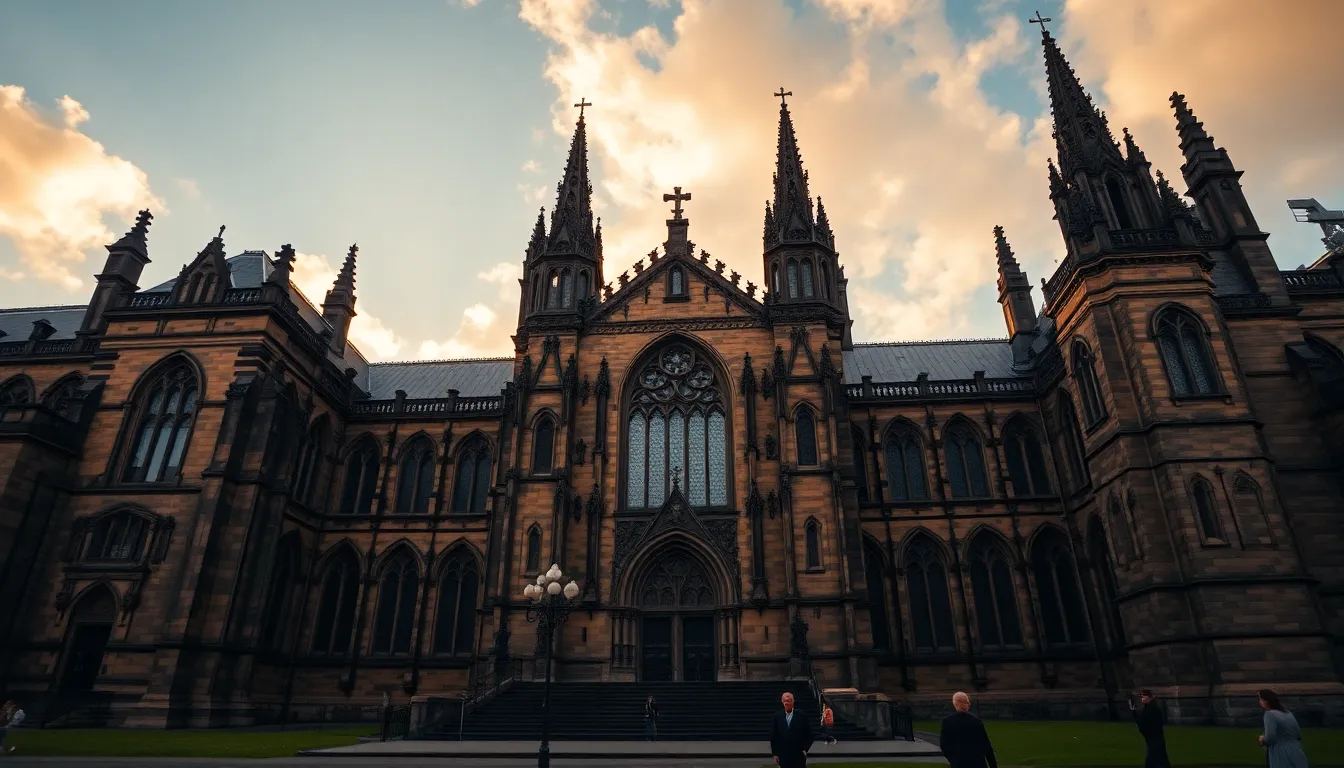
The Cathedral the Reformation Did Not Destroy
When I take a group into Glasgow Cathedral, I tell them to look at it as something close to a miracle of survival. Across Scotland, the Reformation of 1560 swept away most of the great medieval churches, leaving the romantic ruins that dot the country today. Glasgow Cathedral is different. It came through the Reformation almost entirely intact, the only medieval cathedral on the Scottish mainland to do so, which means a group standing in its nave is standing in a genuine pre-Reformation cathedral, the real thing rather than a reconstruction or a shell.
The cathedral is dedicated to Saint Mungo, also known as Saint Kentigern, the sixth-century missionary who founded the Christian community from which the whole city of Glasgow grew. Down in the lower church, the crypt, lies his tomb, the spiritual heart of the building and the reason the cathedral stands where it does. For a Christian group, Glasgow Cathedral offers a rare combination: an unbroken medieval building, the grave of a founding Celtic saint, and a story that runs from the dawn of Scottish Christianity to the present day.
Saint Mungo and the Founding of Glasgow
Mungo lived in the sixth century, in the same age as Columba on Iona, when the Gospel was spreading through the Celtic lands of the west. Tradition says he established his church on the banks of the Molendinar Burn, on the spot where the cathedral now stands, and that he was buried there. The settlement that grew around his church became Glasgow, and Mungo became its patron saint. The city’s coat of arms still carries the symbols associated with the miracles attributed to him, the bird, the tree, the bell, and the fish with the ring.
The name Mungo is an affectionate one, said to mean dear one, while Kentigern was his given name. Like Patrick and Columba, he belongs to that first generation of saints who carried the faith into the pagan lands of northern Britain. Whatever the precise history behind the traditions, the continuity of the site is remarkable. There has been Christian worship on this spot for around fifteen centuries, an unbroken thread from Mungo’s first church to the cathedral congregation that gathers there today.
The Tomb in the Lower Church
The crypt, or lower church, of Glasgow Cathedral is one of the finest medieval interiors in Scotland, a forest of stone pillars and vaulting that draws the visitor down toward the tomb of Saint Mungo at its center. This was the focus of medieval pilgrimage to Glasgow, the destination for the faithful who came to honor the city’s founder. To descend into the crypt and stand at the tomb is to reach the very root of the cathedral and the city alike. Groups often find this the most moving moment of the visit, the place where the long story comes to rest.
The Cathedral Through the Reformation and Beyond
How did Glasgow Cathedral survive when so many others fell? The usual account credits the citizens and the trade guilds of Glasgow, who valued the building too highly to let it be torn down when the Reformers turned against the old churches. Where elsewhere mobs and authorities stripped and demolished, here the cathedral was preserved and turned to Reformed Protestant worship, which it has served ever since as a church of the Church of Scotland.
The building a group sees today is largely the work of the thirteenth and fourteenth centuries, a great Gothic cathedral with its tall nave, its central tower and spire, and the remarkable lower church below. It has hosted royalty, survived the upheavals of Scottish history, and remained a working place of worship throughout. That combination of survival and continuity is what makes it so valuable to a heritage group, since it allows a direct encounter with medieval Scottish Christianity that few other sites can offer.
Why Glasgow Cathedral Matters for a Group
For a Christian group, Glasgow Cathedral ties together two strands that often sit apart on an itinerary. There is the ancient Celtic story, embodied in Mungo’s tomb and the founding of the city, which connects to the wider tale of Columba, Patrick, and David across these islands. And there is the Reformation story, embodied in a building that came through that upheaval intact and was given over to Reformed worship. A group can trace both within a single building, which is a rare gift.
The cathedral also makes a natural anchor for a Glasgow and central Scotland itinerary. It pairs well with the Reformation sites at Stirling, including the Church of the Holy Rude where James VI was crowned, and with the Covenanter story we trace at Greyfriars Kirk in Edinburgh. Read alongside the early Celtic sites in our guide to hidden heritage sites, it helps a group see how the Scottish faith story holds together from the sixth century to the seventeenth and beyond.
How Groups Visit Glasgow Cathedral
Glasgow Cathedral is one of the easier major sites to bring a group to, which is welcome in a country where so many treasures lie down remote lanes. It sits in the heart of Glasgow, near the medieval core of the city, well served by roads and within reach of coach access and parking. The cathedral is cared for as a historic site and is open to visitors through the year, with the lower church and the tomb of Saint Mungo accessible to all who come.
Practical Access
Entry to the cathedral is generally free, with donations welcomed, which makes it an easy fit for any budget. The main floor is largely accessible, though the crypt is reached by steps, so any group with members of limited mobility should plan for that descent. The cathedral welcomes group visits and, with advance arrangement, can accommodate a short act of worship, which works beautifully under the medieval vaulting. The neighboring Necropolis, the great Victorian cemetery on the hill behind, and the nearby St Mungo Museum of Religious Life add further depth for a group with time to give. As with any working church, a little advance contact ensures the building is open and ready when the group arrives.
FAQ: Visiting Glasgow Cathedral and the Tomb of Saint Mungo
Why is Glasgow Cathedral special among Scottish cathedrals?
It is the only medieval cathedral on the Scottish mainland to survive the Reformation of 1560 largely intact, when most others were ruined or demolished. This means a group stands in a genuine pre-Reformation building rather than a reconstruction. The citizens and trade guilds of Glasgow are credited with saving it, and it has served as a Church of Scotland congregation ever since.
Who was Saint Mungo?
Mungo, also called Saint Kentigern, was a sixth-century missionary who founded the Christian community that grew into the city of Glasgow. He is its patron saint, and his tomb lies in the crypt of the cathedral, on the spot where he is said to have established his first church. The symbols of his miracles still appear on Glasgow’s coat of arms.
Can a group see the tomb of Saint Mungo?
Yes. The tomb lies in the lower church, or crypt, one of the finest medieval interiors in Scotland. It was the focus of medieval pilgrimage to Glasgow and remains accessible to visitors today. The crypt is reached by steps, so groups with members of limited mobility should plan for the descent. Many groups find the tomb the most moving moment of the visit.
Is Glasgow Cathedral easy to reach for a group?
Very. It sits in the heart of Glasgow, near the medieval core, with good road access and parking within reach. The cathedral is open through the year, entry is generally free with donations welcomed, and the main floor is largely accessible. Nearby attractions like the Necropolis and the St Mungo Museum add depth for groups with extra time.
Can Glasgow Cathedral be combined with other Scottish sites?
Easily. It anchors a Glasgow and central Scotland itinerary and pairs well with the Reformation sites at Stirling and the Covenanter story in Edinburgh. It also connects to the wider Celtic saints story alongside Iona and the early sites. We build itineraries that link these naturally, with honest travel time so the group is never rushed.
If Glasgow Cathedral fits the journey you have in mind, I would be glad to help you plan it. Heritage Tours builds every itinerary around your community, and with 15 or more participants, the group leader travels free. Begin with our spiritual sites of the United Kingdom, our United Kingdom heritage destination, and our group heritage tours. When you are ready, contact us and we will shape the journey together.