The City That Welcomed the Stranger
People who have never been tend to picture Glasgow as Edinburgh’s rougher cousin, the industrial city next door. I tell my groups to set that picture aside before we arrive. Because Glasgow is, to my mind, one of the richest cities in these nations for a faith heritage trip, precisely because of who it took in. This was a city built by people who came from somewhere else, Highlanders pushed off their land, Irish families fleeing famine, Jewish families fleeing the pogroms of Eastern Europe. Glasgow’s faith story is a story of arrival.
I have led groups here for years, and what moves me every time is how the layers sit on top of one another. You can stand at a medieval cathedral founded around the tomb of a sixth-century saint, then drive twenty minutes to a synagogue that immigrant families raised within a generation of stepping off the boat with nothing. That span, from the Celtic mission to the modern immigrant congregation, is the whole heritage of these nations compressed into one city. This guide walks you through the layers and gives you what you need to lead your group well.
The Cathedral and St Mungo
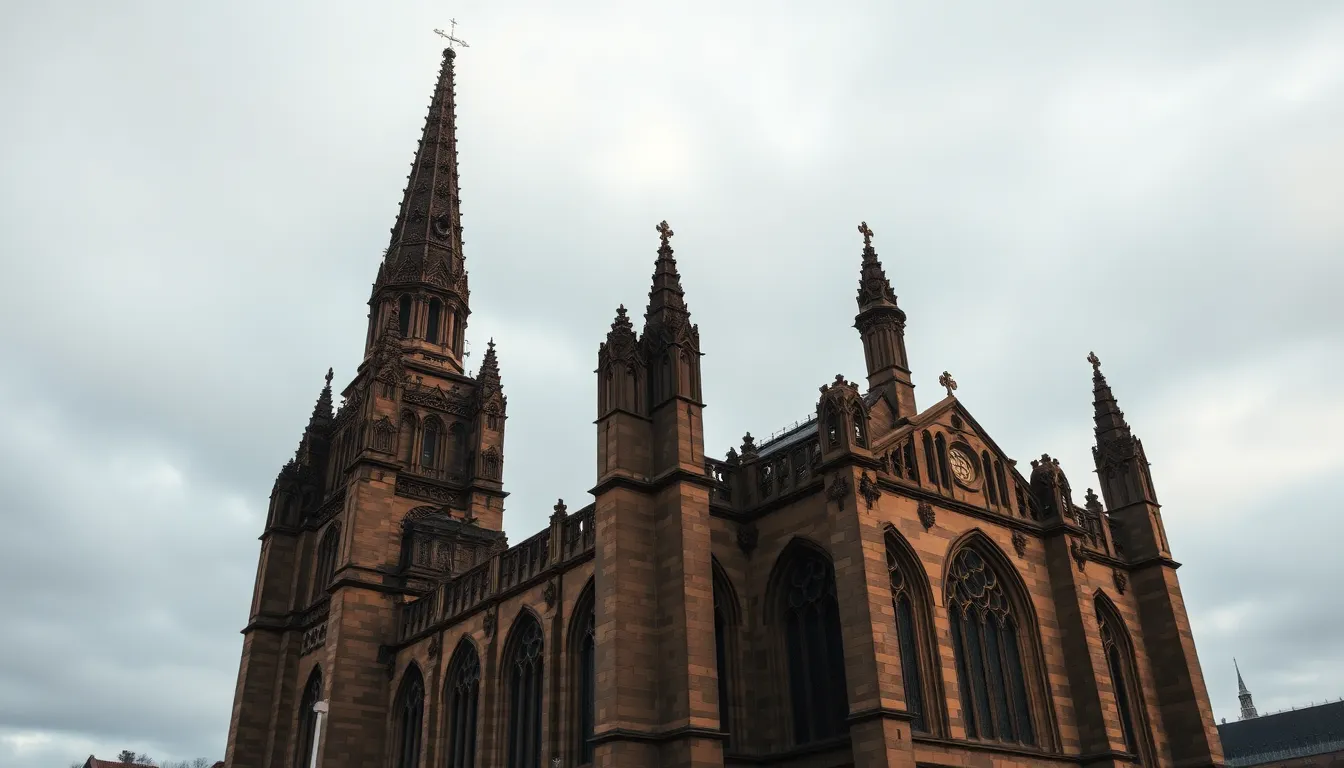
Glasgow Cathedral is where I begin, and it is one of the few medieval cathedrals in Scotland to survive the Reformation more or less intact. That alone makes it worth the visit. But the deeper reason to come is the man buried beneath it. Saint Mungo, also called Kentigern, was the sixth-century missionary who founded the Christian community here, and the city quite literally grew up around his church and his tomb. The lower church, where his shrine sits, is a dim, vaulted, ancient space, and I have watched more than one group fall silent the moment they walk down into it.
Mungo belongs to the oldest layer of faith in these nations, the Celtic Christianity that arrived by sea and spread through wandering missionary monks. He is part of the same world as Columba on Iona, and standing at his shrine is a chance to connect Glasgow to that ancient story. Our guide to Iona and Celtic Christianity carries that thread out to the island where the Scottish mission began.
Beside the cathedral, the Necropolis rises on a hill, a Victorian city of the dead with monuments looking down over the cathedral and the city. It is worth the climb for the view and for what it says about how Glasgow honored its faith and its civic pride. And just across the way, the St Mungo Museum of Religious Life and Art is a thoughtful stop for groups interested in how the city has held many faiths under one roof.
The Jewish Community: Garnethill and the Gorbals
Glasgow’s Jewish heritage is, for my money, the most rewarding in all of Scotland, and for a synagogue group it is the heart of the trip.
Garnethill Synagogue
Garnethill, opened in 1879, is the oldest purpose-built synagogue in Scotland, and it is a beautiful building, a confident statement by a community that had arrived and meant to stay. Walking in, you feel the ambition of those founding families, immigrants and their children who, within a few decades of reaching Scotland, raised a synagogue this fine. The building also houses the Scottish Jewish Archives Centre, which means a group can connect the architecture to the actual records and stories of the families who built it. I always try to arrange time here, because for many of my travelers this is family history made visible.
The Gorbals
To understand where that community started, you go to the Gorbals, the district on the south bank of the Clyde where most of Glasgow’s Jewish immigrants first settled. In its heyday the Gorbals was a dense, poor, vibrant neighborhood packed with Jewish families alongside Irish and Highland incomers, with synagogues, kosher shops, and Hebrew schools woven through the tenements. Much of the old Gorbals was cleared and rebuilt in the twentieth century, so what you see today is changed, but a good guide can walk your group through what was there and how that community lived, worked, and eventually moved south and prospered.
It is the same arc you find across these nations, a small congregation arriving with little and building something durable fast, and the Gorbals is one of its clearest chapters. Our overview of Jewish heritage across Scotland, Wales, and Northern Ireland sets Glasgow’s story alongside Cardiff and Belfast.
The Reformation and Presbyterian Glasgow
Glasgow was also a stronghold of the Scottish Reformation and the Presbyterian faith that grew from it. The city and its university were centers of Protestant thought, and the surrounding countryside of southwest Scotland was deep Covenanter territory. For Protestant groups, Glasgow is a natural base for reaching into the Covenanter heartland of Ayrshire and the southern uplands, where ordinary believers suffered and died for the right to worship as their conscience demanded.
This is the layer that, generations later, sent Scottish Presbyterians across the Atlantic in great numbers, carrying their faith and their forms of worship into congregations that still bear the mark. For groups tracing that story, Edinburgh holds the urban Reformation heart and Glasgow opens the door to the rural Covenanter country. Our Edinburgh heritage guide covers the city where it began at St Giles and Greyfriars.
Practical Notes for Group Leaders
A few things I tell every group leader planning Glasgow.
First, Glasgow is spread out in a way Edinburgh is not. The cathedral sits at one edge of the center, the Jewish heritage sites lie to the west and south, and you will move between them by coach rather than on foot. This is good news for mixed-age groups, since the walking at each site is manageable, but it means the day needs to be planned around the driving.
Second, synagogue and some church visits need arranging in advance. Garnethill and the Scottish Jewish Archives Centre are not always open to drop-in visitors, so access has to be booked ahead. This is exactly the kind of logistics a heritage operator handles, and it is worth getting right, because a community that arrives to a locked door has lost the heart of the day.
Third, Glasgow pairs naturally with Edinburgh, an easy journey apart, and with the Covenanter country to the south. Few groups come to Glasgow alone. Our United Kingdom heritage travel guide lays out how to build the full Scottish journey.
Fourth, the right operator makes the difference between a sightseeing day and a heritage encounter. A heritage tour is not a standard coach trip. You need someone who understands why your group is here, who can open the doors at Garnethill, brief the group on St Mungo and the Gorbals, arrange worship or reflection at the right moments, and handle the logistics so you can lead your people. At Heritage Tours, we build every itinerary around what matters to your specific community, and with 15 or more participants, the group leader always travels free.
If Glasgow is calling to your group, I would love to talk about what the visit could look like. Start by exploring our United Kingdom heritage destination and our group heritage tours. There is no obligation, just a conversation about what is possible.
FAQ: Glasgow Heritage Travel for Faith Groups
What are the most important faith heritage sites in Glasgow?
For most faith groups, the core stops are Glasgow Cathedral with the shrine of Saint Mungo in the lower church, Garnethill Synagogue, the oldest purpose-built synagogue in Scotland and home to the Scottish Jewish Archives Centre, and the Gorbals, the district where the city’s Jewish immigrants first settled. Together they span the full arc of faith in these nations, from the sixth-century Celtic mission to the modern immigrant congregation.
Why is Glasgow significant for Jewish heritage groups?
Glasgow holds the richest Jewish heritage in Scotland. Garnethill Synagogue is a beautiful nineteenth-century building raised by immigrant families within decades of their arrival, and the Scottish Jewish Archives Centre inside it lets groups connect to the actual records and stories of those families. The Gorbals shows where the community began, in the crowded tenements south of the Clyde.
Do I need to book the synagogue and archive visits in advance?
Yes. Garnethill Synagogue and the Scottish Jewish Archives Centre are not always open to drop-in visitors, so access must be arranged ahead of time. Coordinating these visits is part of what a heritage operator handles, which is one reason groups rarely try to do Glasgow on their own.
How does Glasgow fit into a wider Scottish trip?
Glasgow pairs naturally with Edinburgh, a short journey away, and serves as a base for reaching the Covenanter country of southwest Scotland. Most groups combine Glasgow and Edinburgh and add the surrounding heritage rather than visiting Glasgow alone. A typical Scottish heritage trip runs seven to nine days.
Do group leaders really travel free?
Yes. When your group includes 15 or more participants, the group leader travels free on all Heritage Tours group itineraries, including Glasgow and the wider Scottish journey. It is our way of honoring the work that pastors, rabbis, and educators put into bringing their communities together for these experiences.