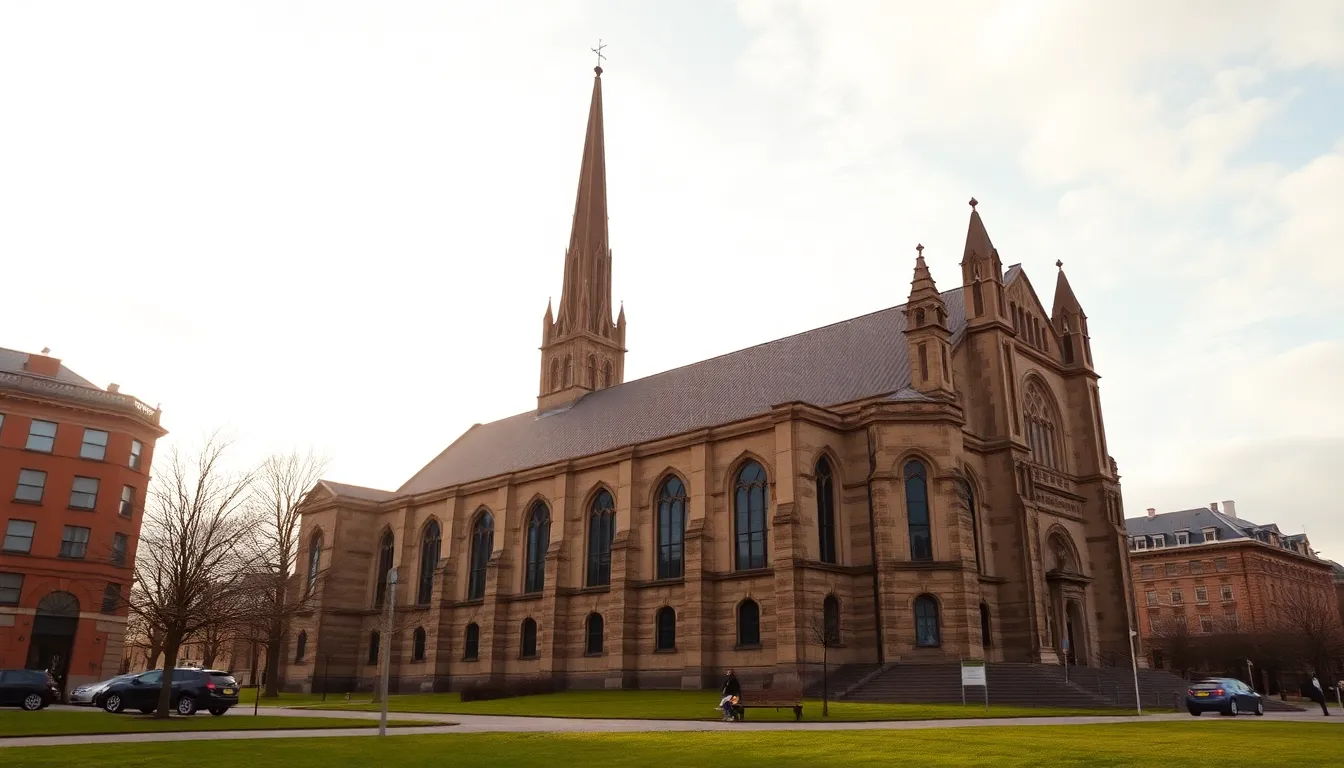
A City That Surprises Faith Groups
Belfast is the stop that group leaders most often arrive at unsure about, and most often leave grateful for. People come carrying the headlines they remember, and they are not wrong that this is a city shaped by hard history. But the Belfast a heritage group encounters is something else, a city of churches and chapels on nearly every corner, a powerful Presbyterian tradition that shaped both Ireland and America, and a small Jewish community that, against all odds, gave the modern State of Israel one of its presidents. Belfast rewards the group that comes with an open mind.
I have led groups across Northern Ireland for years, and what strikes me about Belfast is the density of faith in the fabric of the city. This was a place built by Protestant Scots and English settlers, and the Presbyterian and Anglican traditions ran deep into its civic and commercial life. Layered on top is the Jewish story, smaller than Glasgow’s but carrying a connection to Israel that no other city in these nations can match. This guide walks you through the layers and gives you what you need to lead your group well.
The Cathedrals
Belfast’s cathedrals anchor a group’s orientation to the city’s Christian heritage.
St Anne’s Cathedral
St Anne’s, the Church of Ireland cathedral in the heart of the city, is the building most groups visit first. Its most striking feature is modern: the Spire of Hope, a slender stainless steel spire added in 2007 that rises from the roof and can be seen across the city. I find it a fitting symbol for Belfast, an ancient form pointing upward, raised in a city that has worked hard toward peace. Inside, the cathedral is dignified and welcoming, and it gives a group a calm place to begin understanding the city’s Christian story.
St Peter’s and the Wider Church City
Belfast holds cathedrals and major churches across its traditions, Anglican, Catholic, and the Presbyterian and other Protestant churches that defined the city. Part of orienting a group here is simply helping them see how thoroughly faith is built into Belfast, with substantial churches in nearly every district. A good guide reads the city’s church architecture as a map of its communities and their histories.
The Presbyterian Heritage
If there is one faith tradition that defines Belfast and Northern Ireland for a heritage group, it is Presbyterianism. This part of Ireland was settled in the seventeenth century by Scots Presbyterians, the same tradition that produced the Scottish Reformation, John Knox, and the Covenanters. They brought their faith, their forms of worship, and their fierce attachment to the right to worship as their conscience demanded, and that tradition became the backbone of Ulster’s Protestant life.
For Protestant groups, especially American ones, this is where Belfast becomes personal. The Scots-Irish Presbyterians who settled Ulster emigrated in great numbers to America in the eighteenth century, carrying their faith into the new country and shaping Presbyterian and frontier Christianity there. Many American families trace their roots and their religious heritage to exactly this stream. Standing in Belfast, a group with that ancestry is standing at the source. The story connects directly back across the sea to the Scottish Reformation, which our Edinburgh heritage guide covers at St Giles and Greyfriars, and to the wider Presbyterian world of Glasgow.
The Jewish Community of Belfast
Belfast’s Jewish community is small, but it holds one of the most remarkable stories in all of these nations, and for a synagogue group it is the heart of the Belfast visit.
A Jewish community established itself in Belfast in the nineteenth century, growing as families arrived from Eastern Europe fleeing persecution. They built synagogues, opened businesses, and made their life in the industrial city. What sets Belfast apart is what that small community produced. Chaim Herzog, who became the sixth President of the State of Israel, was born in Belfast in 1918, where his father served as the city’s rabbi before going on to become Chief Rabbi of Ireland and later of Israel. For a synagogue group, to stand in the city where a future President of Israel was born and raised is living family history of an extraordinary kind.
The community has shrunk over the years, as smaller Jewish communities across these islands have, but its story is well preserved, and a knowledgeable guide can walk your group through where the community lived and what it achieved. It is the same arc you find across these nations, a small congregation arriving with little and building something durable and far-reaching. Our Cardiff heritage guide sets Belfast’s chapter alongside the Jewish heritage of Wales and Scotland.
Beyond Belfast: The Wider Northern Ireland Story
Belfast works best as a base for reaching the wider heritage of Northern Ireland, and a few connections are worth knowing.
To the west lies Armagh, the ancient ecclesiastical capital and the heart of Saint Patrick’s mission, which belongs to the oldest Celtic Christian layer of faith in these nations. A heritage trip that bases in Belfast can reach Armagh to add that deep root to the Presbyterian and Jewish layers of the city. And the wider landscape of Northern Ireland connects to the broader Irish Christian story that runs across the whole island. Our United Kingdom heritage travel guide lays out how Belfast fits into a journey that can also reach Scotland by a short ferry crossing.
Practical Notes for Group Leaders
A few things I tell every group leader planning Belfast.
First, Belfast is compact and walkable in its center, which suits mixed-age groups, but the wider sites like Armagh require a coach and a planned travel day. The city itself is easy. Reaching out from it takes planning.
Second, Belfast pairs naturally with Scotland by ferry and with the Republic of Ireland to the south. Few groups visit Belfast alone. It works as part of a wider journey, and the short sea crossing from Scotland makes a combined Scotland and Northern Ireland trip very doable. Distances on the island are modest, so a Belfast-based itinerary can cover a lot.
Third, synagogue and some church visits need arranging in advance. Belfast’s small Jewish community and some of its churches are not open to drop-in visitors, so access must be coordinated ahead. A heritage operator handles this so your group arrives to open doors and a guide who can tell the story.
Fourth, the right operator makes the difference between a sightseeing day and a heritage encounter. A heritage tour is not a standard coach trip. You need someone who understands why your group is here, who can arrange worship at the right moments, brief the group on the Presbyterian emigration story or the Herzog connection, and handle the logistics so you can lead your people. At Heritage Tours, we build every itinerary around what matters to your specific community, and with 15 or more participants, the group leader always travels free.
If Belfast and the Northern Ireland story are calling to your group, I would love to talk about what the trip could look like. Start by exploring our United Kingdom heritage destination and our group heritage tours. There is no obligation, just a conversation about what is possible.
FAQ: Belfast Heritage Travel for Faith Groups
What are the most important faith heritage sites in Belfast?
For most faith groups, the core stops are St Anne’s Cathedral with its Spire of Hope, the city’s deep Presbyterian heritage rooted in the seventeenth-century Scots settlement, and the Jewish community whose most famous son, Chaim Herzog, became the sixth President of the State of Israel. Belfast also serves as a base for reaching Armagh and the wider Saint Patrick story to the west.
Why is Belfast significant for Presbyterian and Scots-Irish groups?
Northern Ireland was settled in the seventeenth century by Scots Presbyterians, and their descendants, the Scots-Irish, emigrated to America in large numbers in the eighteenth century, shaping Presbyterian and frontier Christianity there. For American Protestant groups with that ancestry, Belfast is the source of a religious heritage they may trace in their own family histories.
What is the Belfast connection to the State of Israel?
Chaim Herzog, the sixth President of Israel, was born in Belfast in 1918, where his father served as the city’s rabbi and later became Chief Rabbi of Ireland and then of Israel. For a synagogue group, standing in the city where a future President of Israel was born is a uniquely powerful piece of living history.
How does Belfast fit into a wider trip?
Belfast pairs naturally with Scotland by a short ferry crossing and with the Republic of Ireland to the south. It serves as a base for reaching Armagh and the wider Northern Ireland heritage. Few groups visit Belfast alone. A combined Scotland and Northern Ireland trip usually runs nine to twelve days.
Do group leaders really travel free?
Yes. When your group includes 15 or more participants, the group leader travels free on all Heritage Tours group itineraries, including Belfast and the wider Northern Ireland journey. It is our way of honoring the work that pastors, rabbis, and educators put into bringing their communities together for these experiences.