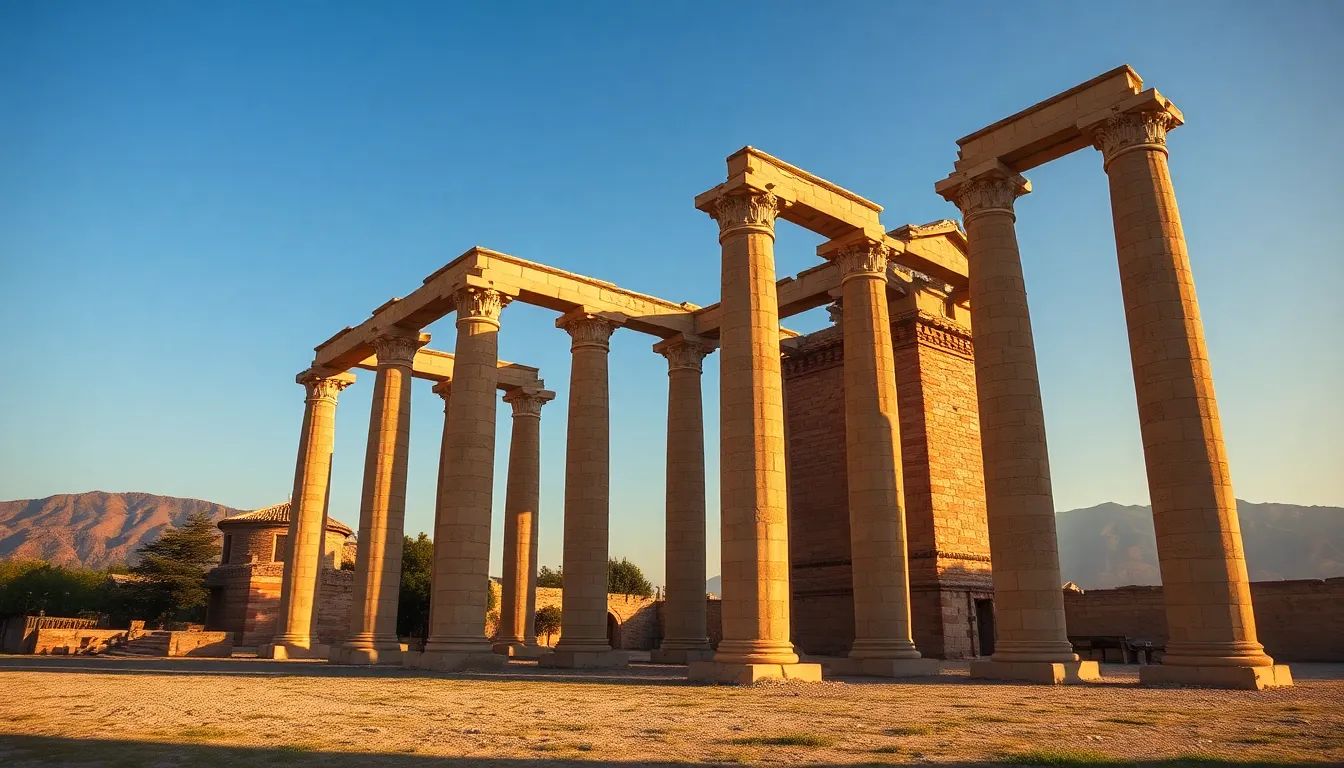
I will be honest with my groups before we arrive at Philadelphia, because honesty makes the stop better, not worse. There is not much left to see. A few tall brick pillars from a Byzantine basilica, standing in the middle of a busy modern town. If you came here expecting Ephesus, you would be disappointed. But that is exactly why I love bringing faith groups here. Philadelphia is the church that received almost nothing but praise, and the city that bears its memory has almost nothing left to show. The lesson sits in that tension, and once a group sees it, they never forget the place.
Of the seven letters in Revelation, only two contain no rebuke at all. Smyrna is one. Philadelphia is the other. This is the church Jesus tells, “I have placed before you an open door that no one can shut.” For a pastor or rabbi leading a heritage group, standing on this ground is a chance to talk about faithfulness in a small, overlooked, pressured community. That is most of the congregations we serve.
Here is what to expect and how to make the visit count.
The Letter of the Open Door
Take time with Revelation 3:7 to 13 before you go, because the letter is the reason to come.
Philadelphia was not a powerful city. The church there had, in the words of the letter, “little strength.” But it had kept Christ’s word and had not denied his name. For that faithfulness it received one of the most generous promises in all of Revelation: an open door no one can shut, protection through the hour of trial, and a place as a pillar in the temple of God.
That last image would have struck home hard. Philadelphia sat in earthquake country, and a massive quake in AD 17 leveled the city. People had fled their homes and lived in the open for fear of aftershocks. When the letter promises that the faithful will become “a pillar in the temple of my God” and “will never again leave it,” every listener knew what it meant to watch buildings fall and walls crack. A pillar that stands when everything else collapses was not an abstraction here. It was the deepest reassurance the city could imagine.
The Name That Outlived Two Empires
There is a detail your group will appreciate. The letter says the faithful will have written on them “the name of my God and the name of the city of my God, the new Jerusalem.”
Philadelphia took that to heart. It was one of the last Christian strongholds in Asia Minor, holding out as a free Christian city long after the surrounding region had passed to other rule. For a long stretch it stood almost alone as a Christian outpost. The church of the open door kept that door open for centuries longer than anyone would have guessed from its small size. When you stand among the few surviving pillars and tell that story, the modest ruins start to look like the point rather than a letdown.
What Survives at Alasehir Today
Ancient Philadelphia is buried under the modern town of Alasehir, so there is no sprawling archaeological park here. What remains is concentrated and worth seeing for what it represents.
The Pillars of the Basilica of St. John
The main remains are several tall brick piers from a Byzantine basilica dedicated to St. John, dated to around the sixth century. They rise out of an excavated area in the middle of town, with fragments of fresco still clinging to the brick in places. These pillars are the natural gathering point for a group. There is a quiet symmetry in reading a letter that promises the faithful will become pillars in God’s temple while standing beneath the literal pillars that outlasted the city around them.
The Town and Its Setting
Alasehir is a working Turkish town surrounded by vineyards, set against the slopes that made this earthquake-prone but fertile country. Part of the value of stopping here is seeing that the church of Revelation was planted in ordinary places where ordinary people lived and worked, not only in grand cities. Walking a short way through the town to reach the pillars puts the letter in a real, lived setting.
How I Lead a Group at Philadelphia
The visit is short, so I keep it focused.
Gather at the basilica pillars and read Revelation 3:7 to 13 aloud. Then I usually say a few words about the two churches that received no rebuke, and ask the group why they think a small, weak congregation earned such a promise. That question opens up real conversation, because most of the people I travel with lead exactly those kinds of communities.
Leave room for a short devotional. Philadelphia is one of the best stops on the circuit for encouragement rather than warning. After Sardis and Laodicea, which both carry hard words, your group will feel the shift, and it is worth naming.
I also like to point out the line about the open door alongside something practical the city knew well. Philadelphia was founded as a kind of gateway, a frontier town meant to spread Greek culture and language into the regions beyond it. The city sat on a road that opened the way east. So when the letter speaks of an open door set before this small church, the people heard it as their own civic purpose redeemed. The town existed to be a doorway. The letter tells the church that its real open door was the one Christ had set before it, and that no power on earth could shut it. That connection between the city’s reason for being and the promise it received gives a group something concrete to hold.
For how this fits the wider circuit, see our guide to the spiritual sites of Turkey, our companion piece on Sardis, the church called alive, and our overview of Paul’s footsteps in Turkey.
Practical Notes for Group Leaders
Philadelphia is an easy stop in terms of access. The pillars sit at ground level in town, the walking is short and flat, and there are no steep climbs, which makes it comfortable for a mixed-age group. Because the visit is brief, most itineraries pair it with Sardis on the same day, since the two sit relatively close together on the Seven Churches loop.
A group leader traveling with fifteen or more usually goes free on our group itineraries. The thing I would stress most for Philadelphia is to set expectations in advance. A group that arrives knowing the ruins are modest, and knowing why that fits the story so well, has a far better experience than one expecting a major site. Lead the meaning first, and the place delivers.
FAQ: Visiting Philadelphia, the Church of Revelation 3
Why is Philadelphia called the church of the open door?
In Revelation 3:7 to 13, Jesus tells the church, “I have placed before you an open door that no one can shut.” It is one of only two of the seven churches, along with Smyrna, that receives no rebuke. The church had little strength but had kept Christ’s word, and the open door symbolized opportunity and security that no power could close.
Where is ancient Philadelphia and what is it called now?
Ancient Philadelphia lies beneath the modern town of Alasehir in western Turkey, inland from Izmir. Faith groups visit it as part of a Seven Churches of Revelation circuit, usually paired with nearby Sardis on the same day.
What is there to see at Philadelphia today?
The main remains are several tall brick pillars from a sixth-century Byzantine basilica of St. John, set in an excavated area in the center of Alasehir. There is no large archaeological park. The site is modest, which fits the story of a small but faithful church remembered for endurance rather than grandeur.
Why did the promise about a pillar matter so much to Philadelphia?
Philadelphia sat in earthquake country and was devastated by a major quake in AD 17, after which residents lived in the open for fear of aftershocks. The promise that the faithful would become “a pillar in the temple of my God” who “will never again leave it” spoke directly to a city that had watched its buildings collapse.
Is Philadelphia an easy stop for older travelers?
Yes. The pillars are at ground level in town with short, flat walking and no climbs, making it one of the more accessible sites on the Seven Churches circuit.
Philadelphia is a small stop with an outsized message, and groups often find it one of the most encouraging moments of the journey. If you are planning a Seven Churches trip for your congregation, I would be glad to help you build it well. See how we structure these journeys on our Turkey heritage page or explore our group heritage tours.
Contact us whenever you are ready to start the conversation.