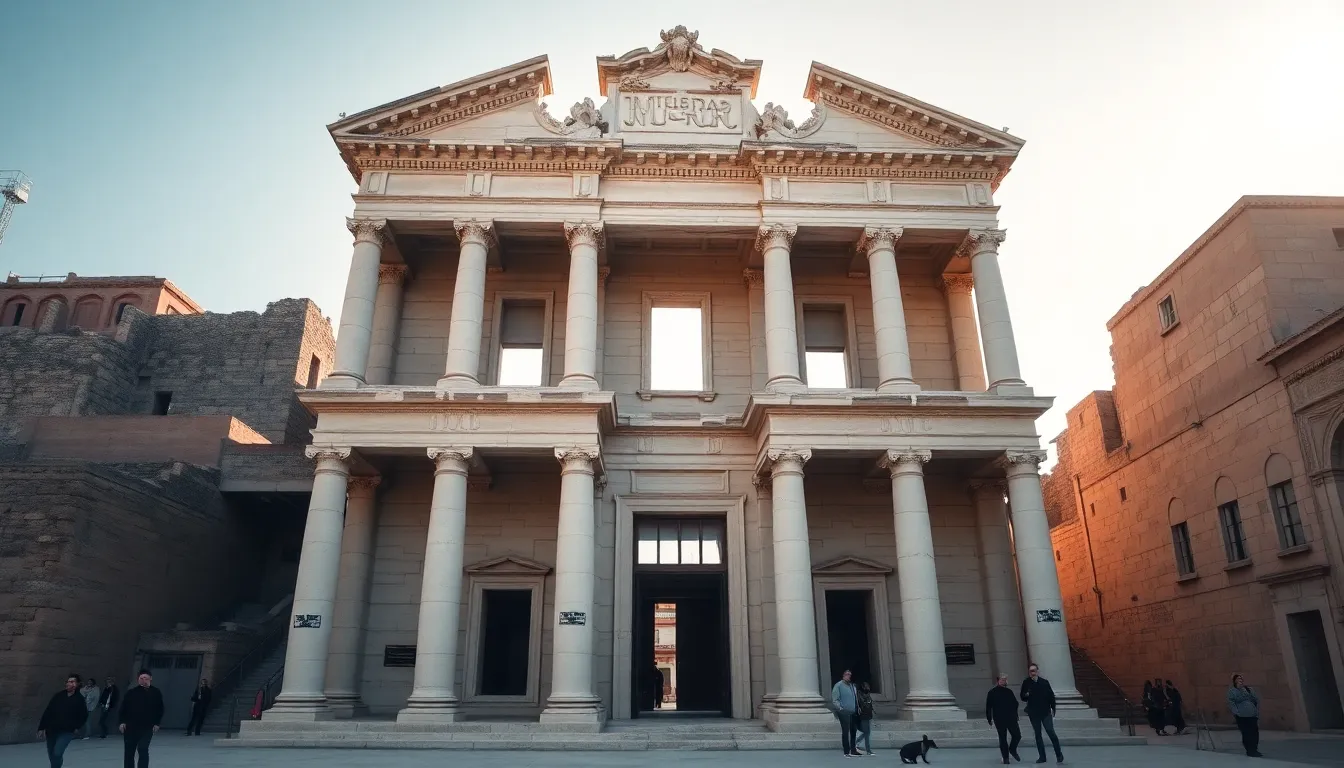
Every group I bring to Ephesus has the same reaction at the same spot. We come down the marble main street, the Curetes Way, and the Library of Celsus appears at the end of it, two stories of columns and statues glowing in the sun. People stop walking. Cameras come out. And then I tell them the part that changes how they see it: Paul walked this same street. The library went up a few decades after he left, but the city around it, the theater, the agora, the harbor road, is the Ephesus he knew for three years.
This is the most photographed ruin in Turkey for good reason, but for a faith group it is far more than a photo. It is the stage where some of the most dramatic scenes in Acts played out. Let me walk you through it.
What the Library of Celsus Is
The Library of Celsus was completed around 117 AD as a monument and tomb. A Roman official named Tiberius Julius Celsus Polemaeanus, who had governed the province of Asia, was buried in a crypt directly beneath it, and his son built the library above as a memorial. That alone tells a group something about Ephesus: this was a wealthy, sophisticated city where a man could be honored with a building full of books.
The facade is the wonder. It was designed with deliberate optical tricks, the base steps up slightly in the middle and the columns at the ends are larger, all to make the front look wider and grander than it is. Four statues in the niches represent Wisdom, Knowledge, Intelligence, and Virtue. At its height the library held thousands of scrolls in a reading hall protected from damp by a clever double wall.
The facade you see today was carefully reassembled from fallen pieces in the 1970s, which is why it stands so complete while much of the rest of the city lies in fragments. It has become the symbol of Ephesus, and it deserves the attention, but it is only one stop on a much larger walk.
The City Paul Knew
For a faith group, the deeper significance is the city itself. Paul arrived in Ephesus around 52 AD and stayed nearly three years, longer than almost anywhere else on his journeys. This was the third or fourth largest city in the Roman world, a port of perhaps a quarter million people, and the center of worship for the goddess Artemis.
Two stops bring the book of Acts to life. The first is the Great Theater, a vast semicircle cut into the hillside that seated around twenty-five thousand and still stands. This is where the riot of Acts 19 erupted. When Paul’s preaching threatened the trade in silver Artemis shrines, a silversmith named Demetrius stirred up the crowd, and the whole city poured into this theater chanting “Great is Artemis of the Ephesians” for two hours. Standing in that theater, a group can feel the scale of what Paul was up against.
The second is the harbor road, the Arcadian Way, which once ran from the theater to the docks. Ephesus was a sea power, and this is how the gospel traveled out from here to the wider Mediterranean. The harbor has long since silted up and the sea is now miles away, but the road is still there.
This is the ground where the Letter to the Ephesians was first received and where, tradition holds, John later ministered and wrote. For the broader collection of these sites, see our hidden heritage sites guide.
Walking the Wider Ruins
Ephesus rewards a group that walks it slowly and in order. The standard route enters at the upper gate and descends, which is easier on the legs and tells the city’s story well.
Coming down the Curetes Way, your group passes the remains of temples, fountains, and public buildings, with the Terrace Houses on one side. These were the homes of wealthy Ephesians, and the preserved mosaics and frescoes inside are some of the finest anywhere, well worth the small extra ticket. The street ends at the Library of Celsus and the adjoining commercial agora, the marketplace at the heart of city life.
From there the route turns onto the marble street toward the Great Theater and the harbor road. Along the way are public latrines, the remains of brothels and bathhouses, and the ordinary fabric of a Roman city, which I find helps a group picture the real world Paul stepped into, not a sanitized one.
The site connects naturally to the cluster of Christian sites nearby. Above Selcuk stands the Basilica of St. John at his traditional tomb, and a short drive away is the House of the Virgin Mary. Together with the ruins they make a full Ephesus-area journey.
How Groups Visit Ephesus
Here is how I run an Ephesus day.
We start early, ideally at opening, because by midmorning the cruise crowds arrive and the marble streets bake in the summer sun. Heritage Tours can arrange early access before the general crowds, which genuinely changes the experience, especially in the Great Theater where you want quiet to read Acts 19.
We enter at the upper gate and walk downhill. I keep the group together for the key teaching stops, the theater for the riot, the library for the sense of the city’s culture, and let people wander a little in between. The Terrace Houses are worth the add-on for any group interested in daily life.
I always build in a reading. The Great Theater is the natural place for Acts 19, and a passage from Ephesians works well near the library. For a group of fifteen or more, the early start and a steady downhill pace make a long site feel manageable.
A Practical Word on Access
Ephesus is a large open-air site with marble and stone underfoot, polished smooth in places and uneven in others. The main route runs downhill, which helps, but it is a real walk, close to a mile end to end, with very little shade.
For a mixed-age group this is doable with the right pace, good shoes, hats, and water, and we plan rest points along the way. Anyone who cannot manage the full descent can be positioned to see the library and theater, the two highlights, with less walking. We handle the early access, the timing around the heat, and the pacing so your group spends its energy on the place rather than enduring it.
FAQ: Visiting the Library of Celsus and Ephesus
Did the apostle Paul see the Library of Celsus?
No. The library was completed around 117 AD, a few decades after Paul’s time in Ephesus in the early 50s. But Paul knew the city around it, the Great Theater, the agora, and the streets, all of which predate the library. It stands in the Ephesus Paul lived and preached in for nearly three years.
What happened at the Great Theater in Ephesus?
The Great Theater was the scene of the riot in Acts 19. When Paul’s preaching threatened the trade in silver shrines of Artemis, a silversmith named Demetrius incited a crowd that filled the theater, chanting “Great is Artemis of the Ephesians” for about two hours. The theater, which seated around twenty-five thousand, still stands.
How long does a group need at Ephesus?
Plan for two to three hours for an unhurried visit, longer if you add the Terrace Houses. The site is large and the walk runs nearly a mile downhill, so an early start and a steady pace matter, especially in the warm months.
Are the Terrace Houses worth the extra ticket?
For most groups, yes. The Terrace Houses preserve the homes of wealthy Ephesians, with mosaics and frescoes among the finest in the ancient world. They give a vivid picture of daily life in the city Paul knew and are protected under cover, offering shade on a hot day.
Can Heritage Tours arrange early access to Ephesus?
Yes. We can arrange entry before the general tourist crowds arrive, which is especially valuable for faith groups who want quiet in the Great Theater for a reading of Acts 19 and time for reflection along the marble streets. We coordinate the timing with local site management.
Ephesus is the centerpiece of a Turkey heritage journey for most groups. If you are planning one for your congregation, I would be glad to help you build the Ephesus area into it well. You can see how we shape these trips on our Turkey heritage page or explore our group heritage tours.
Contact us whenever you are ready to start the conversation.