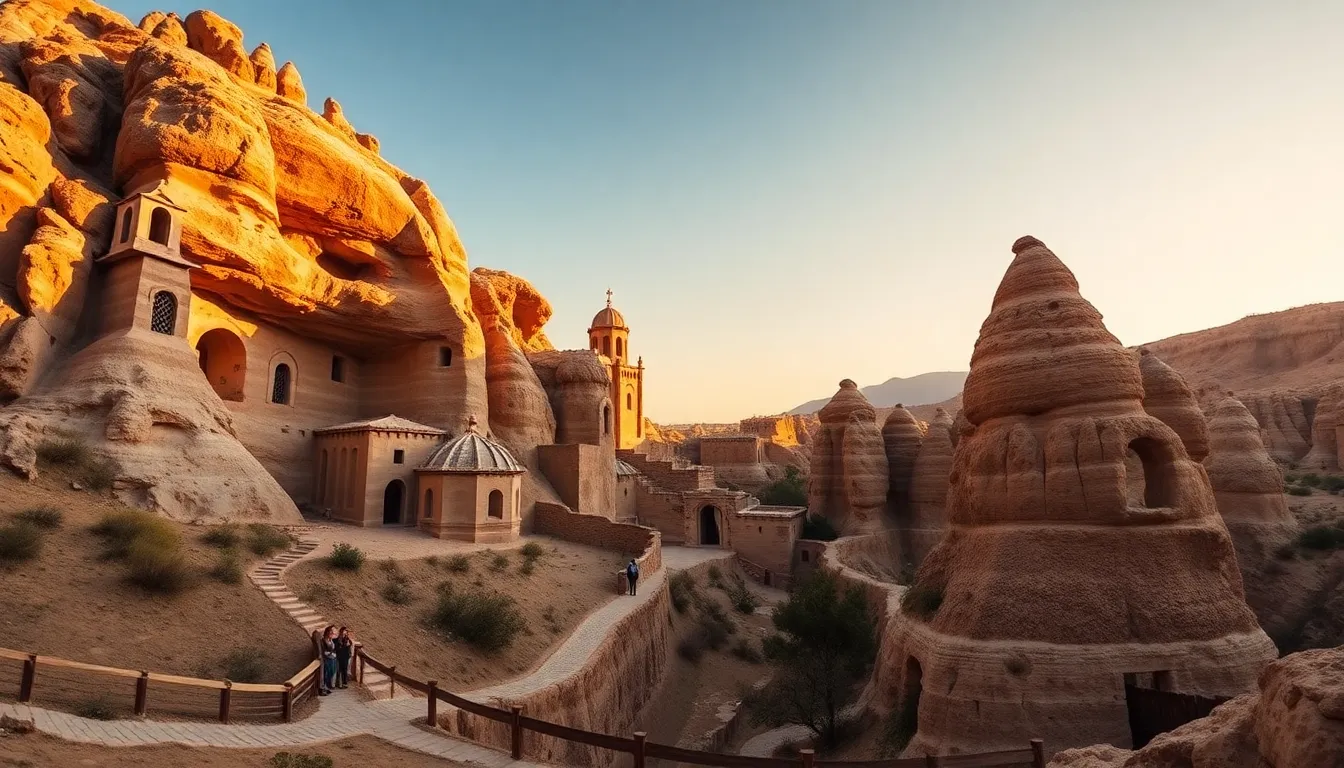
People come to Cappadocia for the hot air balloons and the moonscape, and I understand the pull. The landscape genuinely looks like nowhere else on earth. But the first time I led a group through the cave churches of Goreme, a pastor stopped in front of a thousand-year-old fresco of the resurrection, painted by hand inside a rock, and said something I have never forgotten. He said, these people did not carve all this for the view. They carved it because their faith needed a place to hide and a place to pray. That is the Cappadocia I want to help you give your group.
This guide is the orientation I give leaders deciding how to handle Cappadocia. The scenery sells itself. The heritage underneath it needs someone to frame it, or your people will leave with great photos and miss the deeper story. Let me lay out the layers.
Why Cappadocia Mattered to the Early Church
Cappadocia sits in central Turkey, on the high Anatolian plateau, and its strange terrain is the result of ancient volcanoes laying down soft rock that wind and water carved into cones, spires, and valleys. That soft stone turned out to be easy to dig, and for early Christians living under pressure, that was everything. They hollowed out churches, monasteries, and entire hidden cities.
This region is also tied to some of the most important thinkers of the early church. The Cappadocian Fathers, Basil the Great, Gregory of Nyssa, and Gregory of Nazianzus, came from this land in the fourth century, and their work helped shape Christian teaching on the Trinity that your congregation may still confess today. When I want a group to feel why this remote plateau matters, I start there. The frescoes and the caves are not folk art. They are the physical trace of a region that helped form the faith.
For the wider arc of Christian heritage across the country, our Turkey heritage travel guide sets the whole picture in context.
The Cave Churches of Goreme
The Goreme Open Air Museum is the anchor of any heritage visit, and it is rightly a protected site. Within a small area you can walk into a cluster of rock-cut churches and chapels, several of them still holding frescoes from the tenth and eleventh centuries. The Dark Church, which charges a small extra fee, preserves some of the best-protected paintings in the region precisely because so little light reached it over the centuries. The colors are still vivid. You can read the scenes, the nativity, the baptism, the crucifixion, the resurrection, laid out across the curved rock ceilings.
I tell leaders to slow their group down here. The instinct is to move quickly from church to church, but the meaning is in standing still inside one of them, looking up, and realizing a community gathered in this exact space to worship under conditions most of us cannot imagine. A short reading or a moment of silence inside one of these chapels lands harder than any guide’s commentary.
The Underground Cities
A short drive from Goreme are the underground cities of Derinkuyu and Kaymakli, and they are among the most astonishing things in Turkey. These are not cellars. They are multi-level subterranean complexes, carved down through the soft rock, with ventilation shafts, wells, stables, kitchens, and chapels. Derinkuyu descends many levels and could shelter thousands of people along with their livestock for extended periods.
Early Christians used these cities as refuge during waves of persecution and invasion, rolling great stone doors across the passages to seal themselves in. Walking through the narrow tunnels, stooped over in places, your group feels the reality of faith under threat in a way no museum panel can deliver. A practical word here. The passages are tight, the ceilings are low, and the descent is not for everyone. For groups with members who are claustrophobic or have mobility limits, I plan an alternative so no one feels stranded above ground while the rest go down.
The Monastic Valleys
Beyond the famous museum, Cappadocia is threaded with valleys that held monastic communities for centuries. The Ihlara Valley is a green canyon cut by a river, with rock-cut churches set into its walls, and a walk along its floor is one of the gentler, more contemplative experiences in the region. The Soganli and Zelve valleys hold their own clusters of cave churches and dwellings, quieter than Goreme and often nearly empty of other visitors.
For a group that wants reflection rather than crowds, these valleys are where I steer them. The pace is slower, the spaces are intimate, and the sense of standing where monks lived a life of prayer in the rock is very strong. Cappadocia pairs naturally with the early-church sites further west, like Ephesus and Selcuk, and with the imperial Christian heritage of Istanbul.
How I Plan Cappadocia for a Group
Two full days is the right amount for most heritage groups. Here is the shape I use.
- Day 1, the heart of the heritage. The Goreme Open Air Museum with its cave churches, then an underground city, with an above-ground alternative arranged for anyone who needs it.
- Day 2, the valleys and the landscape. A walk in the Ihlara Valley or a quieter valley, the rock formations at Pasabag and Devrent, and time to absorb the scenery without rushing.
- The balloon question. The dawn hot air balloon ride is genuinely beautiful and optional. I treat it as a personal add-on rather than a group fixture, since it is weather-dependent and not for everyone.
Getting here is simple. Most groups fly from Istanbul into one of Cappadocia’s two airports, which keeps the pace manageable and saves a long drive. The region’s hotels include cave hotels carved into the rock, which are comfortable and add to the experience without being a gimmick.
One detail worth folding into your budget early. With Heritage Tours, the group leader travels free when you bring fifteen or more participants. For a pastor building a congregation trip, that is the kind of thing worth knowing at the start.
FAQ: Heritage Travel in Cappadocia
What is the religious significance of Cappadocia?
Cappadocia was a major center of early Christian life. Believers carved churches, monasteries, and entire underground cities into the soft rock to worship and shelter during persecution. The region also produced the Cappadocian Fathers, fourth-century theologians whose work shaped Christian teaching on the Trinity, which makes this remote plateau important well beyond its scenery.
Are the cave churches and underground cities suitable for older travelers?
The cave churches at Goreme are mostly manageable, though some involve steps and uneven ground. The underground cities are more demanding, with low ceilings, narrow passages, and steep descents that are not right for everyone. A good plan offers an above-ground alternative so members who cannot do the tunnels are not left out of the day.
How many days should a group spend in Cappadocia?
Two full days covers the heritage core comfortably. One day for the Goreme cave churches and an underground city, and a second for the monastic valleys and the rock landscape. Adding a third day suits groups who want a slower, more contemplative pace or who want time for the optional dawn balloon ride.
Is the hot air balloon ride necessary for a heritage trip?
No. The balloon ride is beautiful and many travelers love it, but it is an optional, weather-dependent add-on rather than a heritage essential. I treat it as a personal choice for individuals in the group rather than a fixed part of the itinerary, so no one feels pressured or disappointed if weather grounds the flights.
How do groups get to Cappadocia?
Most heritage groups fly from Istanbul into one of Cappadocia’s two regional airports, a short flight that avoids a long overland drive. From there the cave churches, underground cities, and valleys are all within easy reach by coach, and many groups stay in cave hotels carved into the rock for part of the experience.
If Cappadocia is taking shape in your mind for your community, I would be glad to help you frame it so the heritage carries as much weight as the scenery. The landscape will move your people on its own. The cave churches and underground cities will move them deeper, if someone helps them see what they are standing inside. You can see how we structure these journeys on our Turkey heritage page or learn how the group experience works on our group heritage tours page.
Contact us whenever you are ready to start planning.