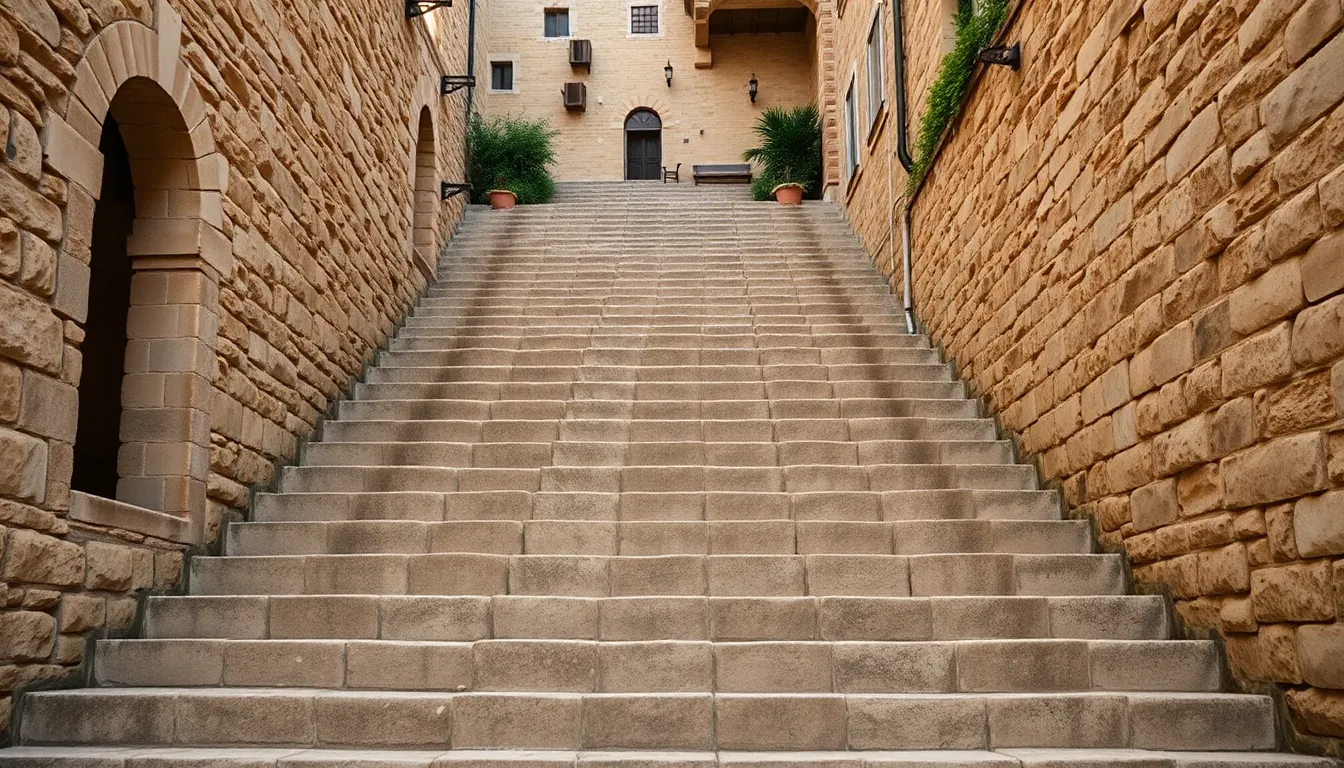
There is a moment in Besalu that I wait for with every group. We walk down the worn stone steps, below street level, into a small Romanesque chamber, and the temperature drops. The light goes dim. At the bottom there is a pool of spring water, still being fed by the same source that fed it eight hundred years ago. And then I watch it land on people’s faces. This is a mikveh, a Jewish ritual bath, from the 12th or 13th century, and it is one of only a handful that survive anywhere in medieval Europe. Standing in it, a group is standing inside the daily, intimate practice of a community most of whose buildings are long gone.
Besalu is a small town, and the mikveh is a small room. But I would put this stop against any grand synagogue in Spain for sheer power, because of what it is. Synagogues were public. They were monuments. A mikveh is private. It belonged to the most personal rhythms of Jewish life, purity, marriage, the cycle of the body and the calendar. To find one preserved is to find a thread of ordinary devotion that survived when almost everything else did not.
What a Mikveh Is, and Why It Matters
Before a group goes in, I take a minute to explain what they are about to see, because not everyone arrives knowing.
A mikveh is a pool of natural, gathered water used for ritual immersion in Jewish practice. It is not about physical cleanliness in the ordinary sense. It is about spiritual transition, a passage from one state to another. It is central to the laws of family purity, used in conversion, and connected to preparation for Shabbat and the festivals. To be valid, a mikveh must draw on a natural source: rainwater, a spring, or living water, not water carried in by hand.
The mikveh of Besalu does exactly that. It is fed by the groundwater of the Fluvia river valley, which is why the pool is still wet. The community dug down to reach living water and built a stone chamber around it. When you explain this to a group standing at the edge of the pool, the engineering and the faith click together. These were people who shaped stone and channeled water in order to keep a commandment.
A Rare Survivor
Here is the fact that makes Besalu matter on a map of Jewish Europe: very few medieval mikvaot survive. The one in Besalu was rediscovered in the 20th century, hidden and largely forgotten, near the river at the lower edge of the old Jewish quarter. Its survival is part luck and part the simple fact that a stone room dug into the ground is hard to erase.
The chamber is Romanesque in style, with a barrel-vaulted ceiling and a stone staircase descending to the water. It is austere and beautiful in the way that purely functional medieval architecture often is. There is nothing decorative competing for your attention. There is only the descent, the vault, and the water.
For a heritage group, the rarity is part of the meaning. You are not looking at one example among many. You are looking at one of the few physical survivals of a practice that was once part of every Jewish community in Spain. What was once everywhere is now almost nowhere, and Besalu is one of the places it remains.
Visiting the Mikveh With a Group
The mikveh is below ground and accessed by guided visit, usually arranged through the local tourist office, which holds the key and times entries. The chamber is small, so groups go in measured numbers rather than all at once. For a group of fifteen or more, this needs coordinating in advance so the visit is calm rather than a queue on a narrow stair. This is precisely the sort of timing we handle when we plan an itinerary, so your people descend into a quiet room and not a crowded one.
I also keep the visit reverent. People sometimes want to touch the water, and I let the moment be what it is. This is a place of devotion, and a thoughtful group feels that without being told twice.
The Town and the Old Quarter
The mikveh is the reason to come, but Besalu itself is one of the best-kept medieval towns in Catalonia, and the setting amplifies the visit.
- The fortified bridge. Besalu is approached across a dramatic angled Romanesque bridge over the Fluvia river. It is one of the most photographed medieval bridges in Spain, and crossing it on foot is a fitting way for a group to arrive. You are walking into a town that has kept its medieval shape.
- The old Jewish quarter. The mikveh sat at the lower edge of the juderia, near the river, exactly where you would expect a ritual bath to be, close to the water source. The streets above it formed the heart of a Jewish community that lived here through the medieval centuries until the expulsion swept it away, as it did everywhere in Spain.
- The synagogue site. Archaeological work near the mikveh has identified remains associated with the community’s synagogue complex. The interpretation here helps a group picture the quarter as a whole, the prayer house and the ritual bath together, the public and the private faces of Jewish life side by side.
Besalu rewards a slow walk. The town is compact enough to take in on foot, and the medieval atmosphere is unusually complete.
Why Besalu Belongs on a Spain Heritage Itinerary
Besalu sits in Catalonia, in the same region as Girona, and the two pair naturally. Girona gives a group a whole preserved Jewish quarter, the Call, with its museum and its lanes. Besalu, a short distance away, gives the single most intimate artifact of Jewish daily practice you will find in Spain. Together they make a powerful Catalan chapter in the larger story told in our Spain Jewish heritage guide.
For groups that care about how this community actually lived, day to day and body and soul, the mikveh connects directly to the practical threads of a modern trip. It pairs especially well with our guide to keeping kosher and Shabbat across Spain, since the mikveh and Shabbat preparation belong to the same rhythm of observance, and with the cultural inheritance traced in Ladino and Sephardic culture, the world these Catalan communities carried into exile.
FAQ: Visiting the Mikveh of Besalu
What is the mikveh of Besalu?
It is a medieval Jewish ritual bath, dated to roughly the 12th or 13th century, carved below street level near the Fluvia river at the edge of the old Jewish quarter. It is one of the very few medieval mikvaot to survive in Europe. The Romanesque stone chamber is still fed by groundwater, so the pool remains wet today.
What is a mikveh used for?
A mikveh is a pool of natural, gathered water used for ritual immersion in Jewish practice. It marks spiritual transition rather than ordinary cleanliness, and it is central to the laws of family purity, used in conversion, and connected to preparation for Shabbat and the festivals. To be valid it must draw on living water, such as a spring or rainwater.
Why is the Besalu mikveh so significant?
Because survivals are so rare. Mikvaot were private, everyday parts of Jewish communities across Spain, but almost none endure in physical form. The Besalu chamber, rediscovered in the 20th century, is one of the few that remain. It preserves the intimate, daily side of Jewish life that public monuments do not show.
How do you visit the mikveh?
Access is below ground by guided visit, typically arranged through the local tourist office, which manages the key and entry times. The chamber is small, so visits are limited in number. Groups should coordinate timing in advance, which lets a larger party enter calmly rather than queuing on the narrow staircase.
Can Besalu be combined with Girona?
Yes, and it is an ideal pairing. Both are in Catalonia and a short distance apart. Girona offers a complete preserved Jewish quarter and museum, while Besalu offers the single most intimate artifact of Jewish daily practice in Spain. Visiting both gives a group the public and private faces of medieval Catalan Jewish life.
If the mikveh of Besalu speaks to the kind of journey you want for your community, let us build it into a Catalan route that fits your group. Our group heritage tours are shaped around the people traveling, and with fifteen or more participants the group leader travels free. See the full picture on our Spain destination page, and contact us when you are ready to plan.