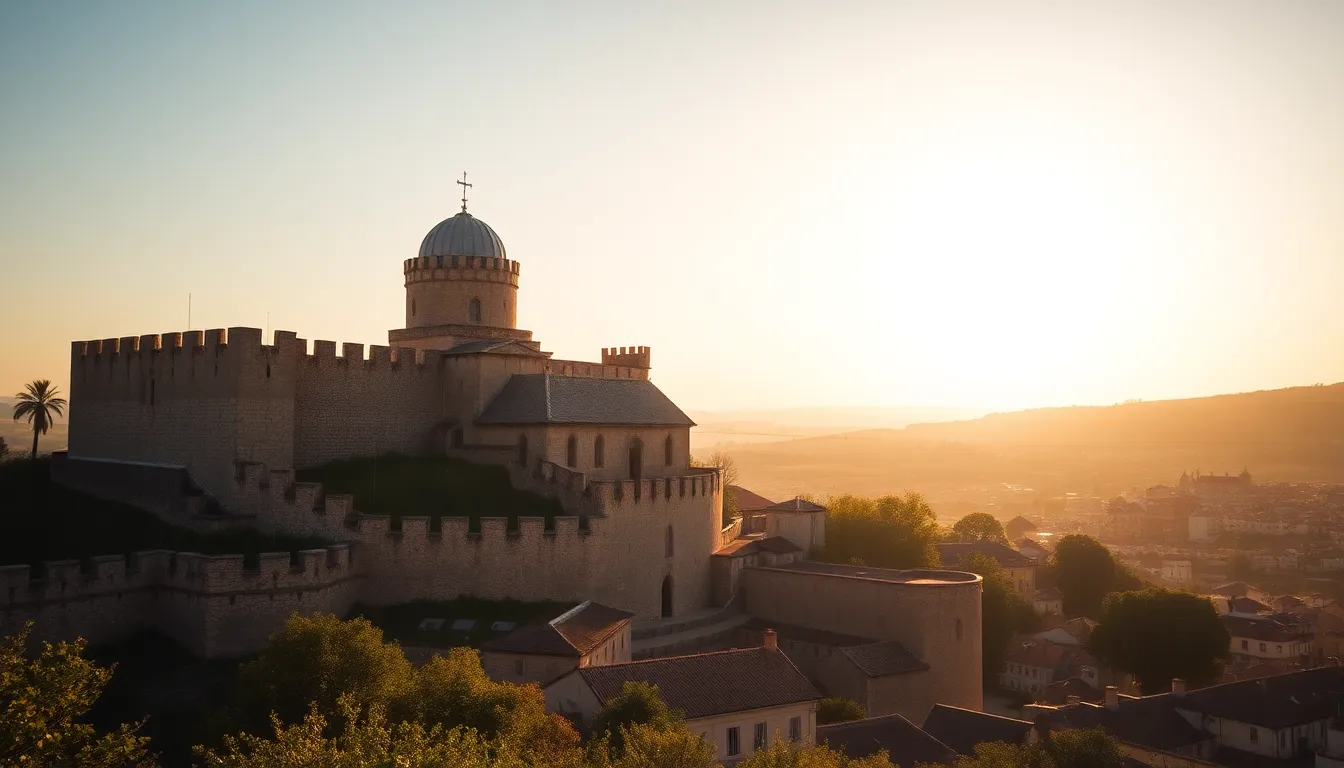
I have stood at the foot of the Tomar castle walls with a lot of different groups, and the question is always the same. Someone looks up at the height of the stone and asks how anyone built this in the twelfth century, on a hilltop, by hand. I never have a tidy answer. The walls are the answer. They were built by men who believed they were holding a frontier for God, and they built like it.
Most visitors to Tomar talk about the Convent of Christ, the great religious complex that crowns the hill. That is right and worth doing, and we have written about it separately. But the convent grew out of something older and harder: the Templar castle and its walls. Before there were Manueline cloisters, there was a fortress. This article is about that fortress.
A Frontier Fortress of the Knights Templar
The castle at Tomar was founded in 1160 by Gualdim Pais, the Master of the Knights Templar in Portugal. To understand why it sits where it sits, you have to picture the map of the time. Portugal was a young kingdom, barely twenty years old, still fighting the long campaign known as the Reconquista to push the frontier south against Muslim Al-Andalus. The Tagus river valley was contested ground. Tomar guarded it.
The Knights Templar were a military religious order, monks who were also soldiers, founded to protect pilgrims in the Holy Land. The Portuguese crown granted them land and authority along this frontier in exchange for defending it and settling it. Gualdim Pais chose the hill at Tomar, and he fortified it with the engineering knowledge the Templars had gathered in the Crusader East. The castle was tested. It withstood a major Almohad siege in 1190, when the town below was overrun but the castle held.
So when you walk these walls, you are not looking at decoration. You are looking at working military architecture that did its job. The order that built it would later be dissolved across Europe under pressure from the King of France and the Pope in the early fourteenth century. In Portugal, the crown protected the knights by reconstituting them as a new body, the Order of Christ, which inherited Tomar and its wealth and went on to help finance the age of exploration. The walls outlived the order that raised them.
Walking the Fortifications
The castle’s defenses were sophisticated for their day. The Templars built a double line of walls, an outer ring and an inner keep, so that an attacker who breached the first line still faced a second. Round towers anchor the circuit, set at the corners and along the wall so defenders could cover the ground in front of the stone from more than one angle. The keep, the strongest tower, sits at the high point as the last refuge.
Look closely at the wall and you will find features that came back from the Crusades. There are alambor sections, where the base of the wall slopes outward to deflect missiles and make undermining harder, a technique the Templars learned in the East. There are arrow slits angled for archers, and walkways along the top where defenders moved under cover. The masonry is heavy, fitted stone, the kind that absorbs a siege rather than shatters.
Inside the walls, the land opens into terraced gardens and the broad enclosure that the order used. From the ramparts the view runs out over the town of Tomar, the Nabão river, and the countryside the knights were sworn to hold. Standing up there, the logic of the place is obvious. You can see anyone coming for miles.
The Round Church Inside the Walls
At the heart of the castle is the building that ties Tomar to Jerusalem: the Charola, the round Templar church, begun in the late twelfth century. It is a sixteen-sided rotunda, modeled on the round churches the Templars associated with the Church of the Holy Sepulchre and the Dome of the Rock in Jerusalem. In the center stands an octagonal sanctuary, and around it runs a circular aisle.
The Templars are said to have ridden into this church on horseback to hear Mass before battle, prepared to leave straight for the frontier. Whether or not every version of that story is exact, the design makes the point. This was a soldiers’ church, round like the holy sites of Jerusalem the order existed to defend, built so that worship and war stood side by side. The interior was richly painted and gilded in later centuries, but the bones of it are pure Templar.
Why Groups Come and How They Visit
For heritage groups, Tomar offers a rare thing: a complete chain of Portuguese faith history in one place. The Templar walls, the round church, the later Order of Christ, the Manueline additions of the age of exploration. You can walk from the twelfth century to the sixteenth in an afternoon.
The whole complex was named a UNESCO World Heritage Site in 1983. Practically, the castle walls and the Convent of Christ are part of the same hilltop site and visited together on one ticket. There is a paid entrance to the convent and its monumental areas, while the outer castle gardens and parts of the fortifications can be walked freely. I tell group leaders to allow at least two hours for the full hill, more if the group likes to linger on the ramparts.
A few practical notes. The site is on a hill, the ground is uneven cobble and stone, and the wall walks involve steps, so steady shoes matter and the less mobile travelers in a group should be paired up. There is coach parking near the top, which saves the climb from the town. Mornings are cooler and quieter, which matters in the Alentejo-edge heat of summer. The old town of Tomar sits at the foot of the hill and is worth the short walk down, both for lunch and for the small medieval synagogue a few minutes away, which we cover in our hidden-sites guide.
For groups of 15 or more, your group leader travels free, which makes Tomar an easy anchor for a central Portugal day between Lisbon and Fatima.
FAQ: The Templar Castle at Tomar
Who built the Tomar castle and when?
The castle was founded in 1160 by Gualdim Pais, Master of the Knights Templar in Portugal, as a frontier fortress during the Reconquista. It guarded the Tagus valley against Muslim Al-Andalus to the south and withstood a major siege in 1190.
What happened to the Knights Templar at Tomar?
When the Templar order was dissolved across Europe in the early fourteenth century, the Portuguese crown protected its knights by reorganizing them as the Order of Christ, which inherited Tomar. The order’s wealth later helped finance the Portuguese voyages of exploration, so the site’s history runs straight from the Crusades to the age of discovery.
What is the round church inside the castle?
It is the Charola, a sixteen-sided Templar rotunda begun in the late twelfth century and modeled on the round holy sites of Jerusalem, including the Church of the Holy Sepulchre. The Templars used it as their church, and tradition holds that knights heard Mass there before riding out to the frontier.
Can you walk the castle walls and fortifications?
Yes. The castle gardens and parts of the fortifications can be walked, and the ramparts give wide views over the town and river. The walls include round defensive towers and sloped alambor bases, techniques the Templars brought back from the Crusader East. Wear steady shoes, since the ground is uneven and the wall walks involve steps.
How long should a group plan for Tomar?
Allow at least two hours for the hilltop, covering the castle walls, the round church, and the Convent of Christ, which share one ticket and one site. Groups that enjoy the ramparts and want time in the old town below should plan for half a day.
The Templar story is one of the strongest threads in Portuguese heritage, and Tomar is where you can stand inside it. If you are a pastor, rabbi, or educator building a central Portugal route, we can place Tomar between Lisbon and Fatima and shape the rest around it. Start with our Portugal destination page, see how we run a group tour, and contact us when you want to talk specifics.
For more on the surrounding history, read our guides to the Knights Templar heritage of Portugal, the Convent of Christ at Tomar, and the hidden heritage sites of Portugal.