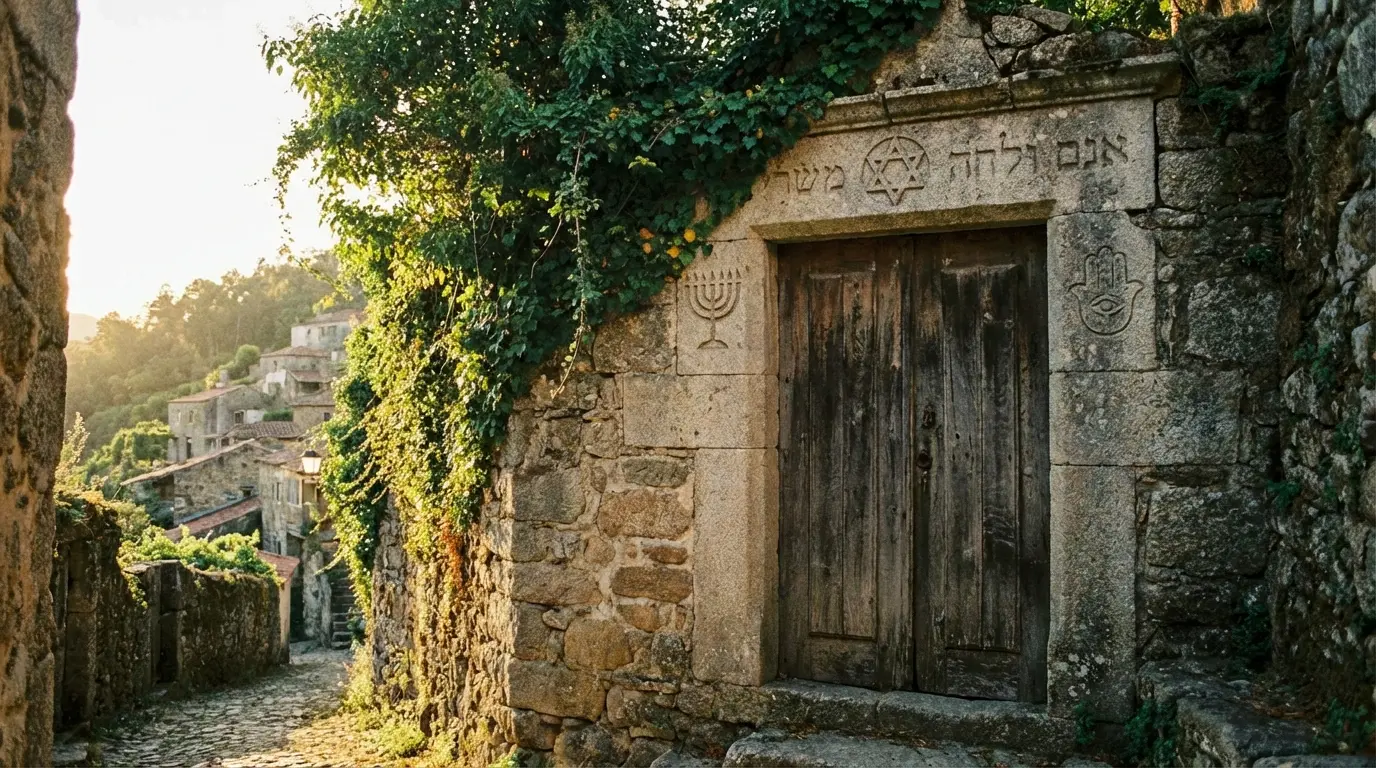
Tomar: The Only Intact Pre-Expulsion Synagogue in Portugal
Most people who visit Tomar come for the Convent of Christ, the old Knights Templar stronghold that dominates the hilltop. It is impressive, and it deserves the attention. But the site I always want groups to see is down in the old town, tucked into a narrow street that you could walk past without a second look.
The Tomar synagogue was built in the mid-15th century, a few decades before the forced conversions of 1497 ended public Jewish life in Portugal. After the expulsion, the building was used as a prison, a hayloft, a warehouse, and a chapel at various points over the centuries. But the structure survived. The Gothic columns, the original layout, the sense of the space, all of it is still there.
Today it houses the Abraham Zacuto Luso-Hebrew Museum, named after the Jewish astronomer and mathematician whose work helped make Portugal’s age of exploration possible. Standing inside, you are in the oldest surviving synagogue in Portugal, a space that predates the expulsion by just enough years to remind you what was lost.
There is no crowd here. No ticket line. Just the building and what it holds.
Castelo de Vide: The Medieval Jewish Quarter Tourists Almost Never Visit
Castelo de Vide sits in the Alentejo, near the Spanish border, in a part of Portugal that most travelers never reach. The town is built on a hillside, white houses stacked above narrow lanes, and at the bottom of the old quarter is one of the best-preserved medieval Jewish neighborhoods in the Iberian Peninsula.
The streets here are original. The houses still carry the marks of their history. You can see the indentations on doorposts where mezuzot once hung, the arched doorways typical of medieval Jewish homes, and the old fountain that served the community. A small synagogue has been excavated and partially restored.
What makes Castelo de Vide different from a museum exhibit is that it is still a town. People live in these houses. The baker on the corner still makes pastries that some historians believe descend from converso recipes, adapted to hide their Jewish origins. The neighborhood is not preserved behind glass. It is quiet, lived-in, and real.
For groups traveling through the Alentejo, Castelo de Vide pairs naturally with the nearby towns of Marvao and Portalegre. But Castelo de Vide is the one that stays with people.
Trancoso: Where Crypto-Jews Left Marks on Their Own Doorways
Trancoso is a walled town in the Portuguese interior, the kind of place where the medieval gates still stand and the cobblestones inside have been worn smooth by centuries of use. It was once home to a significant Jewish community, and after the forced conversions, many of those families stayed.
What they did is remarkable. Unable to practice their faith openly, some converso families carved small symbols into the stone doorways of their houses. Crosses with unusual features. Stars that might be Stars of David if you knew what to look for. Markings that told other converso families, quietly and at great risk, that this was a Jewish home.
These doorway markings are still visible today. A knowledgeable guide can walk you through the old Jewish quarter and point them out, one after another, carved into stone that has stood for five hundred years. Each one is a small act of defiance, a family saying, in the only way they safely could, that they had not forgotten who they were.
Trancoso does not appear in most Portugal travel guides. It is not on most itineraries. But for a heritage group, especially one interested in the crypto-Jewish story, it is one of the most powerful places in the country.
Porto’s Kadoorie Synagogue: A Story of Rescue and Community
Porto’s Jewish history is often overshadowed by Lisbon’s, but the story here has its own weight. The Kadoorie Mekor Haim Synagogue, completed in 1938, is the largest synagogue on the Iberian Peninsula. Its construction was funded in large part by the Kadoorie family, Sephardic Jews from Baghdad who had built their fortune in Hong Kong and Shanghai.
The timing of the synagogue’s completion matters. It opened just as Europe was descending into war. Porto became a transit point for Jewish refugees fleeing Nazi-occupied Europe, many of them aided by Aristides de Sousa Mendes, the Portuguese consul in Bordeaux who defied his government’s orders and issued thousands of visas to Jewish families. His actions saved an estimated 30,000 lives.
The Kadoorie synagogue today is both a functioning house of worship and a monument to that history. Its community is small but active, drawing from both Sephardic and Ashkenazi traditions. A visit here is not just about architecture. It is about the intersection of courage, community, and survival that defines so much of Portugal’s Jewish story.
Porto’s old Jewish quarter, near the Se Cathedral, also holds traces of the medieval community. The streets have been built over and renamed, but the outlines remain, and a guide who knows the city can piece the story together.
The Alentejo Villages: Converso History Off Every Map
South of Lisbon, the Alentejo stretches across rolling plains and cork oak forests, a region that feels older and slower than the coast. Several small towns here, Evora, Monsaraz, Mertola, hold converso histories that are still being uncovered by scholars and local historians.
In Mertola, archaeological work in recent decades has revealed what may be the remains of a medieval synagogue beneath a later building. In Evora, the old Jewish quarter is marked but receives very few visitors. In Monsaraz, the converso story is woven into the fabric of a town so small that the entire population could fit in a single room.
These are not easy sites to visit on your own. They require planning, local knowledge, and often a guide who can arrange access. But for groups willing to go beyond the standard itinerary, the Alentejo offers something rare: the feeling of being the first to hear a story that the rest of the travel world has not yet found.
How to Include These Sites in a Group Itinerary
None of these places are far from each other by Portuguese standards. Portugal is a small country, and a well-planned itinerary can combine Lisbon, Fatima, Tomar, and the interior towns in a single trip of 8 to 10 days without feeling rushed.
The key is working with an operator who knows these sites and has relationships on the ground. Heritage Tours builds custom itineraries that include the interior towns alongside the better-known destinations, creating a journey that has both the pilgrimage sites your group expects and the heritage sites that will surprise them.
For groups of 15 or more, the group leader travels free. If you are a rabbi or pastor considering a trip that goes deeper than the standard Portugal itinerary, you can start by exploring our Portugal destination page and reaching out when you are ready to talk.
Frequently Asked Questions
What is the Tomar synagogue in Portugal?
The Tomar synagogue is the only intact pre-expulsion synagogue still standing in Portugal. Built in the mid-15th century, it survived the forced conversions of 1497 by being repurposed as various secular buildings over the centuries. Today it houses the Abraham Zacuto Luso-Hebrew Museum and is open to visitors.
Are there Jewish heritage sites outside Lisbon in Portugal?
Yes, and many of the most significant ones are in the Portuguese interior. Tomar, Belmonte, Castelo de Vide, Trancoso, and several Alentejo villages all hold important Jewish heritage sites, from medieval synagogues to crypto-Jewish neighborhoods to converso doorway carvings. These interior sites often require a knowledgeable guide to access and interpret.
What are crypto-Jewish villages in Portugal?
After the forced conversions of 1497, many Jewish families in Portugal continued to practice their faith in secret. Several towns in the Portuguese interior, particularly Belmonte, Trancoso, and Castelo de Vide, were home to these crypto-Jewish communities. Some families maintained secret Jewish practices for more than 500 years. Evidence of their hidden observance, including carved doorway symbols and oral prayer traditions, can still be found in these towns today.
What is the Kadoorie synagogue in Porto?
The Kadoorie Mekor Haim Synagogue is the largest synagogue on the Iberian Peninsula. Completed in 1938 with funding from the Kadoorie family, it opened just as World War II began. Porto served as a transit point for Jewish refugees during the war, and the synagogue’s history is connected to the rescue efforts of Aristides de Sousa Mendes, who saved thousands of Jewish lives by issuing visas against his government’s orders.
How do I visit lesser-known Jewish heritage sites in Portugal with a group?
The most effective approach is to work with a tour operator who has local contacts in the Portuguese interior. Many of these sites do not have formal visitor infrastructure and require a guide who knows the region. Heritage Tours creates custom group itineraries that combine these interior heritage sites with Lisbon, Porto, and Fatima. Visit our Portugal page to explore options for your group.