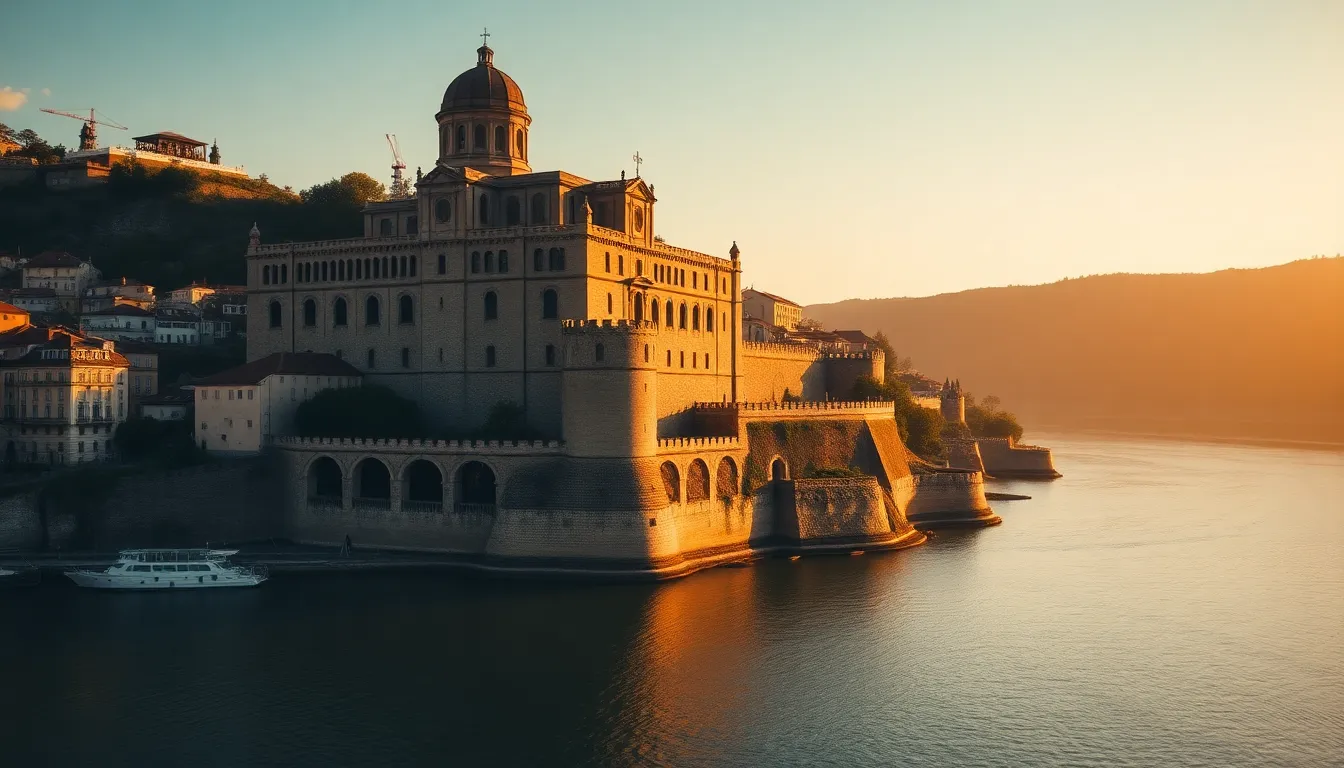
People are usually surprised by the Se do Porto the first time they see it up close. They expect a cathedral and they get something that looks more like a castle. Two squat towers, heavy walls, battlements along the top. I have had a group leader stand in front of it and ask me, only half joking, whether it was built to keep God in or armies out. The honest answer is a bit of both. That is the character of Porto’s cathedral, and it is exactly why it belongs on a heritage itinerary.
The Se sits at the top of the old city, on the high ground above the Douro river, in the medieval heart of Porto. It is one of the oldest and most important monuments in the city, and for a faith group traveling through northern Portugal it offers a very different register from the baroque drama of nearby Braga or the apparition site at Fatima. This is faith built in stone for a hard age.
A Fortress Church on the High Ground
Construction of the cathedral began in the first half of the twelfth century, around the same generation that saw Portugal emerge as an independent kingdom. This was frontier time. The Reconquista was still pushing south, and a major church in a strategic city was built to hold its ground in more than a spiritual sense.
So the original Se was Romanesque, the heavy, rounded, fortress-minded style of the period, with thick walls, small windows, and a defensive crown of battlements that you can still see today. The two flanking bell towers read more like watchtowers than spires. The building sits on the highest point of the old town, commanding the river and the approaches, and it looks the part. Over the following centuries it was altered and enriched, with Gothic and then baroque additions layered on, but the Romanesque bones held, and the cathedral never lost its stern, defensive face.
That blend is the thing to point out to a group. Walk the exterior and you read the twelfth-century fortress. Step inside and into the cloister and side chapels and you read the later centuries of Portuguese wealth and devotion piling beauty onto strength.
What Groups See Inside
The interior is dim and solid, true to its Romanesque origin, with a later gilded baroque high altar and a silver altarpiece in the Chapel of the Blessed Sacrament that survived the Napoleonic looting because, by tradition, the people of Porto plastered over it to hide it from French troops. Those are the kinds of details that make a cathedral memorable, the small acts of protection that tell you what the building meant to ordinary people.
The Gothic cloister, added in the fourteenth century, is one of the highlights. Its walls are lined with eighteenth-century azulejos, the blue-and-white painted tiles that are one of Portugal’s signature art forms, depicting religious and allegorical scenes. From the cloister and the terrace beside the cathedral, the view opens over the red roofs of the old city tumbling down to the Douro, with the river and the famous Dom Luis bridge below. For many groups, that terrace view is as memorable as the church itself.
There is also a piece of national history here. In 1387, King Joao I of Portugal married Philippa of Lancaster in this cathedral, the union that sealed the long alliance between Portugal and England and produced a remarkable generation of princes, including Henry the Navigator. Standing in the Se, you are standing where a marriage shaped centuries of Portuguese and European history.
The Cathedral and the Jewish Quarter Below
There is a layer of the Se’s story that I always make sure faith groups, and especially mixed groups, understand. The streets immediately below the cathedral, in the steep Sé and Vitória districts, were the heart of Porto’s medieval Jewish quarter. Jews lived and traded in the shadow of the cathedral for generations before the forced conversions of 1497 ended public Jewish life in Portugal. The old judiaria has been built over and renamed across the centuries, but the outline of those lanes is still there, and a guide who knows the city can trace it.
That proximity, the great Christian cathedral above and the Jewish quarter on the slope below, is part of what makes Porto worth slowing down for. It is the same intertwined story you find across heritage Portugal, the long coexistence and then the rupture, written into the geography of a single hillside. We cover the city’s later Jewish history, including the Kadoorie synagogue, in a separate guide.
How Groups Visit and Practical Access
The cathedral is easy to fold into a Porto day. It sits at the top of the old town, a short walk up from the riverside Ribeira district, and it is the natural starting point for exploring the historic center, which is a UNESCO World Heritage Site as a whole.
Entry to the main body of the cathedral is generally free, while the cloister and the cathedral museum charge a small admission fee. The visit itself is not long, most groups need forty-five minutes to an hour for the church, cloister, and terrace, but the steep streets around it deserve more time. I usually build the Se into a walking morning that drops down through the old lanes to the Ribeira and the river.
A few practical notes for group leaders. The walk up to the cathedral is genuinely steep, on cobbled streets that are slick when wet, so steady shoes matter and the least mobile travelers may want a vehicle drop near the top, since there is a cathedral square that a coach or van can usually reach. As a working cathedral it observes Mass times and expects modest dress, shoulders and knees covered, which is worth a quiet word to the group before you arrive. Mornings are calmer than the cruise-crowd afternoons. The terrace beside the cathedral is the best photo spot in the old town, so leave time for it.
For groups of 15 or more, your group leader travels free, which makes Porto an easy anchor for a northern leg alongside Braga and the Douro.
FAQ: Visiting Porto Cathedral
What is the Se do Porto?
It is the cathedral of Porto, one of the city’s oldest and most important monuments, begun in the first half of the twelfth century. It is built in a fortress-like Romanesque style, with thick walls, two heavy bell towers, and battlements, and it stands on the highest ground of the old town above the Douro river.
Why does Porto Cathedral look like a fortress?
Because it was built during the Reconquista, when a major church in a strategic city served defensive as well as religious purposes. Its Romanesque design used thick walls, small windows, and battlements typical of the militarized faith of twelfth-century Iberia. Later Gothic and baroque additions enriched it, but the defensive Romanesque core remained.
What is there to see inside?
The dim Romanesque nave, a gilded baroque high altar, and a silver altarpiece that locals hid from Napoleon’s troops by plastering over it. The fourteenth-century Gothic cloister is lined with blue-and-white azulejo tiles, and the terrace beside the cathedral gives a sweeping view over the old city and the Douro. King Joao I married Philippa of Lancaster here in 1387.
Is there a Jewish connection to the cathedral area?
Yes. The steep streets just below the cathedral were the heart of Porto’s medieval Jewish quarter, where Jews lived and traded for generations before the forced conversions of 1497. The lanes have been rebuilt and renamed over the centuries, but a knowledgeable guide can trace the outline of the old judiaria on the slope below the Se.
How long should a group spend, and is there a fee?
Plan forty-five minutes to an hour for the church, cloister, and terrace, with more time for the old streets around it. Entry to the main cathedral is generally free, while the cloister and museum charge a small admission. As a working cathedral it observes Mass times and asks for modest dress.
Porto rewards groups that slow down, and the Se is the place to start. If you are a pastor, rabbi, or educator planning a northern Portugal route, we can build the cathedral, the old town, and the Douro into a wider itinerary. See our Portugal destination page, look at how we run a group tour, and reach out when you are ready to plan.
For more on the region’s faith heritage, read our guides to spiritual sites for faith travelers, the religious heritage of Braga, and the Se Cathedral of Lisbon.