Fatima: What Pilgrims Actually Come to Experience
Most people who have heard of Fatima know the basic outline: in 1917, three shepherd children in a rural Portuguese town reported visions of the Virgin Mary over the course of six months. What is harder to convey in a summary is what it means to stand there.
The Sanctuary of Our Lady of Fatima is centered on the Capelinha das Aparicoes, a small open-air chapel built on the exact spot where the children said the apparitions occurred. It is not grand. It is simple, almost modest compared to the enormous basilicas that surround it. And it is the single most visited spot in the entire complex, because pilgrims understand that this is the place.
The final apparition, on October 13, 1917, was witnessed by an estimated 70,000 people who had gathered despite heavy rain. What they reported seeing, the sun appearing to spin and move across the sky, remains one of the most widely witnessed events in the history of Catholic faith. The Church investigated for thirteen years before formally recognizing the apparitions in 1930.
Today, Fatima draws millions of pilgrims each year. If your group visits on or near May 13 or October 13, the anniversary dates, they will see hundreds of thousands of people filling the plaza, many walking on their knees across the stone as an act of devotion. It is physically intense and profoundly moving. If your group can attend Mass in the Capelinha, that experience alone justifies the trip for many Christian travelers.
What I tell pastors planning a visit: build in time. Fatima is not a site you walk through and photograph. It is a place you sit in. Give your group the morning, at minimum.
Batalha: The Monastery That Was Built as a Promise to God
About twenty kilometers from Fatima stands one of the most extraordinary buildings in Portugal, and one that far too many heritage itineraries skip.
The Monastery of Batalha was commissioned by King Joao I in 1386 after the Battle of Aljubarrota, where a smaller Portuguese force defeated the Castilian army. Before the battle, Joao made a vow: if God granted him victory, he would build a monastery to honor the Virgin Mary. He won, and he kept his promise. Construction took over a century.
The result is a masterpiece of Gothic and early Manueline architecture. The Founder’s Chapel holds the tombs of Joao I and his English wife, Philippa of Lancaster, their hands clasped together in stone. The Unfinished Chapels, open to the sky, were never completed, and their incompleteness gives them an honesty that finished buildings sometimes lack. They stand as a reminder that even the grandest human ambitions have limits.
For faith groups, Batalha is significant not because of its size but because of its origin. This is a building that exists because a man believed God answered his prayer, and he spent the rest of his life and his kingdom’s resources honoring that belief. That story resonates differently when you are standing inside it.
Jeronimos Monastery: Where Age of Exploration Faith Lives in Stone
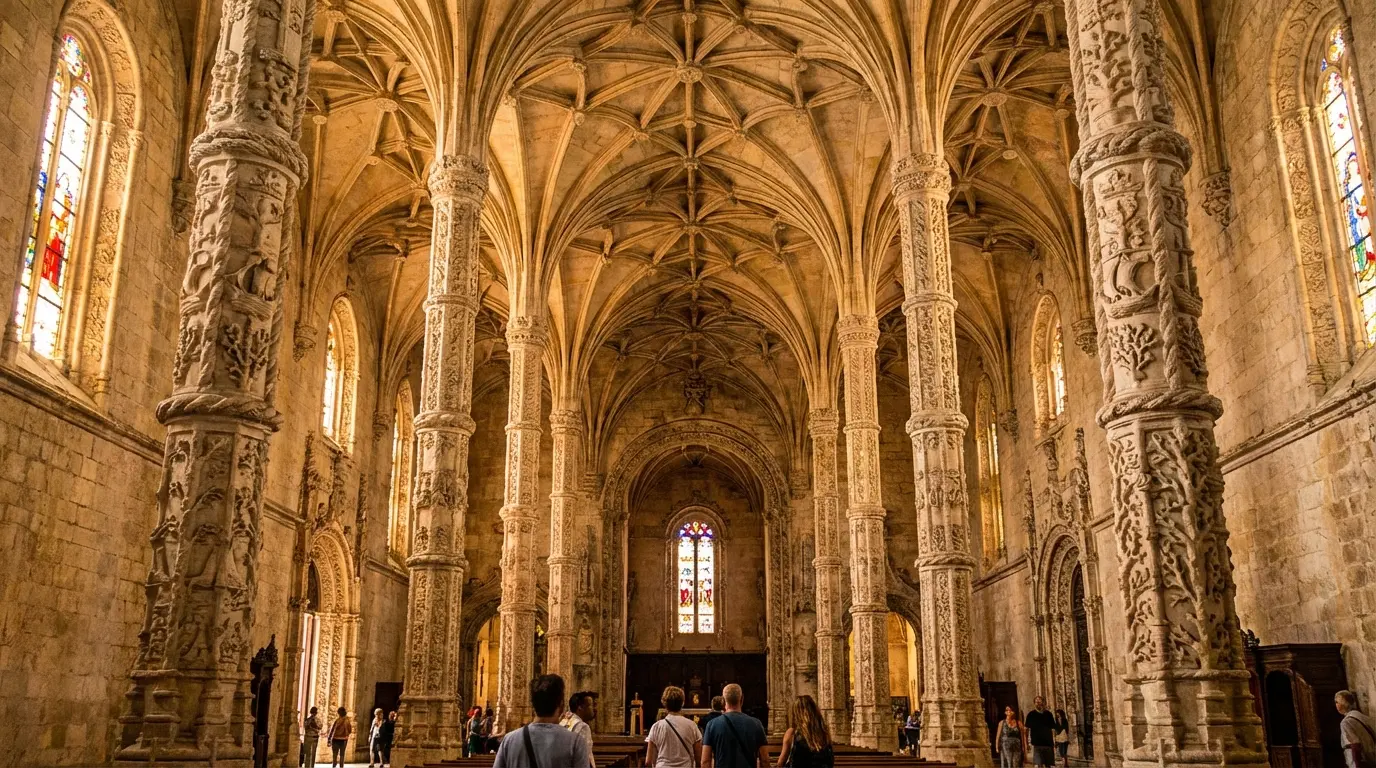
In Lisbon’s Belem district, the Jeronimos Monastery is the most celebrated example of Manueline architecture in Portugal. It was commissioned by King Manuel I in 1501, funded by the wealth of the Portuguese spice trade, and built to celebrate Vasco da Gama’s successful voyage to India.
The south portal of the church is covered in carved stone depicting saints, prophets, and scenes from the life of Saint Jerome. The interior columns branch into ribbed vaulting that looks organic, almost like a stone forest. The cloister is two stories of carved arches, each one different, mixing maritime imagery with religious symbolism in ways that reflect Portugal’s identity as a seafaring nation that understood its exploration as a divine mission.
Da Gama himself is entombed here, along with the poet Luis de Camoes, whose epic “Os Lusiadas” framed the Portuguese voyages as acts of national and spiritual destiny.
For groups interested in how faith shaped European exploration, and how exploration in turn reshaped faith, the Jeronimos Monastery is essential. It is not just a church. It is a statement about what an entire nation believed God was calling it to do.
Alcobaca: Royal Tombs and the Monastic Tradition
The Monastery of Alcobaca, about an hour north of Lisbon, was founded in 1153 by Portugal’s first king, Afonso Henriques, and given to the Cistercian order. For centuries, it was the wealthiest and most powerful monastery in Portugal.
The church is the largest in the country and follows the Cistercian principle of austerity, with clean lines and minimal decoration that contrasts sharply with the ornamentation of Batalha and the Jeronimos. This simplicity is itself a theological statement. The Cistercians believed that beauty in a church should come from proportion and light, not from carved images.
The monastery is also home to the tombs of King Pedro I and Ines de Castro, placed foot to foot so that, according to tradition, they will see each other first when they rise at the Last Judgment. Their love story, which ended with Ines’s murder and Pedro’s legendary grief, is one of the most famous in Portuguese history.
For faith groups, Alcobaca offers a different register. After the intensity of Fatima and the grandeur of Batalha, the Cistercian simplicity here invites a different kind of reflection. The monks who built this place believed that silence and proportion were forms of prayer. Walking through their church, you understand why.
Belmonte’s Synagogue: A Living Jewish Community After 500 Years
In the hilltop town of Belmonte, in Portugal’s remote Beira Interior, there is a synagogue that was built in 1996. That date is important. It was not a restoration of an old building. It was the construction of a new house of worship for a community that had survived in secret for approximately five hundred years.
When the Portuguese Crown forced all Jews to convert or leave in 1497, many families in the interior converted publicly but continued to practice Jewish traditions in private. Across most of Portugal, these crypto-Jewish practices disappeared within a few generations. In Belmonte, they did not. Families passed down Shabbat observance, dietary laws, and Hebrew prayers from mother to daughter for centuries, behind closed doors, in a town so small and remote that the Inquisition never fully penetrated it.
The community was brought to wider attention in the early twentieth century, and in the decades that followed, some members chose to formally return to mainstream Judaism. The synagogue that stands today is their community’s declaration that the secret is over.
Visiting Belmonte’s synagogue is different from visiting any other site on this list. You are not looking at a ruin or a museum. You are standing in the house of worship of a living community whose ancestors held onto their faith through five centuries of concealment. For Jewish groups, this is often the most profound moment of the entire trip. For Christian groups, it is a powerful encounter with the cost and persistence of religious conviction.
Heritage Tours coordinates visits with the community in advance, because Belmonte is a real neighborhood with real families, not a heritage attraction. That coordination matters.
Tomar: The Templar Castle and the Synagogue Next Door
Tomar is a town of about 20,000 people that holds two buildings representing very different chapters of Portuguese faith history, and they stand within walking distance of each other.
The Convent of Christ was the headquarters of the Knights Templar in Portugal and later the Order of Christ. The complex is enormous, built over centuries, and contains everything from a twelve-sided Templar church modeled on the Holy Sepulchre in Jerusalem to Manueline cloisters from the sixteenth century. The famous Chapter Window, covered in maritime carvings, is one of the most photographed architectural details in Portugal.
A short walk down into the old town brings you to the Synagogue of Tomar, built in the mid-fifteenth century and the oldest surviving synagogue in Portugal. After the expulsion, it was used as a prison, a chapel, a hay barn, and a warehouse. It survived all of those uses and was eventually identified and restored. Today it houses a small museum dedicated to the Luso-Hebraic heritage, and the original Gothic columns and vaulted ceiling are still visible.
The proximity of these two sites tells a story on its own. Templar faith and Jewish faith coexisted in this small town for centuries before the expulsion shattered that coexistence. Walking from one to the other takes about ten minutes. Historically, the distance was much shorter than that.
FAQ
What is Fatima and why do pilgrims visit it?
Fatima is a town in central Portugal where, in 1917, three shepherd children reported a series of apparitions of the Virgin Mary. The Catholic Church formally recognized the apparitions in 1930, and today Fatima is one of the most visited pilgrimage sites in the world. Pilgrims visit to pray at the Capelinha, the chapel built on the spot of the apparitions, to attend Mass, and to participate in the candlelight processions that take place on the anniversary dates of the visions.
What happened at Fatima in 1917?
Between May and October of 1917, three children reported six apparitions of the Virgin Mary at a site called the Cova da Iria near Fatima. The apparitions included three prophecies, known as the Secrets of Fatima. During the final apparition on October 13, an estimated 70,000 witnesses reported an extraordinary solar phenomenon. The Catholic Church conducted a formal investigation and recognized the events as worthy of belief in 1930.
Are there Jewish spiritual sites worth visiting in Portugal?
Yes, and they are among the most significant in Europe. Belmonte is home to a living community descended from crypto-Jews who practiced in secret for 500 years, with a functioning synagogue built in 1996. Tomar has the oldest surviving synagogue in Portugal. Lisbon’s Alfama district was the historic Jewish quarter, and Porto is home to the Kadoorie Mekor Haim Synagogue, the largest on the Iberian Peninsula. These sites are not well known in mainstream travel content, which is part of what makes them valuable.
What is special about Batalha Monastery?
Batalha was built as a direct fulfillment of a vow to God. King Joao I promised to build a monastery to the Virgin Mary if he won the Battle of Aljubarrota in 1385. He won, and construction began the following year. The monastery is a masterpiece of Gothic and Manueline architecture and holds the royal tombs. Its origin as an act of faith, rather than simply an act of architecture, gives it particular significance for faith travelers.
Can I visit Belmonte’s synagogue as part of a group tour?
Yes, but advance coordination is strongly recommended. Belmonte’s Jewish community is small and the synagogue is a functioning house of worship, not a tourist site. Heritage Tours arranges visits in advance with the community, which ensures that your group’s visit is welcomed and that a community member may be available to share the history. Drop-in visits by large groups are not appropriate here. You can learn more about planning a visit through our Portugal destination page.