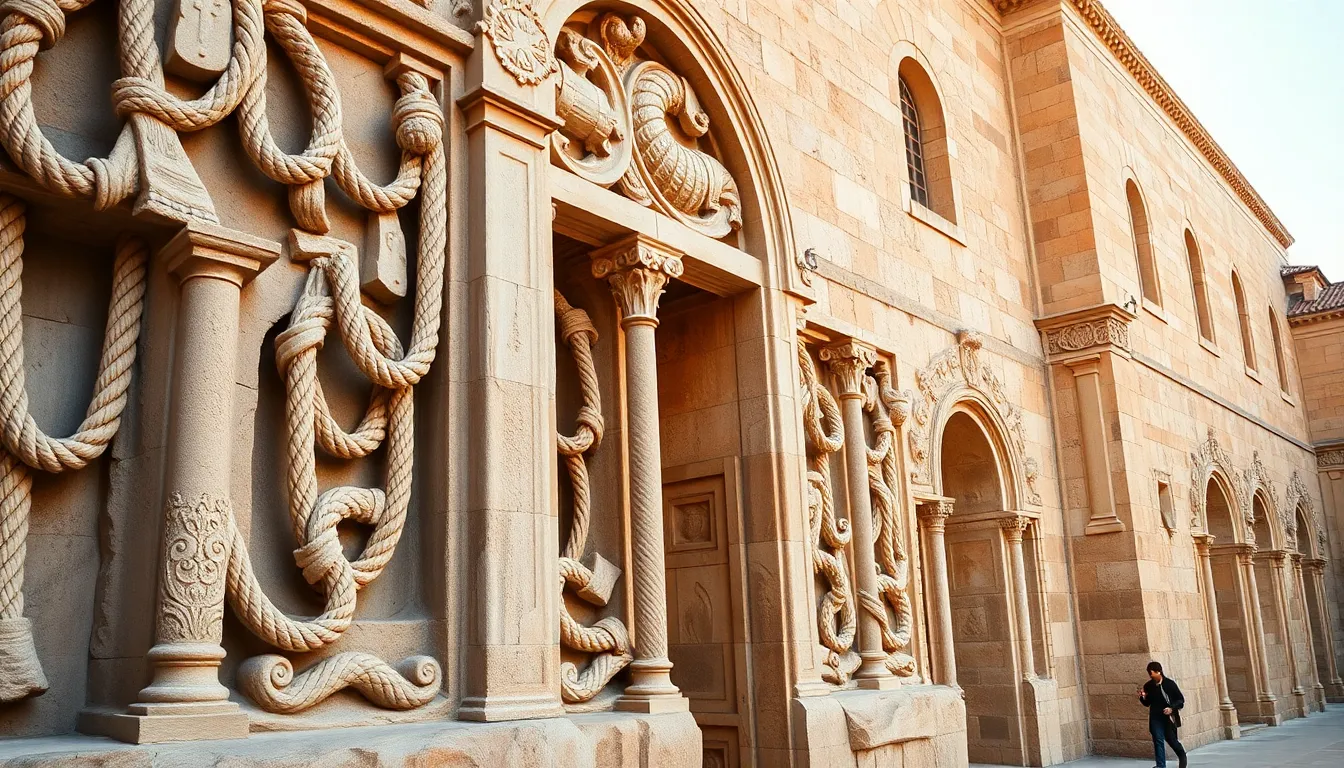
I have a habit when I bring a group to the Jeronimos Monastery for the first time. I do not say anything for the first minute. I just let them walk into the cloister and look up. Because Manueline architecture rewards the eye before it rewards the explanation. You see ropes carved in stone, knots, coils, anchors, armillary spheres, coral, artichokes, all of it climbing the columns and arches, and the question forms on its own: what kind of faith carves the rigging of a ship into the house of God?
That question is the doorway into Manueline architecture, and into the moment in Portuguese history that produced it. Let me open it up for your group.
What Manueline Architecture Is
Manueline is the Portuguese late-Gothic style, and it takes its name from King Manuel I, who reigned from 1495 to 1521. That was the height of the Age of Discovery, when Portuguese ships rounded the Cape of Good Hope, reached India, and opened the sea routes that made a small Atlantic kingdom suddenly, staggeringly rich.
Manueline is what that wealth and that adventure did to architecture. It takes the bones of Gothic, the pointed arches and the ribbed vaults, and covers them in an explosion of carved ornament drawn from the sea and from exploration. It flourished for a short, intense window, roughly the last decades of the fifteenth century and the first few of the sixteenth, before tastes turned toward the Renaissance. A brief golden age, fused to a single generation of Portuguese triumph.
I tell groups to think of it this way. Gothic architecture reaches up toward heaven. Manueline architecture reaches up toward heaven and out across the ocean at the same time. It is faith and seafaring spoken in one breath.
Reading the Symbols
The pleasure of Manueline for a group is that the symbols are legible once you know them, and they carry meaning. Here is what to look for.
The Armillary Sphere
The armillary sphere, a model of the heavens made of interlocking rings, was the personal emblem of King Manuel I and became the signature motif of the style. It appears everywhere in Manueline buildings. It speaks of navigation, of the order of the cosmos, and of a king who understood his maritime empire as part of a divinely ordered creation. When your group spots an armillary sphere, they are looking at the royal signature on the whole age.
The Cross of the Order of Christ
The Order of Christ was the successor in Portugal to the Knights Templar, and its distinctive cross, a red cross with flared arms and a smaller white cross within, sailed on the sails of Portuguese ships. In Manueline buildings it appears again and again in stone. It binds the exploration directly to the faith, declaring that the voyages were undertaken under the sign of the cross, as a continuation of the crusading mission by sea.
Ropes, Knots, Anchors, and Coral
The maritime ornament is the most striking feature. Stone is carved to look like twisted ship’s rope, sailors’ knots, anchors, chains, seaweed, coral, and shells. Columns are wrapped as if rigged. Doorways are framed in stone cables. This is the sea brought into the church, a sanctification of the voyages, a statement that the work of the ships was holy work.
Natural and Exotic Forms
Alongside the maritime motifs you find plants, artichokes, pinecones, laurel, and forms inspired by the newly encountered worlds of Africa, India, and Brazil. The carvers were depicting a world suddenly grown larger, and reading it all as the handiwork of the Creator whose creation Portugal was now sailing across.
Where Groups Encounter Manueline
The style is concentrated in a handful of buildings, and three of them belong on any faith itinerary.
The Jeronimos Monastery, Lisbon
This is the masterpiece. Commissioned by King Manuel I in 1501 and funded by the wealth of the spice trade, the Jeronimos Monastery in the Belem district was built to give thanks for Vasco da Gama’s voyage to India and to serve as a spiritual home for sailors departing into the unknown. Da Gama himself prayed on the site before he sailed, and he is entombed inside.
The south portal is a vast carved screen of saints, prophets, and scenes from the life of Saint Jerome. Inside, the columns rise and branch into the vaulting like a stone forest, slender and impossibly tall for their period. The two-story cloister is the heart of the building, every arch carved differently, maritime and religious imagery interlaced across the whole. I give a group serious time here, because the Jeronimos is where Manueline reaches its fullest expression, and where the fusion of faith and exploration is most complete.
A short walk away stands the Belem Tower, a fortified Manueline gateway on the river, carved with the same armillary spheres and Order of Christ crosses, and worth pairing with the monastery.
Batalha Monastery
Batalha, near Fatima, was begun in pure Gothic in 1386 as a vow fulfilled to God after the Battle of Aljubarrota, but it was completed over more than a century, so it carries Manueline work in its later sections. The most famous is the Unfinished Chapels, where the great unroofed octagon is framed by a Manueline doorway carved in extraordinary, almost overwhelming detail. The contrast at Batalha, the restrained early Gothic giving way to the exuberant Manueline, lets a group see the style emerge before their eyes.
The Convent of Christ, Tomar
The Convent of Christ in Tomar, headquarters of the Order of Christ, holds the single most famous piece of Manueline carving in Portugal: the Chapter Window. This window is a riot of carved rope, coral, cork-oak branches, an armillary sphere, the Order of Christ cross, and a sailor’s belt looped across the base. It is, in a single window, the entire program of Manueline symbolism. Groups who care about the style should not miss it.
Why It Matters for a Faith Group
I tell my groups that Manueline architecture is not just decoration to admire. It is a theological argument carved in stone.
In this one generation, Portugal believed it had been entrusted by God with a mission to carry the faith across oceans no Christian had crossed before. The Manueline churches are the visible expression of that conviction. The ropes and spheres and crosses are saying, in stone, that the voyages were sacred, that the sea was God’s, that exploration was a form of worship. Whether or not you share that reading of history, standing inside the Jeronimos Monastery you understand exactly what an entire nation believed God was calling it to do.
That is why I weave the Manueline sites through a Christian pilgrimage to Portugal. They give the group the Age of Exploration chapter of the faith, sitting alongside the founding-era story at the Cathedral of Lisbon and the modern devotion at Fatima. You can see how we build the Lisbon and Belem days on our Portugal destination page.
FAQ: Manueline Architecture
What is Manueline architecture?
Manueline is the Portuguese late-Gothic style, named for King Manuel I, who reigned from 1495 to 1521. It flourished during Portugal’s Age of Discovery and takes the structure of Gothic architecture, with its pointed arches and ribbed vaults, and covers it in carved ornament drawn from the sea and from exploration, including ropes, knots, anchors, coral, armillary spheres, and the cross of the Order of Christ.
What do the symbols in Manueline carving mean?
They tie faith to exploration. The armillary sphere was King Manuel’s personal emblem and signals navigation and the divine order of the cosmos. The cross of the Order of Christ, successor to the Knights Templar, sailed on Portuguese ships and binds the voyages to the crusading mission. The carved ropes, knots, anchors, and coral bring the sea into the church, declaring the voyages to be holy work undertaken under the sign of the cross.
Where is the best place to see Manueline architecture?
The Jeronimos Monastery in Lisbon’s Belem district is the masterpiece and the fullest expression of the style. The nearby Belem Tower shares its carving. Batalha Monastery near Fatima shows Manueline work in its Unfinished Chapels, and the Convent of Christ in Tomar holds the famous Chapter Window, often considered the single most elaborate piece of Manueline carving in Portugal.
How does Manueline differ from regular Gothic architecture?
Manueline keeps the Gothic skeleton, the pointed arches and ribbed vaults, but adds an explosion of ornament unique to Portugal’s seafaring moment. Where Gothic reaches upward toward heaven, Manueline reaches upward and outward across the ocean at once, fusing religious imagery with maritime and exploration motifs. It was a brief, intense style tied to a single generation of Portuguese discovery.
Why does Manueline architecture matter for a Christian pilgrimage?
Because it is a theological statement in stone. The Manueline churches express Portugal’s conviction that it had been called by God to carry the faith across the oceans, and they make the Age of Exploration chapter of Christian history visible and tangible. Standing in the Jeronimos Monastery, a group grasps what an entire nation believed its God-given mission to be. Contact us to build these sites into your Portugal journey.
Manueline architecture is one of those things a group has to stand inside to understand, and the Jeronimos cloister does the explaining better than I ever could. If you are planning a Portugal pilgrimage, I would love to make sure these carved-stone chapters are part of it. Reach out and we will shape the Lisbon days together.