The first time I led a group to Portugal, I made the mistake almost everyone makes. I treated Fatima as the destination and everything else as filler. Get to Fatima, spend a day, then fill out the week with whatever was nearby. By the end of that trip I understood I had it backwards. Fatima is the heart, yes. But Portugal gives a Christian group a complete arc, from the founding of a Christian kingdom in the twelfth century to a Marian apparition that shaped the twentieth, and the journey works best when you build the whole arc on purpose.
So let me walk you through how I structure a Christian pilgrimage to Portugal now, after years of refining it. Not a list of sites. A journey with a shape.
Start With the Question Your Group Is Actually Asking
Before I route a single day, I ask the group leader one thing. What do you want your people to carry home?
That sounds soft, but it determines everything. A parish that wants a Marian devotional experience needs Fatima at the center with long, unhurried hours at the Capelinha. A group of educators who want to understand how faith built a nation needs more time at Batalha, Alcobaca, and the Reconquista sites. A mixed congregation usually wants both, which is fine, but it changes the pacing.
I have learned not to skip this conversation. A pilgrimage is not a sightseeing trip with prayers attached. The structure has to serve the spiritual intention, or you end up with a group that saw a lot and felt little.
The Core Route: Fatima and Beyond
Most of my Portugal pilgrimages run eight to ten days. That is enough to do the heart of the country without sprinting. Here is the spine I build from.
Lisbon as the Arrival and the Grounding
Almost every group flies into Lisbon, and I never treat it as just an airport. Lisbon gives you the Age of Exploration faith story in stone. The Jeronimos Monastery in Belem is the grandest expression of Portuguese faith and ambition fused together, built from the wealth of the spice trade to celebrate Vasco da Gama’s voyage. The carved south portal, the forest of ribbed vaulting inside, the two-story cloister, all of it tells you what a seafaring nation believed God was calling it to do.
Walk down through the old city and you reach the Cathedral of Lisbon, the Se, a Romanesque fortress of a church begun in 1147, the year the city was taken back from Moorish rule. Saint Anthony of Padua, the most beloved of Portuguese saints, was baptized there. Starting a pilgrimage at the Se grounds your group in the deep history before you move toward the modern miracle at Fatima.
Fatima at the Center
From Lisbon it is about ninety minutes north to Fatima, and this is where the trip slows down on purpose. I give a full day at minimum, often a night as well, so the group can be present for the evening candlelight procession and morning Mass.
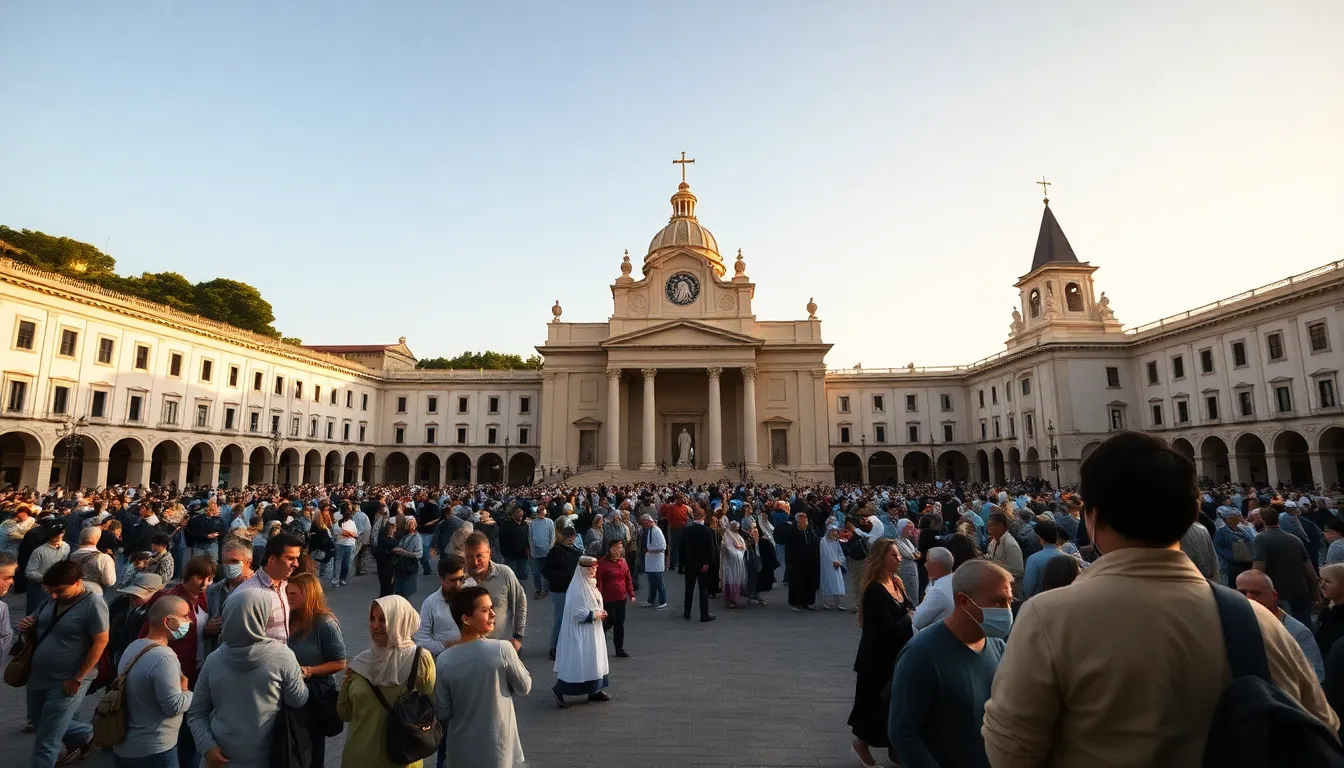
Fatima is not a place you walk through. It is a place you sit in. The Capelinha das Aparicoes, the small open-air chapel on the exact spot of the 1917 apparitions, is the single most visited point in the whole sanctuary, and it is humble compared to the basilicas around it. That humility is the point. If your dates allow you to be there on or near the 13th of the month, your group will witness something that words do not fully prepare them for. I cover the May and October pilgrimages to Fatima in detail separately, because the timing decision is large enough to deserve its own conversation.
The Monastic Triangle Around Fatima
Within an easy radius of Fatima sit three of the most significant churches in Portugal, and skipping them is the most common itinerary mistake I see.
Batalha, about twenty kilometers away, was built as a literal promise to God. King Joao I vowed to build a monastery to the Virgin Mary if he won the Battle of Aljubarrota in 1385. He won, and construction ran for over a century. The Founder’s Chapel holds his tomb beside his English wife Philippa of Lancaster, their stone hands clasped. The Unfinished Chapels, open to the sky, were never completed, and that incompleteness preaches its own quiet sermon about the limits of human ambition.
Alcobaca, founded in 1153 by Portugal’s first king and given to the Cistercians, is the largest church in the country and the opposite of Batalha in spirit. The Cistercians built in austerity. Clean lines, minimal decoration, beauty drawn from proportion and light rather than carved images. After the intensity of Fatima, Alcobaca invites a different and quieter kind of prayer.
Tomar, a little farther out, gives you the Convent of Christ, headquarters of the Knights Templar in Portugal, with a twelve-sided Templar church modeled on the Holy Sepulchre in Jerusalem. For groups drawn to the crusading and military-religious history, this is where it lives.
Pacing: The Thing Most Itineraries Get Wrong
I will say this plainly because it matters more than any single site. Most pilgrimage itineraries are too full. Group leaders, wanting to give their people value, cram in a tenth stop, and the group arrives at the most important moment of the trip exhausted and unable to feel it.
Build in margin. One major site in the morning and one in the afternoon is a full day for a mixed-age group. Leave the evenings open near Fatima so people can return to the Capelinha on their own, light a candle, sit. The unscheduled hours are often where the real pilgrimage happens.
For older travelers, factor in the walking. Batalha and the Jeronimos involve a lot of standing on stone floors. Fatima’s plaza is enormous. A good pace protects the spiritual experience, not just the knees.
Logistics That Make or Break the Trip
A few practical pieces I have learned the hard way.
Book Mass times in advance. If you want your group to celebrate Mass in the Capelinha or in one of the basilicas at Fatima, that has to be arranged ahead, especially around the 13th when the sanctuary handles enormous crowds. The same is true for any group Mass at the cathedrals.
Coordinate a guide who knows the faith dimension, not just the architecture. There is a real difference between a guide who recites construction dates and one who can hold the spiritual weight of a place for your group. I bring guides who understand they are serving a pilgrimage.
Think about the shoulder season. Portugal in late spring and early autumn gives you mild weather and lighter crowds at every site except Fatima on the pilgrimage dates, which are intentionally crowded and all the more powerful for it.
One thing worth knowing as you plan the group economics: with Heritage Tours, the group leader travels free with fifteen or more participants. That threshold shapes the conversation with your parish or congregation, and the earlier you confirm the trip, the easier it is to build your group to that number.
A Sample Shape, Start to Finish
To make it concrete, here is a rhythm that works for an eight-day group.
- Days 1 to 2: Arrive Lisbon, recover from the flight, the Se cathedral and the Jeronimos Monastery, Saint Anthony’s church.
- Day 3: Travel north, Alcobaca in the afternoon.
- Days 4 to 5: Fatima, with a full day and an overnight for the evening procession and morning Mass.
- Day 6: Batalha in the morning, Tomar in the afternoon.
- Day 7: A northern extension toward Coimbra or the sanctuary at Santa Luzia in Viana do Castelo, depending on the group’s appetite for travel.
- Day 8: Return to Lisbon and depart.
You can compress this to a week or stretch it to ten days with a Porto extension. The shape holds either way. You can see how we frame these journeys on our Portugal destination page and how the group-leader experience works through our group heritage tours.
FAQ: Planning a Christian Pilgrimage to Portugal
How many days do you need for a Christian pilgrimage to Portugal?
Eight to ten days is the sweet spot for doing the heart of the country without rushing. That covers Lisbon, Fatima with an overnight, and the monastic triangle of Batalha, Alcobaca, and Tomar. You can do a focused version in six or seven days, or extend to ten with a Porto and northern Portugal addition. Fewer than six days forces you to cut something that matters.
Is Fatima the only reason Christians go on pilgrimage to Portugal?
No, though it is the center for most groups. Portugal offers a full arc of Christian heritage, from the founding of the kingdom during the Reconquista in the twelfth century, to the great monastic foundations of Batalha and Alcobaca, to the Age of Exploration faith expressed at the Jeronimos Monastery, to the modern Marian apparitions at Fatima. A well-built pilgrimage connects all of these rather than treating Fatima as a single stop.
When is the best time to take a group on pilgrimage to Portugal?
Late spring and early autumn give the most comfortable weather and lighter crowds at most sites. The exception is Fatima on and around the 13th of the month, May through October, when the sanctuary is intentionally full for the major pilgrimages. Many groups plan specifically to be present on those dates because the experience is so powerful, and accept the crowds as part of it.
Do we need to arrange Mass in advance?
Yes, if you want your group to celebrate Mass at a specific site such as the Capelinha at Fatima or one of the cathedrals. This is especially important around the 13th of the month when the Fatima sanctuary manages very large crowds. We coordinate Mass times and group access ahead of the trip so your itinerary is confirmed before you arrive.
How large does our group need to be?
We work with groups of various sizes, and the group leader travels free with fifteen or more participants. That threshold matters for the planning conversation with your parish or congregation, so the sooner you confirm dates and begin inviting people, the easier it is to reach. We are happy to help you think through how to build and market the trip to your community. Contact us and we will talk it through.
If you are beginning to picture a pilgrimage for your community, I would welcome the conversation. The structure of a Portugal journey rewards thought, and the right shape is the one that fits your people and what you want them to carry home. Reach out whenever you are ready to start planning.