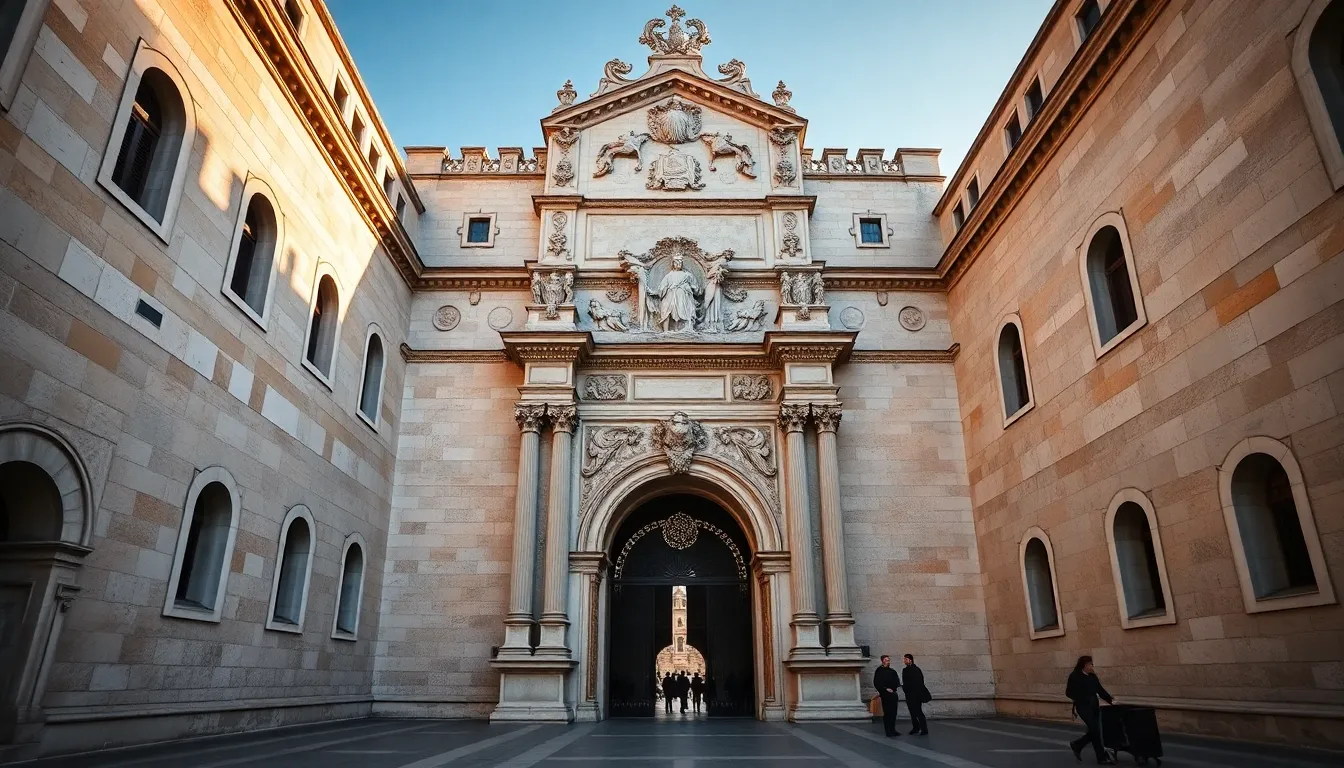
When I bring a group to Belem, I do not start with facts. I just let them stand in front of the south portal of the Jeronimos Monastery for a minute and look up. It is a wall of carved limestone, dozens of feet high, dense with saints, prophets, angels, and Saint Jerome himself, every surface worked until the stone looks soft. People go quiet, then they start pointing. There is too much to take in at once, and that overwhelm is exactly the point. The men who built this church wanted it to feel like more than a building could hold, because they believed Portugal’s voyages across the oceans were nothing less than a divine commission.
This is the most celebrated monument in Lisbon and one of the great churches of the Age of Discovery. Here is what your group needs to understand to feel it, not just see it.
A Church Built on the Spice Trade and a Sense of Mission
King Manuel I commissioned the Jeronimos Monastery in 1501, and the funding came from a remarkable source: a tax on the spices, gold, and goods flowing back from Portugal’s new trade route to India. Vasco da Gama had returned from that first sea voyage to India in 1499, and the monastery rose in part to celebrate and give thanks for it. The site itself was chosen with care. It stood near the spot on the Tagus where da Gama and his crew had spent their last night in prayer before sailing into the unknown.
Manuel gave the monastery to the Order of Saint Jerome, the Hieronymites, whose monks were charged with praying for the king’s soul and for the safety of the sailors and explorers who set out from these shores. That is the heart of the place, and it is what I most want a faith group to grasp. To the Portuguese of that age, exploration and faith were not separate enterprises. They believed they were carrying Christianity to the ends of the earth, and they built this church as both a thanksgiving for what had been found and a prayer for those still at sea.
The style born here even carries the king’s name. Manueline architecture is Portugal’s own late-Gothic flowering, and it weaves the symbols of the sea straight into sacred space: carved ropes, knots, anchors, armillary spheres, and the cross of the Order of Christ, all wrapped around saints and biblical scenes. Nowhere is it more fully realized than at the Jeronimos.
What a Group Sees Inside
The South Portal and the Church
Start outside at the great south portal, then move to the church itself. Inside, the columns are the thing. They rise like the trunks of trees and branch out near the top into ribbed vaulting that spreads across the ceiling, so the whole interior feels like a stone forest. There are no heavy walls breaking up the space; the slender columns carry the vast roof, which gives the church an airy, almost weightless quality despite its size. Remarkably, this vaulting survived the catastrophic 1755 Lisbon earthquake that destroyed so much of the city. For your group, that survival is part of the story: the church that prayed for sailors at sea outlasted the disaster that leveled the capital.
The Tombs of Vasco da Gama and Camoes
Just inside the main entrance, in the lower choir, lie two tombs that anchor the whole national story. On one side rests Vasco da Gama, the explorer whose voyage to India opened the sea route that funded this very building. On the other side lies Luis de Camoes, Portugal’s national poet, whose epic Os Lusiadas framed the Portuguese voyages as a sacred and national destiny. The pairing is deliberate: the man who made the voyage and the man who turned it into scripture-like verse, resting at the threshold of the church the voyages built. I always pause a group here. To understand Portugal, you stand between these two tombs.
The Cloister
For many of my groups, the cloister is the high point of the whole visit. Two stories of carved arches surround a quiet courtyard, and no two columns are exactly alike. The carving mixes maritime imagery, gargoyles, fantastical creatures, and religious symbols in a way that captures the Portuguese imagination of the period: a people who looked out at the unknown ocean and saw both danger and divine calling. It is one of the most beautiful enclosed spaces in Europe, and it invites the slow, reflective walk that a faith group does so well. The poet Fernando Pessoa is also memorialized here, a quieter, modern note among the explorers and kings.
Why the Jeronimos Belongs on Your Itinerary
The Jeronimos completes a picture that the inland monasteries begin. Alcobaca shows the austere, contemplative faith of the Cistercians. Batalha shows the Gothic grandeur of a royal vow. The Jeronimos shows what happened when Portuguese faith met the open ocean and the wealth of a global trade route: confident, exuberant, certain it was doing God’s work in sailing to the ends of the earth. For groups interested in how faith shaped European exploration, and how that exploration in turn reshaped the faith, no site says it more completely.
It is also simply convenient. The monastery sits in Belem, a riverside district of Lisbon that holds several major sights within an easy walk, which makes it efficient to fold into a day in the capital. And it pairs naturally with the intimate Lisbon story of Saint Anthony on the other side of the city, giving a group both the monumental and the human-sized faces of Lisbon’s faith.
Practical Notes for Group Leaders
The Jeronimos is a UNESCO World Heritage Site and one of the most visited places in Portugal, so lines can be long. Book timed entry in advance for a group, and aim for early morning or later afternoon to avoid the heaviest crowds. The church itself is often free to enter, while the cloister requires a ticket, and the cloister is the part you do not want to miss. Allow ninety minutes to two hours.
While you are in Belem, the famous custard tarts, the pasteis de Belem, come from the bakery right beside the monastery, baked from a recipe that originated with the monks. It is a fitting, and delicious, way to close a visit that began with the monastery’s spiritual purpose. The Monument to the Discoveries and the Belem Tower are a short walk along the river if your schedule allows.
I usually pair the Jeronimos with the Saint Anthony sites in the Alfama on a Lisbon day, and set it against the contemplative Alcobaca monastery to give a group the full range of Portuguese faith.
FAQ: The Jeronimos Monastery
Why was the Jeronimos Monastery built?
King Manuel I commissioned it in 1501 to give thanks for Vasco da Gama’s successful sea voyage to India and to honor the Age of Discovery. It was funded by a tax on the spice trade that the new sea route opened. He gave it to the Order of Saint Jerome, whose monks prayed for the king’s soul and for the safety of the sailors setting out from nearby on the Tagus. It expresses the Portuguese belief that their voyages were a divine mission.
Who is buried in the Jeronimos Monastery?
The explorer Vasco da Gama and the national poet Luis de Camoes lie in tombs just inside the church entrance, on opposite sides of the lower choir. The poet Fernando Pessoa is also memorialized in the cloister. The pairing of da Gama and Camoes is deliberate: the man who made the voyage to India and the man whose epic poem turned that voyage into Portugal’s national and spiritual story.
What is Manueline architecture?
Manueline is Portugal’s distinctive late-Gothic style, named for King Manuel I, and the Jeronimos Monastery is its greatest masterpiece. It weaves maritime symbols, carved ropes, knots, anchors, armillary spheres, and the cross of the Order of Christ, into sacred architecture alongside saints and biblical scenes. The style reflects Portugal’s identity as a seafaring nation that understood its exploration as a divine calling.
Where is the Jeronimos Monastery and how do I visit with a group?
It is in Belem, a riverside district in the west of Lisbon, easily reached from the city center. It is one of Portugal’s most visited sites, so lines can be long. For a group, book timed entry in advance and aim for early morning or late afternoon. The church is often free, while the cloister requires a ticket and should not be missed. Allow ninety minutes to two hours.
What else is near the Jeronimos in Belem?
Belem packs several sights into a short walk. The famous pasteis de Belem custard tarts, based on a recipe from the monastery’s monks, are baked right next door. The Monument to the Discoveries and the riverside Belem Tower are both a short stroll away. This concentration makes Belem an efficient half-day for a group, with the monastery as its spiritual and architectural centerpiece.
If you are planning a day in Lisbon for your community, the Jeronimos Monastery is the stop I most want a group to experience unhurried. It pairs naturally with the Saint Anthony sites and rounds out the wider monastery route through Portugal. You can see how it fits the journey on our spiritual sites in Portugal guide and our Portugal destination page.
We build these itineraries around groups, and through our group heritage tours the group leader travels free with fifteen or more participants. Contact us when you are ready to start planning.