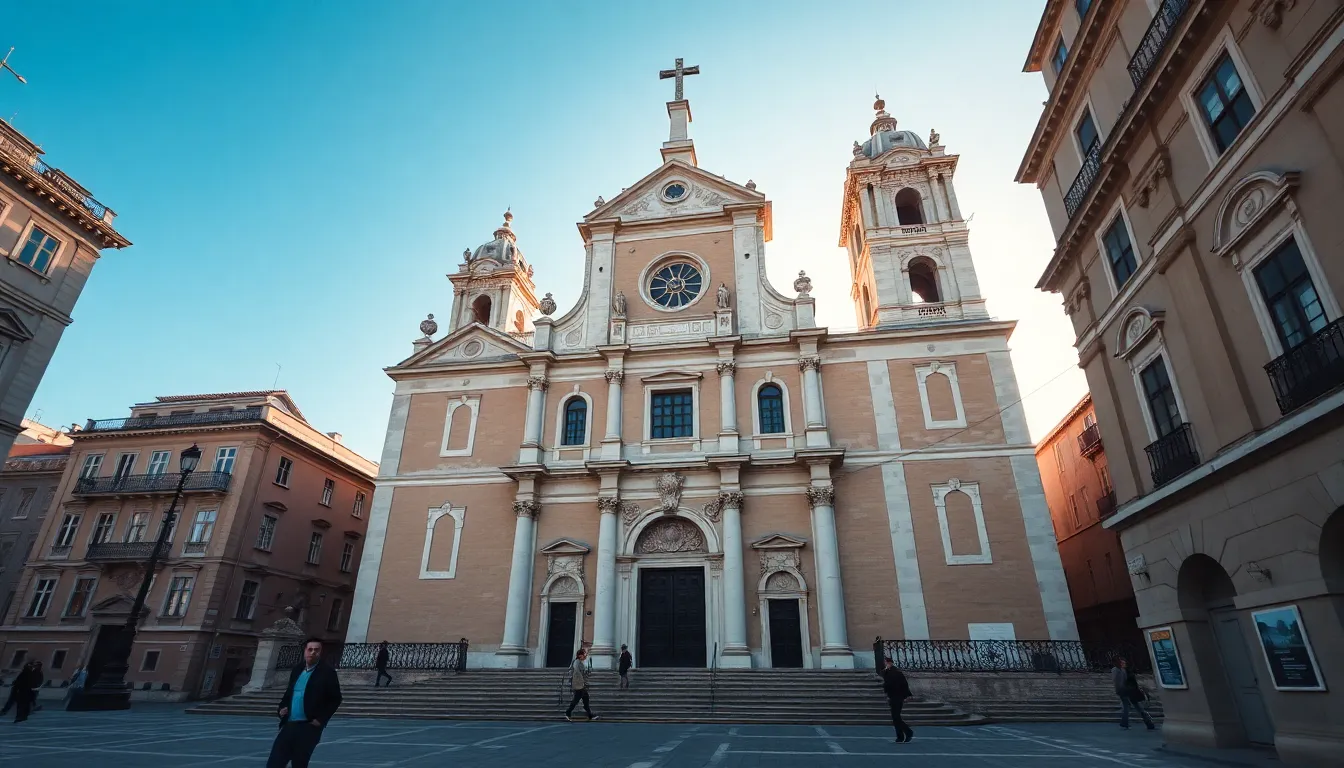
The first time I brought a group to the little church behind Lisbon’s cathedral, one of the pastors with me stopped at the door and said, “Wait. He was born here? In Lisbon? I always thought he was Italian.” That happens almost every time. The world knows him as Saint Anthony of Padua, the patron saint of lost things, and most travelers never learn that the man was a Lisbon native who lived the first half of his life on Portuguese soil. If you are bringing a group to Portugal, this is one of the most rewarding stories you can put in front of them, because it corrects a misunderstanding most of them are carrying without knowing it.
Let me walk you through who he was, where to stand in Lisbon, and what happens in June when the whole city turns out for him.
Who Saint Anthony Actually Was
He was born Fernando Martins de Bulhoes in Lisbon around 1195, into a well-off family. His birthplace sat near the cathedral, in the old part of the city that climbs up toward the castle. As a young man he joined the Augustinian canons, first at the monastery of Sao Vicente in Lisbon and later at the larger house in Coimbra, where he received a serious theological education and access to one of the best libraries in the kingdom.
The turning point came in 1220. The relics of five Franciscan friars who had been martyred in Morocco were brought back to Coimbra. Fernando was moved by their witness, left the Augustinians, joined the new Franciscan order, and took the name Anthony. He set out for Morocco himself, intending to preach and, if it came to it, to die as those friars had. Illness forced him to turn back. The ship meant to carry him home was blown off course to Sicily, and that detour is how a Lisbon man ended up spending his final years in Italy.
His gift as a preacher was discovered almost by accident at an ordination in Forli, where no one had prepared a sermon and Anthony was asked to speak. What came out astonished everyone present. From then on he preached across northern Italy and southern France, drawing enormous crowds, often against the heresies of the day. He was a scholar with a rare command of scripture, and Francis of Assisi himself trusted him to teach theology to the friars.
He died near Padua in 1231, only thirty-five or thirty-six years old. He was canonized less than a year later, one of the fastest canonizations in the history of the Church, and in 1946 he was declared a Doctor of the Church. The popular image of him holding the infant Christ and a lily came later, but the devotion was immediate and it never faded.
Where to Stand in Lisbon
The Church of Saint Anthony
The single most important stop is the Igreja de Santo Antonio, the Church of Saint Anthony, built directly over the house where tradition holds he was born. It sits just below the cathedral in the Alfama district. The church you see today is mostly eighteenth century, rebuilt after the 1755 earthquake that flattened much of Lisbon, but the crypt below preserves the spot venerated as his birthplace.
When I bring a group here, I take them down into the crypt first. It is small and quiet, and standing in the place where a Doctor of the Church entered the world tends to settle a group in a way that the grander basilicas elsewhere do not. There is no crowd to fight, no ticket line. It is intimate, which is exactly right for this saint.
The Cathedral Next Door
A few steps uphill stands the Se de Lisboa, the cathedral, where Anthony was baptized. It is Lisbon’s oldest church, begun in 1147 right after the city was taken from the Moors, and its fortress-like Romanesque front has survived earthquakes that destroyed almost everything around it. For a faith group, the pairing matters: the child was born in the house below and baptized in the great church above, and you can walk between the two in three minutes.
The Museum and the Wider City
Beside the church there is a small municipal museum dedicated to Anthony, useful for groups who want the fuller story of his life and his cult. From there, the Alfama itself becomes part of the visit. These are the streets he would have known as a boy, the steep lanes that still smell of grilled sardines in summer, and they give your group a sense of the ordinary world that produced an extraordinary man.
The June Festival: Lisbon’s Patron Comes Home
If your itinerary can land in Lisbon in June, you will see something most visitors never do. Saint Anthony is the unofficial patron of the city, and his feast day, June 13, is the center of the Festas de Lisboa, weeks of celebration that take over the entire city.
The night of June 12 into the 13th is the heart of it. The Alfama and the other old neighborhoods string up colored paper, set out grills, and stay up until dawn. Sardines are everywhere. Brass bands play, neighborhoods compete in the marchas populares parades down the Avenida da Liberdade, and the whole city has the feel of a single enormous block party held in honor of a friar who died eight hundred years ago.
There is a quieter, deeply Catholic layer underneath the festival that I always make sure my groups see. Anthony has long been invoked as a patron of marriage, and on his feast day the cathedral hosts the casamentos de Santo Antonio, the Saint Anthony weddings, in which couples are married together in a public ceremony tied to the saint. Watching dozens of couples marry under his patronage, with the city celebrating around them, tells you more about living Portuguese faith than any guidebook can.
For a group leader, June is a tradeoff. The city is crowded and hotel prices climb, so this is a window to book well ahead. But the experience of being in Lisbon for Anthony’s feast is something your people will talk about for years. If you want it, plan early.
Why This Stop Belongs on a Heritage Itinerary
Portugal’s better-known faith sites pull most of the attention, and they should. But Saint Anthony gives a group something different: a human-sized story they can hold. He was a real young man from a real Lisbon neighborhood who gave up comfort and learning for a harder road, became one of the great preachers of the Middle Ages, and died young and far from home. For pastors and educators especially, his life is a teaching gift. It connects the medieval Church to a specific street you can stand on.
I usually pair this stop with the larger monastery sites so a group sees both registers, the intimate and the monumental. You can see how that fits together on our spiritual sites in Portugal guide, and it sits naturally alongside a visit to the Jeronimos Monastery in Belem on the same day in Lisbon.
FAQ: Saint Anthony of Lisbon
Was Saint Anthony from Lisbon or Padua?
He was born in Lisbon around 1195 and lived the first half of his life in Portugal, in Lisbon and then Coimbra. He is called Saint Anthony of Padua because he spent his final years in Padua, Italy, and died there in 1231. In Portugal he is known as Saint Anthony of Lisbon, and the city considers him its own. Both names refer to the same man.
What is Saint Anthony the patron saint of?
He is best known as the patron saint of lost things and lost people, which is why so many people pray to him when something goes missing. He is also a patron of the poor, of travelers, of sailors, and, in Portugal, of marriage. He was declared a Doctor of the Church in 1946 in recognition of his teaching and his command of scripture.
Can groups visit the church where he was born?
Yes. The Church of Saint Anthony in the Alfama district is built over his traditional birthplace, and the crypt below preserves the venerated spot. It is a short, manageable stop, just below the cathedral where he was baptized, which makes the two an easy pairing for a group. Entry to the church is straightforward and the site is rarely crowded outside the June festival.
When is the Saint Anthony festival in Lisbon?
His feast day is June 13, and the celebrations run through much of June as part of the Festas de Lisboa. The biggest night is June 12 into the 13th, when the old neighborhoods fill with grilled sardines, parades, and music. The cathedral also hosts the traditional Saint Anthony weddings on the feast day. Plan a June visit well in advance, since the city is busy and rooms fill early.
Is Saint Anthony’s tomb in Portugal?
No. His tomb is in the Basilica of Saint Anthony in Padua, Italy, where he died and where his relics remain a major pilgrimage destination. In Lisbon you visit the place of his birth and baptism rather than his tomb. The two cities together hold the full arc of his life, the Portuguese beginning and the Italian end.
If you are building a Portugal itinerary and want your group to meet the real Saint Anthony, the Lisbon native rather than the souvenir-shop figure, I would be glad to help you place this stop where it lands best. It pairs naturally with Lisbon’s monasteries and the wider faith route through the country. You can see how we structure these journeys on our Portugal destination page and our group heritage tours, where group leaders travel free with fifteen or more participants.
Contact us when you are ready to start planning.