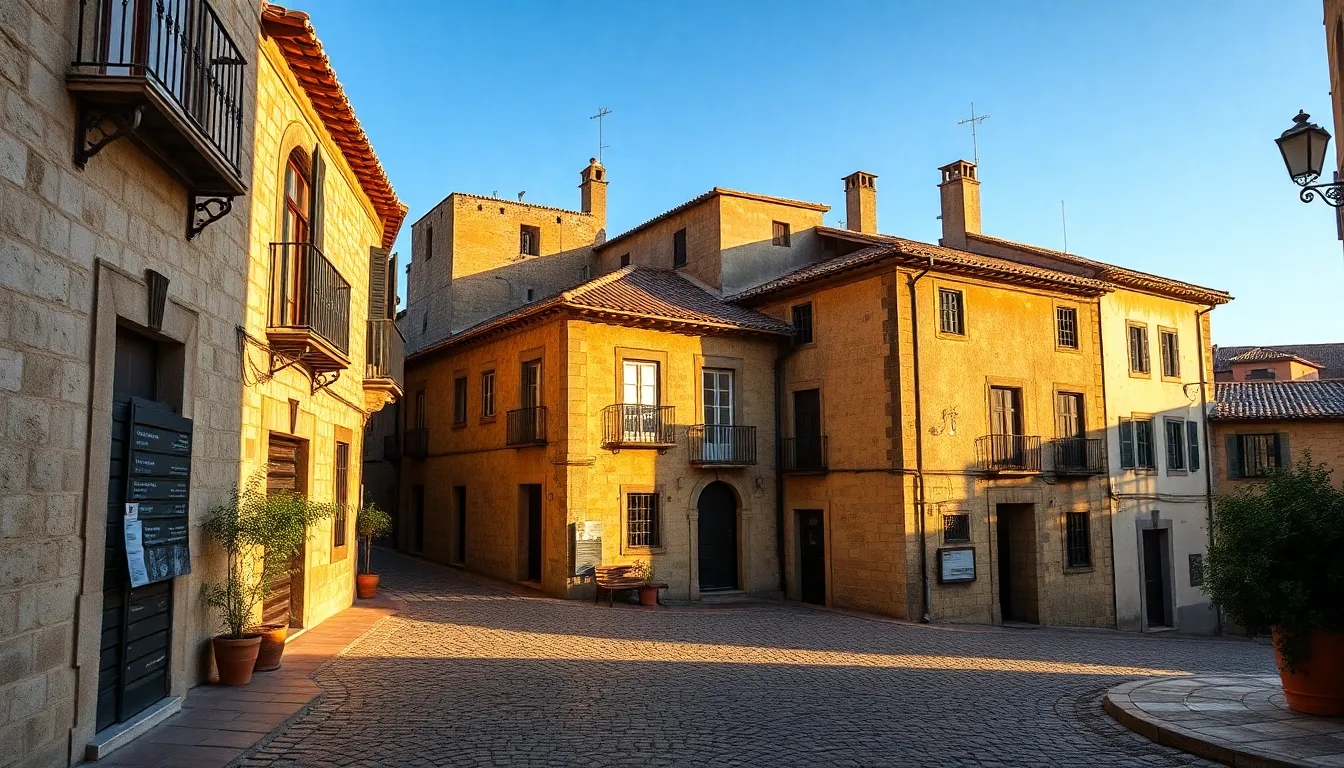
There is a Portugal that almost no first-time visitor sees, and it is the one I most want to show people. Drive east from Coimbra, away from the coast and into the granite highlands near the Spanish border, and you reach a string of stone villages clinging to hilltops, built from the rock they stand on. The Portuguese call them the Aldeias Historicas, the Historic Villages, twelve fortified settlements that the country has worked to preserve as a living record of its medieval frontier.
I bring groups here for a specific reason. This is where Portugal’s two great heritage stories, Christian and Jewish, are written into the same walls. These villages guarded the border against Castile, so they carry castles, churches, and the architecture of a Christian kingdom defending itself. And because they were remote and inward-looking, they became refuges for Jewish families after the forced conversions of 1497, places where a hidden faith could survive far from the eyes of the Inquisition. Walking these streets, you read both stories in the doorways.
Let me give you the trail.
What the Historic Villages Are
The Aldeias Historicas program brings together twelve villages across the interior districts of Guarda and Castelo Branco. They are not a single connected town but a network you travel between, each with its own character, linked by the shared story of the frontier. Most sit on defensible high ground, ringed by walls or crowned by a castle, built almost entirely of the gray granite that gives the region its severe, beautiful look.
What unites them for a heritage group is layering. These were Christian strongholds, and many hold Romanesque or Gothic churches and the remains of castles raised by Portugal’s early kings. They were also, in several cases, home to significant Jewish communities both before and after 1497, and the physical evidence of that Jewish life, far more visible here than in the cities, is what makes the trail extraordinary.
The Jewish Layer: Hidden Faith in Stone
Reading the Doorways
The most moving thing I show groups in these villages is the simplest. On the granite doorposts of certain old houses, you can still see carved crosses, and sometimes a small hollow or mark beside the door. After 1497, New Christian families, the conversos who had been forced to convert, sometimes carved crosses on their doorways to demonstrate their Christian faith to suspicious neighbors and Inquisition officials. Other marks are read as discreet signs of a Jewish presence, the trace of a mezuzah or a family quietly holding to the old ways.
Historians debate the precise meaning of individual marks, and I am honest with groups about that uncertainty. But the larger picture is not in doubt. These villages held communities living a double life, outwardly Christian and inwardly Jewish, for generations after the open practice of Judaism was outlawed. To stand at a doorway where that tension was lived daily, in stone you can touch, is something no museum can reproduce.
Belmonte and Trancoso
Two villages carry the Jewish story most fully. Belmonte is the famous one, the town where crypto-Jewish families practiced Judaism in secret for more than five hundred years, lighting Shabbat candles inside closed cupboards and observing Passover under the guise of spring cleaning, until they were rediscovered in the twentieth century. Today Belmonte has an active synagogue and a Jewish museum, and it is one of the most significant Jewish heritage sites in all of Europe. Our Portugal heritage guide tells the Belmonte story in full.
Trancoso is the quieter counterpart, and in some ways the more atmospheric. Its walled old town holds the famous Casa do Gato Preto, the House of the Black Cat, decorated with carvings long associated with the local Jewish community, and a building identified as a former synagogue and house of study. Walking Trancoso’s lanes, with the carved doorways and the old Jewish quarter laid out around you, is one of the experiences I most want Jewish groups to have in Portugal. For the southern reach of this same story, the Castelo de Vide and Marvao guide covers the best-preserved Judiaria in the country.
The Christian Layer: Castles, Churches, and the Frontier
Monsanto and Sortelha
If the Jewish layer is about hidden survival, the Christian layer is about visible defense. Monsanto is the village every photograph captures, a settlement built among and beneath enormous granite boulders, where houses are wedged under rocks the size of buildings and a ruined castle crowns the summit. It is often called the most Portuguese village in Portugal, a title it won in a 1938 competition, and the climb to the castle gives a view across the plains toward Spain that explains in one glance why these places were fortified.
Sortelha is the medieval village in its purest form, a complete walled town that looks almost untouched since the Middle Ages. You enter through a stone gate, walk streets where nothing modern intrudes, and reach a castle keep at the top. For Christian and historic-heritage groups, Sortelha and Monsanto together show how Portugal’s early kings held the eastern frontier, church and castle built side by side, faith and defense bound together.
Almeida and the Star Fortress
For groups interested in the later chapters, Almeida is a different kind of fortification, a star-shaped fortress town from the age of gunpowder, its twelve-pointed walls designed to deflect cannon fire. It guarded the border in the wars of the seventeenth and eighteenth centuries. Almeida shows that the frontier story did not end in the Middle Ages but continued for centuries, and its geometric ramparts are unlike anything else on the trail.
Planning the Historic Villages Trail
How the Route Works
The villages are spread across the interior, so this is a driving trail, not a single base you walk from. With a good local driver and a guide who knows the region, a group moves between three or four villages a day, with time at each to walk the streets, climb to a castle, and absorb the place. The roads through the highlands are quiet and scenic, winding through cork oak and granite country, and the transfers themselves become part of the experience.
I usually build the trail as a two to four day stretch within a wider Portugal itinerary, often connecting it to Coimbra to the west and Guarda or the Serra da Estrela to the north. Our Guarda and Serra da Estrela guide covers the mountain region that sits right alongside several of the villages.
A Guide Who Knows the Stones
This is the part I cannot overstate. The Historic Villages do not have the infrastructure of a major tourist site. There are no audio guides walking you through the carved doorways of Trancoso or the converso history of the region. The meaning here is local, often unmarked, and it lives with the people and guides who know these communities. In Belmonte you want someone who can introduce you to the Jewish community. In Trancoso and the smaller villages you want someone who can show you which doorway carries which mark and what it meant. Heritage Tours works with local operators throughout the Portuguese interior who know these villages and their stories.
When to Travel
The interior highlands are hot and dry in summer and genuinely cold in winter, with snow possible in the higher villages and the nearby Serra da Estrela. Spring and fall are the windows I recommend: comfortable temperatures for walking and climbing, green hills in spring, and the soft golden light of autumn over the granite. For Jewish groups, the fall window after the High Holidays works naturally and pairs well with the cooler highland weather.
For groups of 15 or more, the group leader travels free. That is how Heritage Tours honors the pastor, rabbi, or educator who gathers the community and makes the journey possible.
FAQ: The Historic Villages of Portugal
What are the Historic Villages of Portugal?
The Aldeias Historicas are twelve fortified villages in the granite highlands of the Portuguese interior, near the Spanish border, preserved as a network under a national heritage program. Built from local granite and crowned by castles and churches, they guarded the medieval frontier against Castile. For heritage travelers, they carry both Christian defensive history and one of the richest Jewish heritage stories in Europe.
What Jewish heritage can you see in the Historic Villages?
The villages hold visible traces of Jewish life that survived the forced conversions of 1497. Carved doorways, former synagogues, and old Jewish quarters remain in places like Belmonte and Trancoso. Belmonte’s crypto-Jewish community practiced in secret for over five hundred years and now has an active synagogue and museum. Trancoso preserves a former synagogue and carved houses tied to its Jewish community. A knowledgeable local guide is essential to read these traces.
Which villages should a group prioritize?
For Jewish heritage, Belmonte and Trancoso are the priorities. For Christian and frontier history, Monsanto with its boulder houses and castle, and Sortelha with its perfectly preserved walled town, are the standouts. Almeida adds a later star-shaped fortress for groups interested in the gunpowder-age frontier. A typical trail combines several of these over two to four days.
Do I need a guide for the Historic Villages?
Yes, strongly. Unlike major tourist sites, the villages have little interpretive infrastructure, and much of the meaning, especially the carved doorways and crypto-Jewish history, is local and unmarked. A guide who knows the region can introduce you to the Belmonte community and read the stones in Trancoso and the smaller villages. Heritage Tours works with local operators throughout the interior who know these villages well.
When is the best time to travel the Historic Villages trail?
Spring and fall are ideal. The interior highlands are hot in summer and cold in winter, with snow possible in the higher villages and the nearby Serra da Estrela. April through June and September through October give comfortable temperatures for walking and climbing, with green hills in spring and golden light in autumn. For Jewish groups, the fall window after the High Holidays pairs well with the cooler weather.
If a journey through Portugal’s hidden interior is right for your community, I would welcome the conversation. Start with our Portugal heritage guide, explore the Portugal destination page, or see how our group heritage tours work.
Contact us whenever you are ready to begin planning.