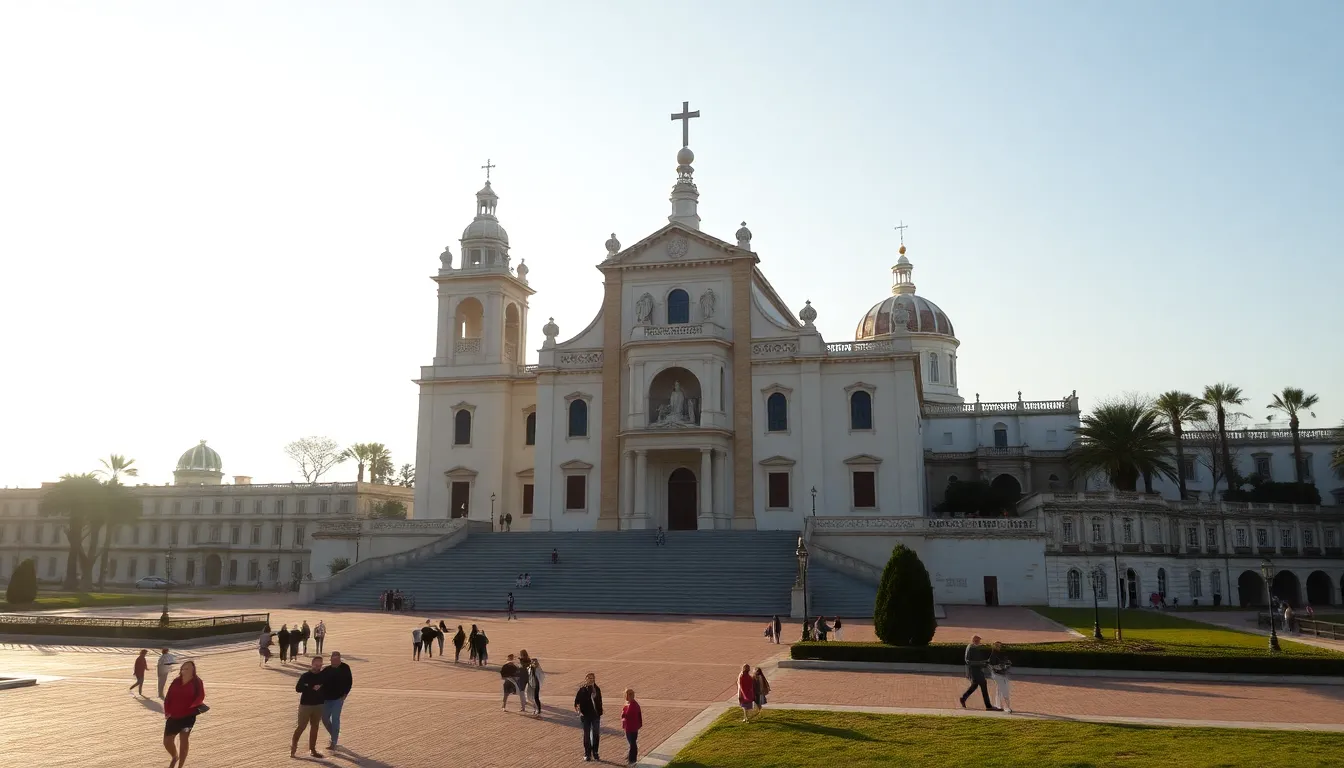
The first time I brought a group into the Sanctuary of Fatima, a pastor stopped me at the edge of the plaza and asked, quietly, “Is this it? It’s so big and so empty at the same time.” That is exactly right. Fatima is one of the largest pilgrimage spaces in the Catholic world, and the heart of it is a small open-air chapel you could walk past if you did not know what it was. Understanding how the place is laid out, and how a group moves through it, is the difference between a rushed photo stop and a morning your people will talk about for years.
Let me walk you through the sanctuary the way I walk a group through it.
What the Sanctuary of Fatima Actually Is
The Sanctuary of Our Lady of Fatima sits in the parish of Fatima, in central Portugal, about ninety minutes north of Lisbon. It grew up around a field called the Cova da Iria, where in 1917 three shepherd children reported a series of apparitions of the Virgin Mary. The Catholic Church investigated for thirteen years and recognized the events as worthy of belief in 1930. Everything you see on the site today was built around that field.
The scale is hard to convey until you stand in it. The main prayer plaza is roughly twice the size of the square in front of St. Peter’s in Rome. On the great pilgrimage days it holds hundreds of thousands of people. On an ordinary Tuesday in March it can feel almost still. Both versions of Fatima are worth experiencing, and which one your group gets depends entirely on timing, which I will come back to.
The Capelinha das Aparicoes: The Heart of It All
If your group sees only one thing at Fatima, it should be the Capelinha das Aparicoes, the Chapel of the Apparitions. This is the spot. The children said the Virgin appeared above a small holm oak tree here, and the chapel was built on that exact ground in 1919, only two years after the events.
It is deliberately plain. A simple covered structure, open on the sides, with a statue of Our Lady of Fatima marking the place of the apparitions. There is no grand architecture to admire and nothing to photograph that does it justice. What there is, instead, is prayer. At almost any hour you will find pilgrims kneeling here, and many of them have walked across the plaza on their knees to reach it, a traditional act of penance and devotion.
What I tell group leaders: this is where you slow down. Do not schedule the Capelinha as a five-minute stop between the basilicas. If your group can attend a Mass here, and Masses are offered throughout the day, that single experience justifies the visit for most Christian travelers. Sitting in the open air at the place of the apparitions, with pilgrims from a dozen countries around you, is the encounter people came for.
The Two Basilicas
The plaza is anchored at its two ends by two very different churches, and the contrast between them tells you something about how Fatima developed over a century.
The Basilica of Our Lady of the Rosary
At the north end stands the older basilica, begun in 1928 and consecrated in 1953. Its tall central tower is the image most people picture when they think of Fatima. Inside, it holds the tombs of the three shepherd children: Francisco and Jacinta Marto, who died young in the influenza pandemic that followed the First World War and were canonized as saints in 2017, and Lucia dos Santos, who lived into her late nineties as a Carmelite nun and was buried here in 2006.
For groups, standing at these tombs is a quiet, grounding moment. These were not legendary figures. They were real children from a poor farming family, and two of them are buried in a wall you can reach out and touch.
The Basilica of the Most Holy Trinity
At the south end is the modern basilica, completed in 2007 for the ninetieth anniversary of the apparitions. It is enormous, circular, and architecturally austere, with seating for around nine thousand people. Some pilgrims find it cold compared to the older church. Others find its plainness fitting. Either way, it exists for a practical reason: on the great pilgrimage days, the crowds simply outgrew every covered space on the site.
The Candlelight Procession
If your itinerary allows an overnight near Fatima, stay for the evening. After dark, pilgrims gather in the plaza with candles for the Rosary and the candlelight procession, when the statue of Our Lady is carried among the crowd and a sea of small flames moves across the square. I have watched group members who came skeptical end the evening in tears. It is the most moving hour the sanctuary offers, and it costs nothing but a night in town.
For more on how Fatima fits alongside Portugal’s other faith landmarks, our guide to spiritual sites in Portugal for faith travelers lays out the wider picture.
When to Visit, and What That Means for Crowds
The two great pilgrimage dates are May 13 and October 13, the anniversaries of the first and last apparitions. On these days the sanctuary fills with hundreds of thousands of pilgrims, and the atmosphere is overwhelming in the best sense. If you want your group to feel the full weight of Fatima as a living pilgrimage, this is when to come. But plan far ahead, because accommodation in the area books out months in advance and the logistics of moving a group through those crowds require real preparation.
If you want a quieter, more contemplative visit, where your group can sit at the Capelinha without a wall of people, come in the off-peak months. February, March, and November offer a sanctuary that breathes. Neither version is better. They are simply different experiences, and the right one depends on what you want your people to encounter.
The story behind the place is essential to understanding it. Before you go, walk your group through the Fatima apparitions of 1917, because the field means very little without the events that happened in it.
How Groups Actually Visit
A few practical notes from years of bringing congregations here.
Give it the morning at minimum. Fatima is not a walk-through site. It is a sit-in site. A rushed visit defeats the entire purpose.
Build in time for confession and Mass if your group wants them. Both are available throughout the day, often in multiple languages, and they are part of why people make the journey.
Mind the dress code. This is an active place of worship. Shoulders and knees covered, modest dress, as at any working church.
Pair it with nearby heritage. Fatima sits close to two of Portugal’s greatest religious monuments, and a faith itinerary that includes the Convent of Christ in Tomar gives your group both the living pilgrimage and the deep church history within an easy drive.
And the practical detail that matters for planning: with Heritage Tours, group leaders travel free with fifteen or more participants. For a pastor weighing whether a Portugal pilgrimage is realistic for the congregation, that changes the math.
You can see how we structure these journeys on our Portugal destination page, and our group heritage tours page explains how the group leader experience works from start to finish.
FAQ: Visiting the Sanctuary of Fatima
What is the Sanctuary of Fatima?
It is the Catholic pilgrimage site built around the Cova da Iria, the field in central Portugal where three shepherd children reported apparitions of the Virgin Mary in 1917. The complex includes the Capelinha das Aparicoes (the chapel on the site of the apparitions), the Basilica of Our Lady of the Rosary, the modern Basilica of the Most Holy Trinity, and a vast prayer plaza. The Church recognized the apparitions in 1930.
What should a group see first at Fatima?
The Capelinha das Aparicoes, the Chapel of the Apparitions, is the heart of the sanctuary and the place pilgrims most want to reach. It marks the exact spot of the 1917 visions. If your group can attend a Mass there, that is the experience most Christian travelers came for. The two basilicas and the tombs of the three children come next.
When are the main pilgrimage days at Fatima?
May 13 and October 13, the anniversaries of the first and final apparitions, are the great pilgrimage dates. On these days the sanctuary fills with hundreds of thousands of pilgrims and the candlelight processions are at their largest. Visiting on these dates is powerful but requires booking accommodation far in advance.
How long should we spend at the sanctuary?
Plan a morning at minimum, and ideally include an evening if you are staying nearby so your group can attend the candlelight procession. Fatima rewards time. Groups that rush through in an hour miss the contemplative quality that makes the place meaningful.
Is there a dress code at Fatima?
Yes. The sanctuary is an active place of worship, so modest dress is expected, with shoulders and knees covered, particularly inside the basilicas and at Mass. It is the same standard you would observe at any working church. You can talk through the details of a group visit with us through our contact page.
If you are beginning to imagine a Fatima pilgrimage for your community, I would be glad to help you picture what the days look like and how to build the group. That first conversation is one of my favorites, and it is where every meaningful trip starts.
Contact us whenever you are ready to begin.