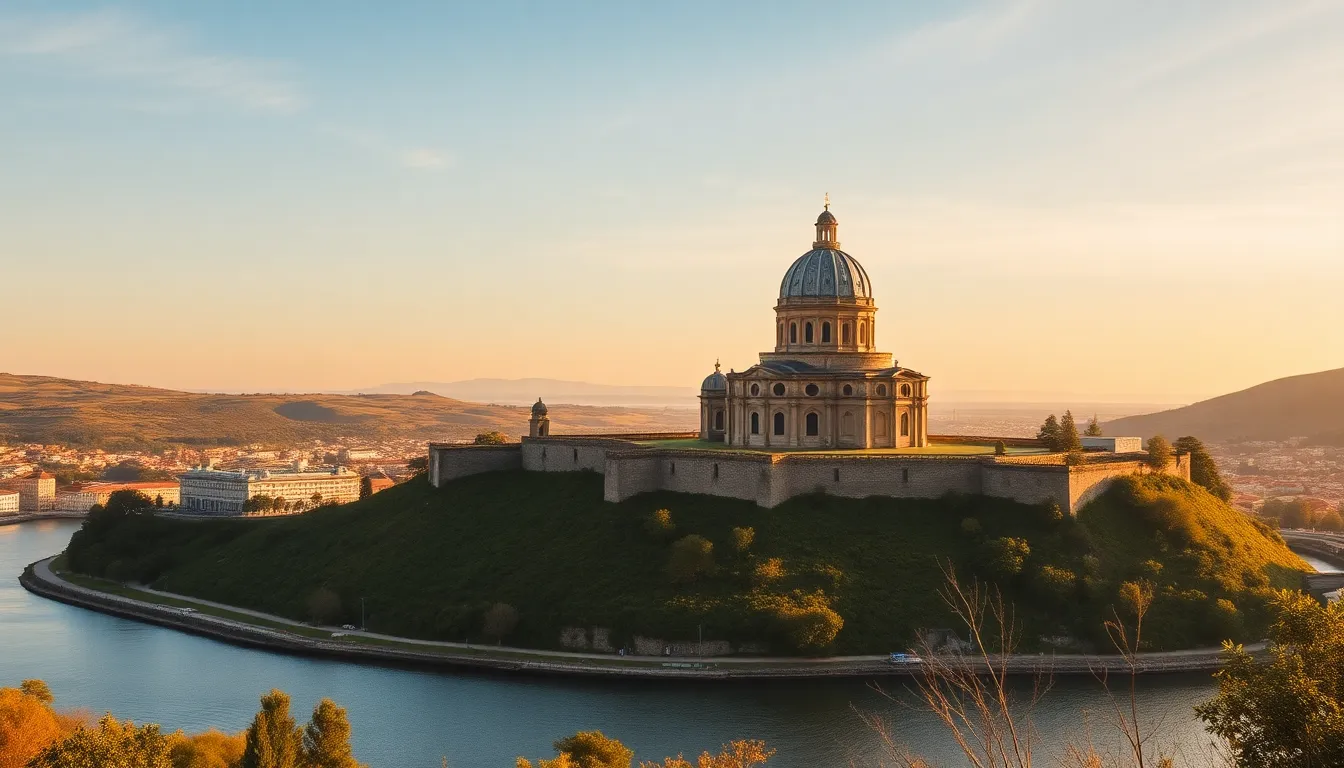
There is a moment I wait for every time I bring a group up the hill to Santa Luzia. You climb, or you take the old funicular, and you step out of the basilica onto the terrace, and the whole of the Minho coast opens up below you. The River Lima meeting the Atlantic, the red roofs of Viana do Castelo, the green hills folding north toward Spain. People go quiet. One woman in my group last year said it was the closest she had felt to seeing the way God sees. I have heard variations of that line many times on this terrace.
Santa Luzia is the great hilltop sanctuary of northern Portugal, and while it does not have the international fame of Fatima, it gives a group something Fatima does not: height, vista, and a sense of the land. Let me tell you about it.
A Modern Basilica With an Ancient Devotion
First, a clarification I always make, because the building can mislead you. The Basilica of Santa Luzia looks medieval at a glance, with its great dome and rose windows, but it is not. It was built in the twentieth century, with construction beginning in 1903 and the main structure completed by 1926, and consecrated as a basilica later in the century. So this is a young church carrying an old form.
The architect, Miguel Ventura Terra, drew on the Romanesque-Byzantine and neo-Byzantine tradition, which is why visitors often compare it to the Sacre-Coeur in Paris. The great central dome, the rounded arches, the symmetrical towers, all of it reaches back to an older architectural language even though the stone is recent. For a group, this is a useful teaching moment about how faith communities deliberately reach for ancient forms to express continuity with the church across the centuries.
The sanctuary is dedicated to the Sacred Heart of Jesus, and that devotion is central to its meaning. The late nineteenth and early twentieth centuries saw a great flourishing of Sacred Heart devotion across the Catholic world, and Santa Luzia is one of its Portuguese monuments. The dedication to Saint Lucy, the early Christian martyr after whom the hill is named, sits alongside it, giving the sanctuary its name while the Sacred Heart gives it its theological center.
The View and What It Means
I do not apologize for talking about the view, because at Santa Luzia the view is part of the devotion.
The basilica crowns the Monte de Santa Luzia, and from its terrace and dome you look out over one of the more celebrated panoramas in Portugal. The River Lima spills into the Atlantic, Viana do Castelo spreads along the estuary, and the patchwork of the Minho countryside runs to the horizon. For an additional small climb you can ascend inside the dome itself to a narrow gallery for an even higher vantage.
Why does this matter for a faith group? Because a sanctuary set on a height, looking out over creation, invites a particular kind of prayer. The psalms are full of mountains and high places, of lifting the eyes to the hills. Standing on the Santa Luzia terrace, your group has a natural moment to read a psalm, to be still, to take in the scale of the land and sea. I have led some of my most meaningful unscripted moments of group prayer right there on that terrace.
There is also an iron-age archaeological site on the same hill, the ruins of a Celtic-Iberian settlement, which adds a layer of deep history for groups that want it. Faith on that hill goes back far longer than the basilica.
Viana do Castelo Below
The sanctuary does not stand alone. The town of Viana do Castelo at the foot of the hill is one of the most attractive in northern Portugal, and I always give a group time there.
Viana grew rich in the Age of Exploration as a port for the cod fishery and trade, and that prosperity left it a fine historic center. The Praca da Republica, the main square, holds a beautiful Renaissance fountain and the old town hall. The town is also a stronghold of Portuguese folk tradition, famous for its festival of Nossa Senhora da Agonia, Our Lady of Sorrows, in August, one of the great religious-folk festivals of the country, with processions, traditional gold filigree costumes, and carpets of flowers laid in the streets.
For a group, the pairing works well. The basilica on the height gives you contemplation and vista. The town below gives you the living religious culture of the Minho, where faith and folk tradition are woven together in a way that is harder to find in the bigger cities.
Fitting Santa Luzia Into a Northern Extension
Most of my Portugal pilgrimages center on Fatima and the monasteries, but for groups with the appetite to go farther north, Santa Luzia anchors an excellent extension.
Viana do Castelo sits in the far north of Portugal, near the Spanish border, and pairs naturally with Porto, about an hour to the south, and with the Minho region generally. Porto itself holds the Se do Porto, its own fortress cathedral, and is the gateway to the north. A northern loop of Porto, Viana do Castelo, and Santa Luzia gives a group a different Portugal from the central pilgrimage heartland, greener, more traditional, less crowded.
I usually frame this as a choice for the group leader. If your community wants a focused Fatima-and-monasteries pilgrimage, the north is optional. If your community has the days and wants breadth, including the contemplative height of Santa Luzia and the folk-Catholic life of the Minho, the extension is well worth it. You can see how we structure the full Portugal journey and where the north fits in, and how the broader spiritual landscape of Portugal connects.
Practical Notes for Groups
A few things I have learned bringing groups up that hill.
You can reach the sanctuary by road, by the historic funicular that climbs from the town, or, for the energetic, by the long stairway. With a mixed-age group I usually arrange road or funicular access and save the stairs for anyone who wants them. The funicular is itself a small pleasure, one of the longest in Portugal, and groups enjoy the ride.
The terrace is exposed, so on the Atlantic coast it can be windy and cool even in summer. I tell people to bring a layer. The light is best in the morning or late afternoon, when the long shadows fall across the estuary.
As with any working sanctuary, dress modestly and check the service schedule before planning a group gathering. If your group wants a moment of prayer or Mass at the basilica, we coordinate it ahead. You can read how we frame these journeys on our Portugal destination page and how the group-leader experience works.
FAQ: The Sanctuary of Santa Luzia
Is the Basilica of Santa Luzia an old church?
No, despite its medieval appearance. Construction began in 1903 and the main structure was completed by 1926, making it a twentieth-century building. The architect drew on Romanesque-Byzantine and neo-Byzantine forms, which is why it is often compared to the Sacre-Coeur in Paris. It is a young church deliberately built in an ancient architectural language, dedicated to the Sacred Heart of Jesus.
Why is the sanctuary dedicated to Santa Luzia and the Sacred Heart?
The hill is named for Saint Lucy, the early Christian martyr, which gives the sanctuary its name. The basilica itself is dedicated to the Sacred Heart of Jesus, reflecting the strong devotion to the Sacred Heart that flourished across the Catholic world in the late nineteenth and early twentieth centuries when it was built. Both threads run through the site.
What makes Santa Luzia worth visiting for a faith group?
The combination of a contemplative hilltop sanctuary and one of the finest views in Portugal. From the terrace and dome you look out over the River Lima meeting the Atlantic and the whole Minho coast. A sanctuary on a height invites a particular kind of prayer, and the town of Viana do Castelo below offers the living folk-Catholic culture of northern Portugal, including the great August festival of Nossa Senhora da Agonia.
Where is Santa Luzia and how does it fit a pilgrimage itinerary?
The sanctuary stands on the Monte de Santa Luzia above Viana do Castelo, in the far north of Portugal near the Spanish border. It pairs naturally with Porto, about an hour south, as part of a northern extension to a Fatima-centered pilgrimage. Groups with extra days and an appetite for the greener, more traditional north find it a rewarding addition.
How do groups reach the basilica on the hill?
There are three ways: by road, by the historic funicular that climbs from the town, or by a long stairway for the energetic. With mixed-age groups we usually arrange road or funicular access. The funicular is one of the longest in Portugal and a small pleasure in itself. Contact us and we will arrange access and any group prayer or Mass at the sanctuary.
If your community has the days for a northern extension, Santa Luzia gives them height, vista, and a contemplative breath that the busier pilgrimage sites do not. I would love to help you decide whether it belongs in your journey. Reach out and we will talk through the shape of your trip.