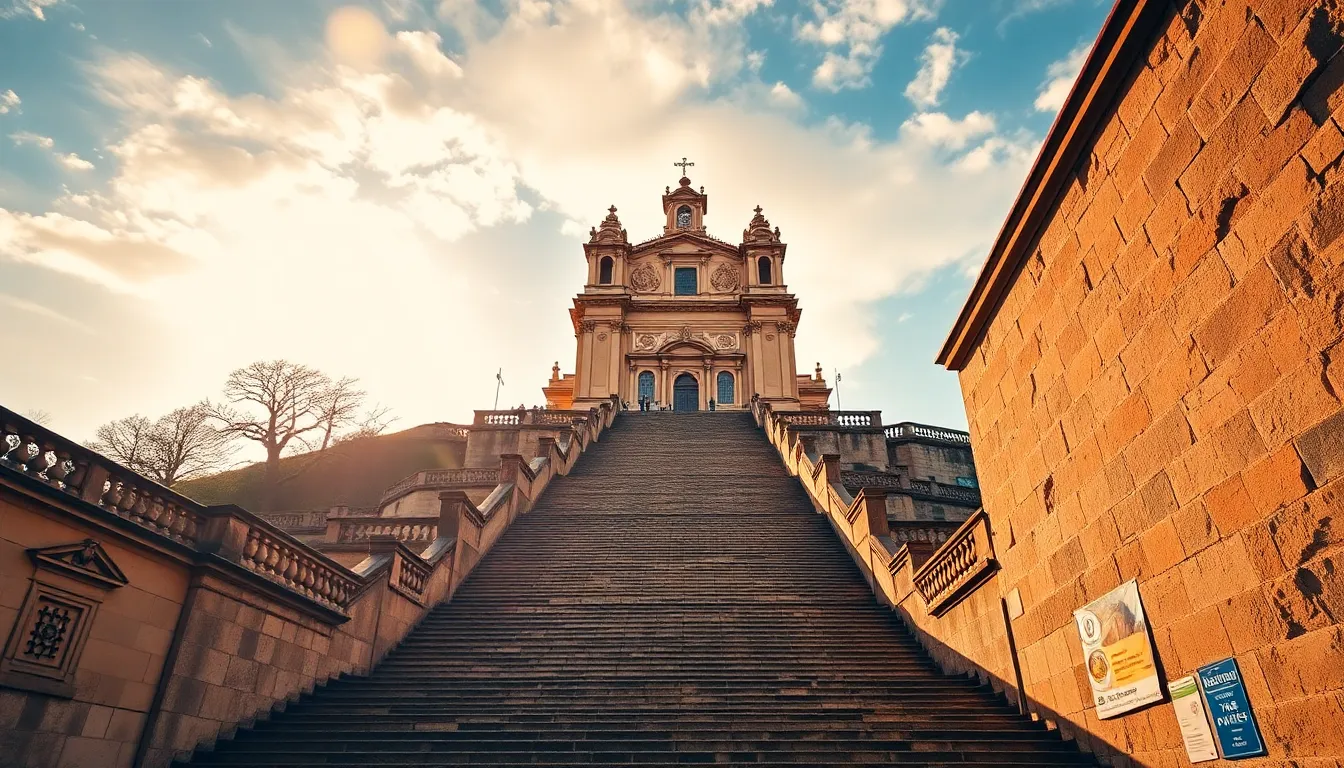
The first time I brought a group up the Bom Jesus stairway, a woman in her seventies told me at the bottom that she would wait in the gardens above and meet us at the church. By the third landing she had changed her mind and was climbing with the rest of us, slowly, one zigzag at a time. That is what this stairway does to people. It is built to be walked, not photographed from the parking lot.
Bom Jesus do Monte sits on a wooded hill just outside Braga, in the north of Portugal. The full name means Good Jesus of the Mount. What draws people here is not the church at the top, fine as it is, but the great baroque stairway that climbs the hillside in front of it. If you have seen one image of religious Portugal that was not Fatima, there is a good chance it was this one.
What You Are Actually Climbing
The stairway is a Via Crucis, a devotional path that a pilgrim climbs as an act of prayer and penance. It was built in stages from the early eighteenth century onward, the work of more than one architect across several generations. The lower sections came first. The famous upper zigzag, the part everyone recognizes, was designed by Carlos Amarante in a more restrained late-baroque style and completed toward the end of the eighteenth century.
The whole ascent rises roughly 116 meters from the base to the church terrace. The climb is broken into sections, each one a stage in a spiritual journey that moves from the earthly toward the divine. You do not climb it in a straight line. You climb it in a series of switchbacks, and that design is deliberate. The path is meant to slow you down and make you pay attention.
The white granite-edged steps against the green hillside, the dark stone walls, the chapels set into the landscape along the way, all of it was built to turn a walk uphill into something closer to a meditation. The pilgrims who built it were not trying to make a tourist attraction. They were trying to build prayer into stone.
The Stairway of the Five Senses
The most famous section is the Escadório dos Cinco Sentidos, the Stairway of the Five Senses. This is the white double staircase that crisscrosses up the steep middle of the hill, and it is the image you have probably seen.
At each landing there is a fountain, and each fountain represents one of the five human senses. Water flows from the eyes of one figure, from the ears of another, from the mouth, the nose, and finally from the hands of a fountain representing touch. The idea is theological. As the pilgrim climbs, the senses that tie a person to the physical world are purified one by one, and the soul is prepared to rise above them. Statues of Old Testament figures and allegorical figures stand along the balustrades, watching the climb.
Above the Five Senses comes a second symbolic stairway dedicated to the three theological virtues, Faith, Hope, and Charity. By the time you reach the top, you have climbed past the senses and the virtues both, and you arrive at the church terrace having walked through a complete spiritual lesson laid out in stone and water.
I always tell groups to stop reading the guidebook on the way up and just notice the fountains. The design rewards attention. You feel the logic of it in your legs before you understand it in your head.
Why It Belongs on a Heritage Itinerary
Bom Jesus was added to the UNESCO World Heritage list in 2019, recognized as one of the finest examples of a Sacred Mount, a type of devotional landscape that spread through Catholic Europe after the Reformation. For a faith group traveling through northern Portugal, it offers something Fatima does not. Fatima is about a modern apparition and a vast open plaza. Bom Jesus is about the older European tradition of the pilgrimage climb, the body and the spirit moving together up a hill.
It pairs naturally with Braga itself, one of the oldest Christian centers in the Iberian Peninsula and the seat of Portugal’s primate archbishop. A group can spend a morning in Braga’s cathedral and old town, then drive a few minutes out to Bom Jesus in the afternoon. The two together tell the story of why the north of Portugal calls itself the cradle of the nation’s faith.
How Groups Visit and Climb
Here is the practical part, because the climb is the whole point and you want your group to experience it well.
The stairway is free and open to the public. There is no ticket to climb it. If your group wants the full devotional experience, you start at the bottom and walk up, which takes most people somewhere between twenty and forty minutes depending on pace and how often you stop at the fountains.
Not everyone in a group can manage the climb, and that is fine. There are two good alternatives. A road winds up the hill to a parking area near the top, so a coach can drop less mobile travelers at the church terrace while the rest of the group climbs. There is also the Bom Jesus funicular, a water-balance funicular that has run since 1882 and is the oldest of its kind still operating in the world. It carries passengers from the base to the top in a few minutes and is itself part of the heritage. I often send half a group up on the funicular and let them watch the climbers arrive.
A few notes I give every group leader. Wear real shoes, because the granite steps are uneven and can be slick after rain, which in Braga is not rare. Build in at least ninety minutes so the climb does not feel rushed and there is time to sit on the terrace afterward, where the view back over Braga and the valley is part of the reward. Mornings are quieter than afternoons, and the light on the white stairway is better early.
For groups of 15 or more, your group leader travels free, which makes Bom Jesus an easy site to anchor a northern Portugal day around.
FAQ: Visiting the Bom Jesus Stairway
What is the Bom Jesus stairway in Portugal?
It is a baroque devotional staircase at the Sanctuary of Bom Jesus do Monte, on a hill above Braga in northern Portugal. Built in stages from the early eighteenth century, it climbs about 116 meters in a series of zigzagging flights designed to be walked as a prayer pilgrimage. It was named a UNESCO World Heritage Site in 2019.
What is the Stairway of the Five Senses?
It is the most famous section of the climb, a white double staircase where each landing holds a fountain representing one of the five senses, with water flowing from eyes, ears, mouth, nose, and hands. The symbolism is that the pilgrim’s earthly senses are purified one by one during the ascent, preparing the soul to rise toward God.
Do you have to climb the stairs, or is there another way up?
There are three ways up. You can climb the stairway on foot, which takes most people twenty to forty minutes. You can ride the historic water-balance funicular, running since 1882, which reaches the top in a few minutes. Or a vehicle can drive up the hillside road to the parking area near the church terrace. Many groups split, with some climbing and others riding.
How long should a group spend at Bom Jesus?
Plan for at least ninety minutes. That allows time for the climb at an unhurried pace, stops at the fountains along the way, and time to rest on the church terrace and take in the view over Braga and the valley. Mornings are quieter and the light is better on the white stone.
Is Bom Jesus suitable for older or less mobile travelers?
Yes, with planning. The funicular and the hilltop parking area both let travelers who cannot manage the stairs reach the church and terrace easily, while the rest of the group climbs. We coordinate this in advance so everyone arrives together at the top.
Bom Jesus is one of those sites that changes a group’s mood for the rest of the day. If you are a pastor or rabbi planning a northern Portugal route, we can build the Braga and Bom Jesus morning into a wider heritage itinerary. Explore our Portugal destination page, look at how we structure a group tour, and when you are ready, reach out and we will talk through the climb and the rest of the trip.
You can also read more about the wider faith landscape in our guides to spiritual sites for faith travelers, Braga’s religious heritage, and the hidden heritage sites of Portugal.