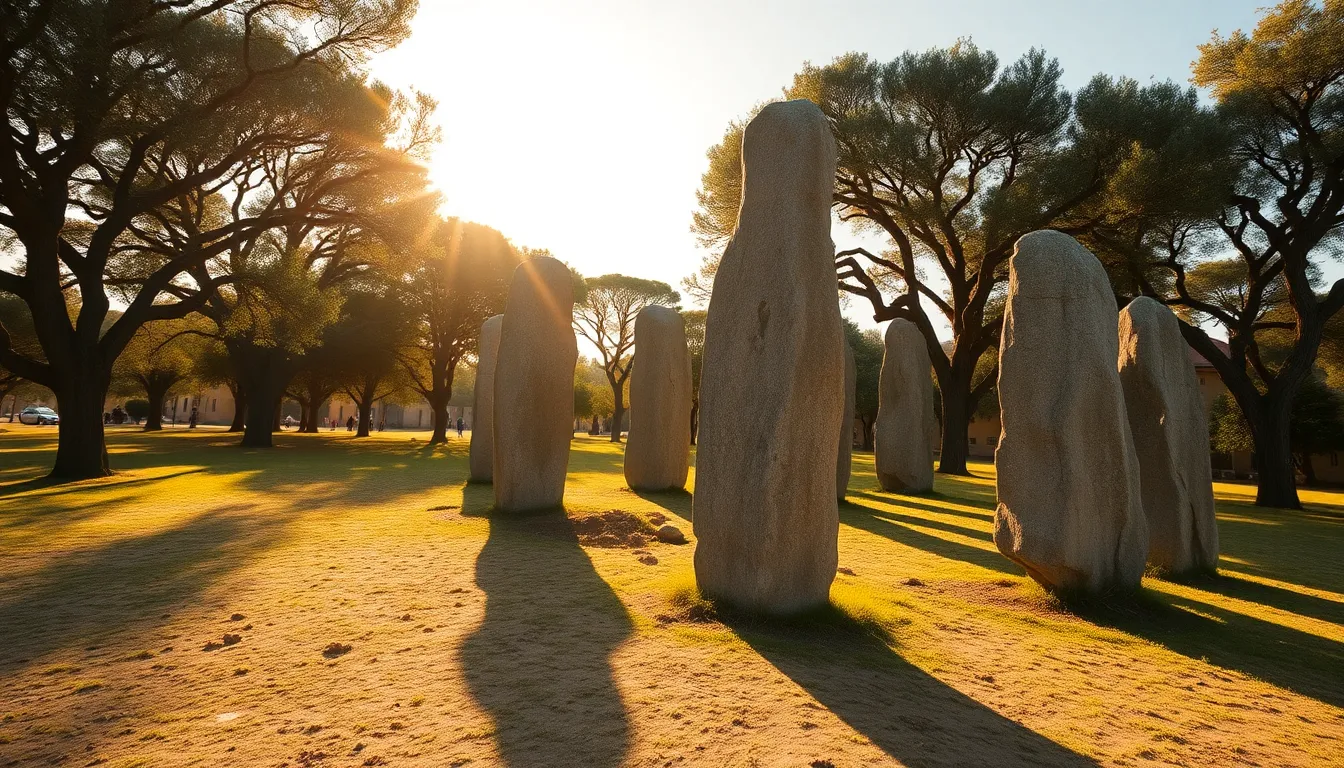
There is a moment on the dirt track out to the Almendres Cromlech when the cork oaks open up and you see them: dozens of rounded granite stones standing in the grass, exactly where someone placed them roughly seven thousand years ago. I have watched groups go quiet at that point. People who came to Portugal for cathedrals and synagogues are not always ready for the feeling of standing among stones older than writing, older than the pyramids, older than almost anything they have a frame of reference for.
The Almendres Cromlech sits in the Alentejo, about fifteen kilometers west of the city of Evora. It is the largest group of standing stones on the Iberian Peninsula and one of the most important megalithic sites in Europe. And for a heritage group, it offers something the rest of a Portugal itinerary does not: a direct encounter with the deep human impulse to mark sacred ground, long before any of the faiths we usually travel to study.
What the Site Actually Is
A cromlech is an arrangement of standing stones, set deliberately by people in the prehistoric past. The Almendres Cromlech is made up of around 95 surviving granite monoliths, arranged in two main groupings on a gentle slope facing east toward the rising sun.
It was not built all at once. Archaeologists who studied the site read it as the work of several phases across thousands of years. The earliest stones were raised in the early Neolithic, around the sixth millennium BC, in small circular settings. Later peoples added to it, rearranged it, and over time it grew into the larger double oval you see today. Some of the stones carry faint carvings, spirals, circles, and shapes that may relate to the sun or moon, though weathering has made many of them hard to read.
To put the age in plain terms: the oldest stones here were standing for well over a thousand years before the first stones of Stonehenge were placed in England, and for thousands of years before the earliest sites we visit for Jewish and Christian heritage. This is one of the oldest constructed sacred landscapes in the world.
A Place Built to Watch the Sky
The orientation of Almendres is not random. The site faces the eastern horizon, and researchers who have studied the alignment of the stones believe it functioned partly as an astronomical and ceremonial space, tied to the movements of the sun across the year, the solstices and equinoxes that governed the lives of farming people.
That matters for the way I introduce the site to faith groups. We spend a Portugal trip among places where people built to honor God, the cathedral at Evora, the monasteries, the synagogues. Almendres is what came before all of it. Here, thousands of years before any of those traditions, people were already raising stone to track the heavens and mark the turning of the seasons. The instinct to build something permanent in response to the sky and the divine is older than any single faith. Standing in the cromlech, you feel the length of that human story under your feet.
About a kilometer and a half away stands a single tall stone, the Menir dos Almendres, a related menhir that lines up with the cromlech across the landscape, part of the same prehistoric planning.
How Groups Frame and Visit It
For a heritage itinerary, Almendres is not a stand-alone destination. It works as a counterpoint, a half-hour stop that reframes everything else the group sees. It pairs perfectly with Evora, which is fifteen kilometers away and a major heritage stop in its own right, with its Roman temple, its Gothic cathedral, and its old Jewish quarter. A group can spend the morning in Evora and drive out to the cromlech in the late afternoon, which is also when the light on the stones is best for photographs.
Here is the practical reality, and group leaders need to hear it plainly. The site is free and open at all hours, with no fence, no ticket, and no staff. The last stretch of road is an unpaved track through cork-oak estates. A full-size coach can usually manage it in dry weather but it is slow and bumpy, and after heavy rain it can be rough enough that we switch to smaller vehicles. We always check conditions before sending a group down it. There are basic interpretive panels on site but no visitor center at the stones themselves, so the value of the visit depends heavily on having a guide who can explain what the group is looking at. Without that, it is just stones in a field. With it, it is seven thousand years of human history.
A few notes. There is no shade except the scattered oaks and no facilities, so bring water and use the restrooms in Evora first. The ground is uneven grass and earth, fine for most people but worth a steadying arm for the least mobile. And because there is no closing time, sunset visits are possible and quietly powerful, though you want to be back on the paved road before full dark.
For groups of 15 or more, your group leader travels free, which makes it easy to add an Evora and Almendres day to an Alentejo leg without stretching the budget.
FAQ: Visiting the Almendres Cromlech
What is the Almendres Cromlech?
It is a prehistoric arrangement of about 95 standing granite stones near Evora, in the Alentejo region of Portugal. It is the largest megalithic stone circle complex on the Iberian Peninsula. The oldest stones were raised around the sixth millennium BC, making the site thousands of years older than Stonehenge and older than the earliest Jewish and Christian heritage sites.
Why were the stones put there?
The site faces the eastern horizon and is understood to have served a ceremonial and astronomical purpose, tied to the movements of the sun and the seasons that mattered to early farming communities. Some stones carry faint carvings that may relate to the sun or moon. It was a sacred and ritual landscape built across several phases over thousands of years.
How far is Almendres from Evora?
About fifteen kilometers west of Evora. The final stretch is an unpaved track through cork-oak country. It pairs naturally with a visit to Evora itself, and many groups do Evora in the morning and the cromlech in the late afternoon when the light is best.
Is there an entrance fee or visitor center?
No. The site is free, open at all hours, and has no fence or staff. There are basic interpretive panels but no visitor center at the stones, which is why a knowledgeable guide makes the difference between a quick photo stop and a meaningful visit. Bring water and use facilities in Evora first.
Can a tour coach reach the site?
In dry weather a coach can usually manage the dirt track, slowly. After heavy rain the track can be rough, so we check conditions in advance and use smaller vehicles when needed. We never send a group down the road without knowing it is passable that day.
Almendres is the stop that reframes a whole Portugal trip, the moment a group feels how deep the human story runs here. If you are a pastor, rabbi, or educator building an Alentejo leg around Evora, we can fit the cromlech in and brief your guide to bring it to life. See our Portugal destination page, look at how we run a group tour, and contact us to start planning.
For the wider heritage of the region, read our guides to the hidden heritage sites of Portugal, Jewish heritage in Portugal, and Manueline architecture across the country.