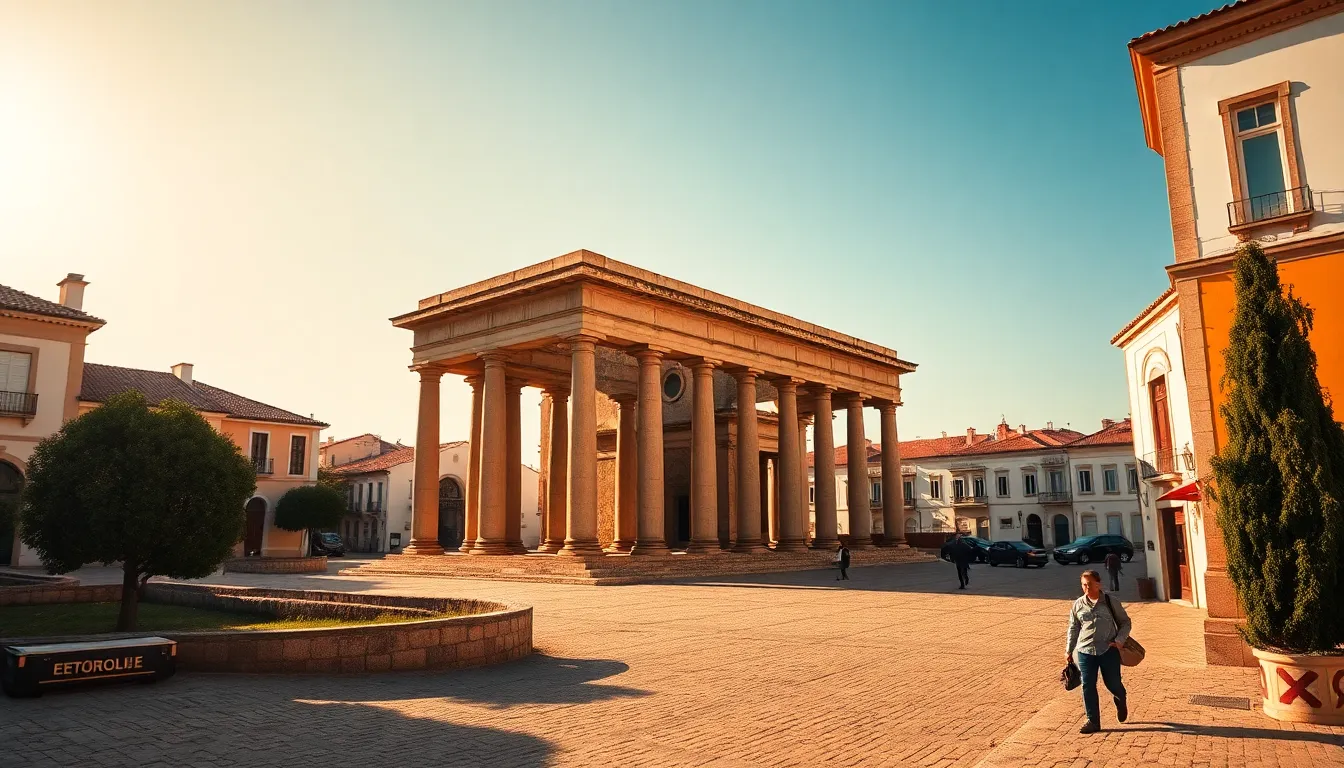
People rush through the Alentejo. I understand why. It sits between Lisbon and the Algarve, a wide stretch of plains that most itineraries treat as the drive between the places you actually came to see. For years I treated it that way too. Then I started stopping, and I found that the Alentejo holds some of the deepest heritage in Portugal, hidden in plain sight across its towns and its open country.
This is a region that asks you to slow down, and that asks more of your imagination than a site like Fatima does. There are no enormous esplanades here, no crowds of pilgrims. Instead there is Evora, one of the most complete historic towns in the country, and around it a scattering of fortified villages where Roman, Christian, and Jewish history are layered into the walls. Let me give you the orientation that turns the Alentejo from a drive-through into a destination.
Understanding the Alentejo as a Region
The Alentejo is the great plain of southern Portugal, a region of wheat fields, cork oaks, and whitewashed towns spread thin across a wide landscape. The name means “beyond the Tagus,” the river that separates it from the country’s center, and that sense of being beyond, of being a place apart, still defines it. Distances feel longer here because the towns are spread out, and the pace of everything slows to match the land.
For heritage travel, that spaciousness is part of the point. The Alentejo was a crossroads for millennia. The Romans farmed it and built across it. The Moors held it for centuries. The Christian reconquest fortified it town by town. And Jewish communities lived and traded throughout the region long before the forced conversions of 1497. All of that history is still legible if you know where to look, and the looking is best done unhurried.
A group that gives the Alentejo two or three days, with Evora as a base, comes away with a far richer sense of Portugal than one that races through to the coast. Our Portugal heritage travel guide sets the wider national story this region fits into.
Evora: The Heart of the Region
Evora is where any Alentejo heritage trip should center. The historic core of the town is a UNESCO World Heritage Site, and walking it is like walking through two thousand years of layered history compressed into a few square kilometers.
At the center stands a Roman temple, its granite columns still upright after some twenty centuries, one of the best-preserved Roman monuments on the Iberian Peninsula. A short walk away rises the medieval cathedral, a fortress-like Gothic structure that speaks to the Christian kingdom that reconquered the town in the twelfth century. The University of Evora, founded in the sixteenth century, gives the town an intellectual weight that still shapes its character.
And then there is the Chapel of Bones, the Capela dos Ossos, lined with the bones of thousands of the dead and inscribed with a reminder of mortality at its entrance. I bring groups there deliberately, because it stops people cold and opens conversations that matter on a faith journey. It is not morbid. It is one of the most honest meditations on death and eternity you will find in any Christian space in Europe.
Evora also held a significant Jewish community before 1497, with a Jewish quarter, the Judiaria, in the old town. The physical traces are subtle now, but the history is real, and a knowledgeable guide can walk a group through the streets where that community lived and worked. For the fuller arc of Portugal’s Jewish heritage, including the crypto-Jewish story, our Trancoso and the walled towns guide traces it through the fortified Beira towns to the north.
The Historic Towns Beyond Evora
Evora anchors the region, but the Alentejo’s character lives in its smaller towns, and several reward a group willing to make the drive.
Monsaraz sits on a hilltop near the Spanish border, a tiny walled village of whitewashed houses and a castle, looking out over a vast reservoir and the plains beyond. It is one of the most atmospheric places in southern Portugal, and standing on its walls at the end of the day, watching the light change over the plain, is the kind of quiet that a pilgrimage group remembers.
Beja, further south, holds a powerful medieval castle and a convent with its own layered religious history. Elvas, near the border, is a great fortified frontier town, its star-shaped ramparts a UNESCO site in their own right, built to defend the kingdom against Spain. These towns tell the story of a contested frontier, of a land fought over across centuries by competing powers and faiths.
Throughout these towns, the Jewish heritage layer surfaces again and again. Many Alentejo towns had Jewish quarters before 1497, and in some you can still find the medieval streets where those communities lived. The traces are quieter than the synagogue at Tomar, but they are part of the same national story of a Jewish presence that ran deep and was forced underground. For groups whose interest centers on that story, the southern coast continues it, as our Faro and the Algarve guide describes.
The Plains Themselves
I want to say a word about the landscape, because in the Alentejo the land is part of the heritage. The wide plains, the solitary cork oaks, the long horizons, these shaped the people who lived here and the slow rhythm of their faith and work. Driving across the Alentejo is not dead time between sites. It is part of the experience, a chance for a group to settle, to talk, to let the intensity of a heritage trip breathe.
I often plan a quiet stretch of road into the Alentejo portion of an itinerary on purpose. After the crowds of Fatima or Sintra, the open country does something for a group that no monument can. It gives them room.
Planning an Alentejo Trip for Your Group
A few practical notes. The Alentejo is best done with a base in Evora, from which the smaller towns sit within comfortable day drives, though some of the further ones make for longer days. Two to three days lets a group see Evora properly and reach two or three of the surrounding towns without rushing.
The summer heat here is real. The Alentejo is one of the hottest parts of Portugal in July and August, and the open plains offer little shade. For mixed-age groups, spring and fall are far kinder. The land is also greener and more alive in those seasons.
As with the rest of interior Portugal, the heritage here is not signposted for you. The Jewish quarters, the layered histories of the towns, the stories behind the castles, these come alive with a guide who knows the region. That is the piece worth investing in. You can see how the Alentejo fits into a full Portugal itinerary on our Portugal destination page, and how the group experience works on our group heritage tours page.
For groups of 15 or more, the group leader travels free. That is how Heritage Tours honors the rabbi, pastor, or educator who brings the community together and gives the journey its purpose.
FAQ: The Alentejo Heritage Guide
What is the Alentejo region known for?
The Alentejo is the great plain of southern Portugal, known for its wheat fields, cork oaks, whitewashed towns, and slow pace. For heritage travel, it is known above all for Evora, a UNESCO World Heritage town with a Roman temple, a medieval cathedral, and a layered Jewish and Christian history, surrounded by fortified hilltop towns across the plains.
Why visit Evora?
Evora is the heart of the Alentejo and one of the most complete historic towns in Portugal. In a small area you can see a two-thousand-year-old Roman temple, a fortress-like Gothic cathedral, a centuries-old university, the striking Chapel of Bones, and the streets of a former Jewish quarter. It is a remarkably concentrated heritage experience.
Does the Alentejo have Jewish heritage?
Yes. Many Alentejo towns, including Evora, had significant Jewish communities and Jewish quarters before the forced conversions of 1497. The physical traces are quieter than the intact synagogue at Tomar, but a knowledgeable guide can walk a group through the medieval streets where these communities lived and trace their place in Portugal’s broader Sephardic story.
How many days do you need in the Alentejo?
Two to three days, with Evora as a base, lets a group see the town properly and reach two or three surrounding towns such as Monsaraz, Beja, or Elvas without rushing. The region rewards a slower pace, so it is worth resisting the temptation to race through it on the way south.
When is the best time to visit the Alentejo?
Spring and fall are best. The Alentejo is one of the hottest parts of Portugal in summer, with little shade across the open plains, which is hard on mixed-age groups. In spring and fall the temperatures are comfortable and the landscape is greener and more alive.
If the Alentejo is calling to you, or if you want to understand how to weave it into a Portugal itinerary without losing the slower pace that makes it special, I would be glad to talk. This is a region that rewards groups who give it time, and helping you plan that is a pleasure.
Contact us whenever you are ready to begin.