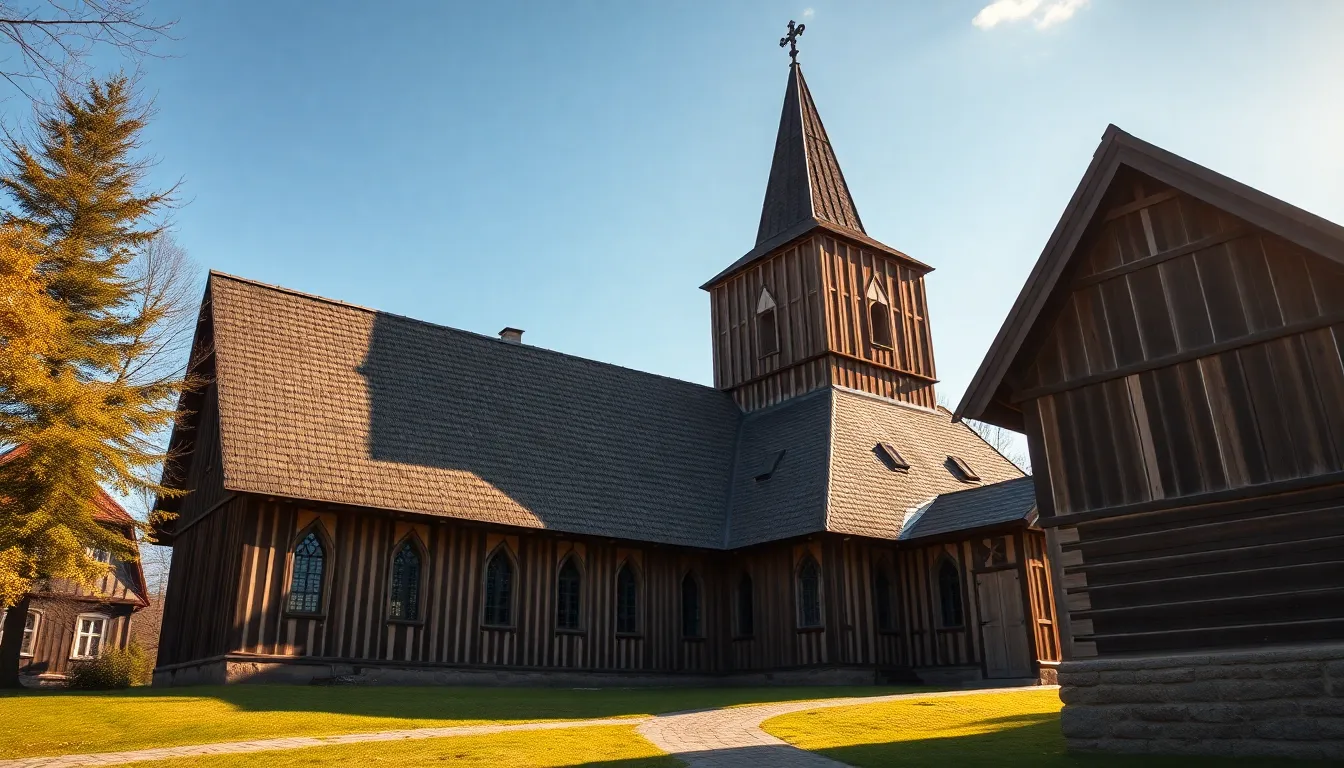
The first wooden church I ever showed a group sat at the edge of a village in the Malopolska hills, and from a distance my travelers thought it was a barn. Then we walked inside. The smell of old timber, the painted ceiling, the way the light came through small windows onto five hundred years of darkened wood, and the whole bus went silent. One woman said it felt more like a church than any cathedral she had seen. I have heard versions of that sentence many times since.
These are the wooden churches of southern Poland, and they are among the most quietly powerful sites I can put on an itinerary. They do not announce themselves the way the great shrines do. They are small, rural, and easy to drive past. But for a faith group willing to slow down, they offer something the grand basilicas cannot: an unbroken line of village worship, built by hand, standing for centuries on the same patch of ground.
This guide covers what these churches are, why they hold UNESCO World Heritage status, and how to fit them into a Poland trip. For the wider sacred landscape, start with our overview of spiritual sites across Poland.
What the Wooden Churches Are
Across southern Poland, in the foothills and valleys of the Carpathian Mountains, stand hundreds of historic wooden churches. They were built from the late Middle Ages onward by village communities using the timber they had and the carpentry skills passed down among them. No stone, no imported marble, just logs and beams and shingles, joined by craftsmen who were often the same people who farmed the surrounding land.
What makes them remarkable is their survival. Wood burns and rots, and yet these churches stand, some for more than five hundred years, kept alive by the villages that built them and worshipped in them generation after generation. They represent a folk tradition of Christian architecture that vanished almost everywhere else in Europe.
The Two Traditions
It is worth telling a group that not all of these churches are the same. The region was home to two Christian traditions living side by side. The Roman Catholic churches of the area, with their Gothic forms rendered in timber, sit alongside the wooden Orthodox and Greek Catholic churches, called tserkvas, built by the Lemko and Boyko communities of the eastern Carpathians. The tserkvas have a distinct shape, with tiered domes and a layout following the Eastern rite. Seeing both reminds a group that this borderland held more than one way of being Christian.
The UNESCO World Heritage Listing
Two separate UNESCO inscriptions protect these buildings, and naming them helps a group understand what they are looking at.
The Wooden Churches of Malopolska
In 2003, UNESCO inscribed a group of wooden Roman Catholic churches in the Malopolska region of southern Poland. These Gothic timber churches, built with horizontal log construction, are among the finest surviving examples of medieval wooden ecclesiastical architecture in Europe. The listing recognized them as a unique survival of building techniques that were once common across the continent and are now exceedingly rare.
The Tserkvas of the Carpathian Region
In 2013, a second inscription added a series of wooden tserkvas, the Orthodox and Greek Catholic churches of the Carpathians, shared across the Polish and Ukrainian sides of the mountains. These represent the Eastern Christian tradition of the same region and the same materials, a parallel story in timber.
Between the two listings, southern Poland holds one of the densest concentrations of UNESCO-protected wooden sacred architecture anywhere in the world.
Why They Move People
I have thought a lot about why these small churches affect groups so deeply, often more than the famous shrines do.
Part of it is scale. These are human-sized rooms, built for a single village, and you feel held by them in a way you do not in a vast nave. Part of it is the material. Wood is warm and alive in a way stone is not, and the painted interiors, often covered in folk-art depictions of scripture, carry the hands of the people who made them. And part of it is continuity. The same families worshipped in these rooms for centuries. You are not visiting a monument to faith. You are standing inside its ordinary, unbroken practice.
For groups who have already seen the great shrines of Polish Catholicism, the wooden churches offer the other half of the picture: not the faith of kings and national devotion, but the faith of the village, kept by hand for five hundred years.
Visiting Them With a Group
This is where I have to be practical, because these churches are not set up for tourism the way a major basilica is.
They Are Spread Out
The wooden churches are scattered across rural southern Poland, often one to a village, sometimes down small roads. You cannot see them all, and you should not try. A good plan is to choose a cluster of three or four within reach of each other and build a half-day or full-day rural drive around them. The drive itself, through the Carpathian foothills, is part of the experience.
Access Takes Planning
Many of these churches are still active parish churches, and some are kept locked outside service times, opened by a local keyholder. This is the single most important practical point for a group leader: you cannot simply turn up and expect entry. Visits need to be arranged in advance so a guide or keyholder can open the church for you. This is exactly the kind of coordination we handle, and it is the difference between standing inside one of these churches and standing in the car park looking at the door.
Pace and Respect
Keep the group small in spirit even if it is large in number. These are intimate spaces, and twenty people fill them fast. Modest dress, quiet voices, and care around old and sometimes fragile interiors are essential. Photography rules vary by church, so always ask the keyholder first.
Where They Fit in a Poland Trip
The wooden churches lie in the south, which makes them a natural extension of a trip centered on Krakow. They pair especially well with a route that also takes in Wroclaw’s Cathedral Island further west, giving a group a southern Poland itinerary built around quieter, less-traveled Christian heritage rather than the headline shrines alone.
I would not send a group all the way to Poland only for the wooden churches. But added to a Krakow-based trip, a day among them gives travelers a memory that often outlasts the bigger sights. You can see how we shape routes like this on our Poland destination page.
FAQ: The Wooden Churches of Southern Poland
What are the wooden churches of southern Poland?
They are historic timber churches built by village communities across the Carpathian foothills from the late Middle Ages onward, using local wood and traditional carpentry. Some have stood for more than five hundred years. They include both Roman Catholic Gothic churches and Eastern-rite tserkvas, and they preserve a folk tradition of sacred architecture that has nearly vanished elsewhere in Europe.
Are the wooden churches a UNESCO World Heritage Site?
Yes, across two inscriptions. The Wooden Churches of southern Malopolska were listed in 2003, and the Tserkvas of the Carpathian Region, shared with Ukraine, were added in 2013. Together they make southern Poland one of the densest concentrations of protected wooden sacred architecture in the world.
Can you just turn up and visit a wooden church?
Often not. Many are active parish churches kept locked outside service times and opened by a local keyholder. Visits usually need to be arranged in advance so someone can open the church for your group. This coordination is essential and is something we handle as part of planning the route.
How many wooden churches should a group try to see?
Three or four within reach of each other, built into a half-day or full-day rural drive. They are scattered one to a village across the countryside, so trying to see them all is not realistic. A focused cluster, with the Carpathian drive between them, gives the best experience.
How do the wooden churches fit a Poland itinerary?
They lie in southern Poland and extend naturally from a Krakow-based trip. They pair well with Wroclaw further west for a southern itinerary built around quieter Christian heritage. They work best as an added day rather than the sole reason for the journey.
If you want your group to see the village heart of Polish Christianity and not just its great shrines, a day among the wooden churches is one of the most rewarding additions I can make to a trip. I would be glad to handle the access and build it into your route.
Contact us whenever you want to start planning.