Poland is one of the great faith destinations of Europe. I say that knowing how it sounds, because most people associate Poland with memorial sites and difficult history. But the truth is that Poland held, and still holds, sacred ground for both Jewish and Catholic traditions in ways that very few countries can match.
For Jewish travelers, Poland is where centuries of rabbinical scholarship, synagogue architecture, and communal religious life took root. For Catholic pilgrims, it is the home of the Black Madonna of Czestochowa and the birthplace of John Paul II’s spiritual formation. And for Protestant leaders bringing a group here, Poland offers something that goes beyond denominational boundaries: the chance to stand in places where faith shaped entire communities for a thousand years.
This guide covers the sites that matter most, for all three traditions. If you are looking for a broader overview of what Poland offers heritage travelers, start there. But if you already know you are coming for the sacred history, read on.
Why Poland Is One of Europe’s Great Faith Destinations
Before the war, Poland was home to the largest Jewish community in Europe. Over three million Jews lived here, and the religious institutions they built, yeshivas, synagogues, rabbinical courts, shaped Jewish thought for centuries. Some of those buildings still stand. Some are active houses of prayer.
At the same time, Poland has been one of the most deeply Catholic countries in Europe since the 14th century. The Jasna Gora Monastery in Czestochowa receives millions of pilgrims every year. Wawel Cathedral in Krakow holds the tombs of Polish kings and saints. The Divine Mercy Shrine in Lagiewniki draws Catholic visitors from around the world.
These two traditions existed side by side in Poland for a very long time. A faith-based trip here can honor both.
Jewish Sacred Sites
Krakow’s Synagogues: Remuh, Tempel, Isaac, and Old
Krakow’s Kazimierz district contains the densest concentration of historic synagogues in Poland. The Old Synagogue, built in the 15th century, is the oldest surviving Jewish religious building in Poland. The Tempel Synagogue, from the 19th century, reflects the Reform movement. The Isaac Synagogue is a 17th-century baroque structure with original frescoes still visible on its walls.
But the heart of Jewish Krakow is the Remuh Synagogue.
The Cemetery of Remuh: 500 Years of Prayer in One Acre
The Remuh Synagogue, founded in 1553 by Israel ben Joseph, is still active. Services are held here. Behind the synagogue lies the Remuh Cemetery, one of the oldest Jewish cemeteries in Europe. The graves date to the 1500s. Among them is the tomb of Rabbi Moses Isserles (the Rema), one of the most important authorities in Jewish law.
During the war, the cemetery was buried under rubble and earth, which paradoxically preserved many of the tombstones. Fragments of destroyed gravestones were later recovered and set into the cemetery wall as a memorial.
For Jewish groups, this is a place of pilgrimage. For Christian groups, it is a chance to witness how deeply Jewish religious life was woven into this city.
The Synagogues of Lublin: Where Europe’s Greatest Rabbis Taught
Lublin was known as the Jerusalem of Poland. The Chachmei Lublin Yeshiva, founded by Rabbi Meir Shapiro in 1930, was one of the most prestigious rabbinical academies in the world. The building survived the war and has been restored. Walking through its study halls, you stand where some of the finest minds in Jewish scholarship once taught and debated.
For more on Jewish heritage sites across Poland, including sites beyond Krakow and Lublin, see our dedicated guide.
Active Jewish Prayer in Krakow Today
It is worth knowing that Jewish religious life in Krakow did not end with the war. The Remuh Synagogue holds regular Shabbat services. The Jewish Community Centre of Krakow runs programs, classes, and cultural events. Kazimierz is not a museum district. It is a neighborhood where Jewish life continues, smaller than before, but present and real.
Catholic Pilgrimage Sites
Czestochowa: The Black Madonna and the Jasna Gora Monastery
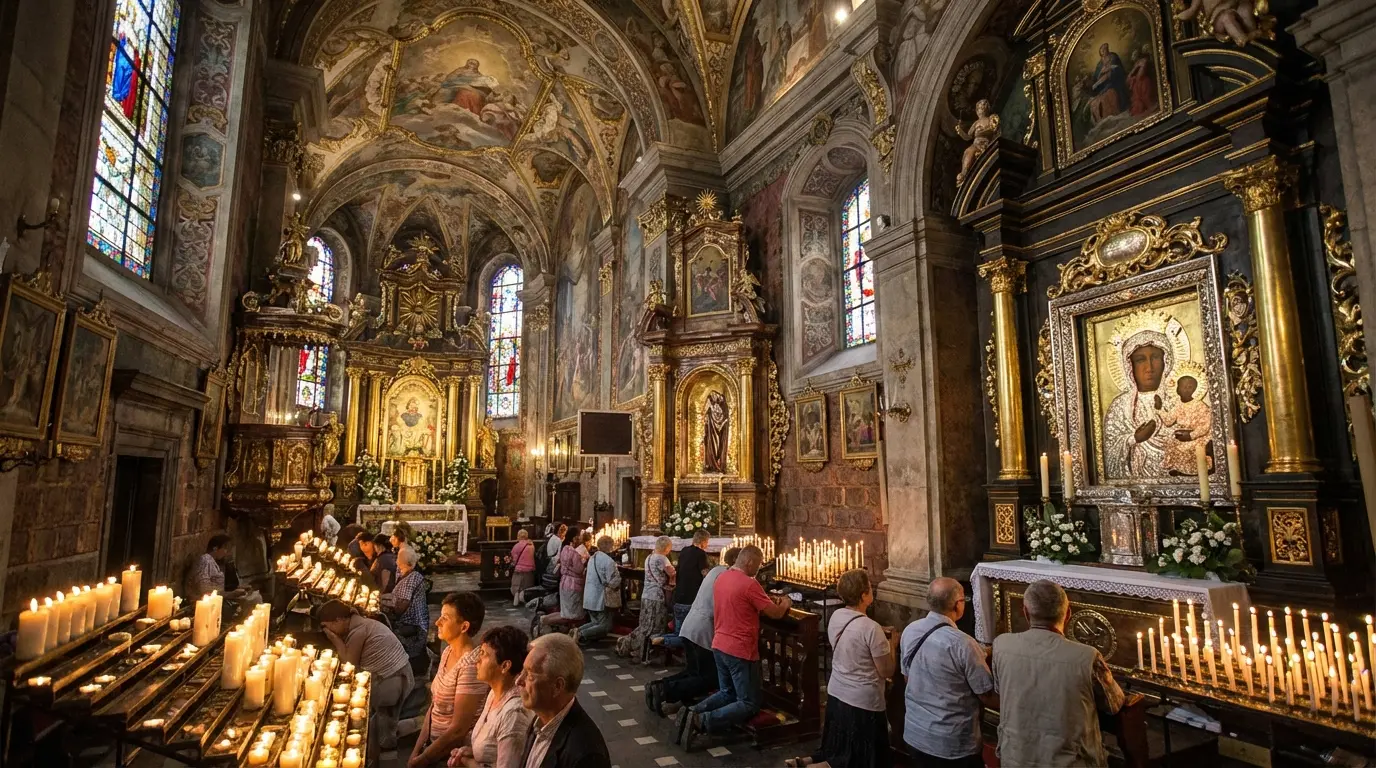
The Jasna Gora Monastery in Czestochowa is home to the Black Madonna, one of the most revered icons in Catholic tradition. The painting, which tradition attributes to Saint Luke, has been at Jasna Gora since 1382.
Millions of pilgrims visit every year. The monastery sits on a hill overlooking the city, and the approach to it, up the long avenue, is an experience in itself. Inside, the Chapel of the Miraculous Image holds the Black Madonna behind a silver cover that is ceremonially raised at set times during the day.
For Catholic groups, Czestochowa is not a side trip. It is the destination. If your itinerary includes any Catholic dimension, this belongs at the center of it.
What the Black Madonna Means to Polish Catholics
The Black Madonna is more than a religious image. She is the Queen of Poland, formally crowned in 1656 after the Swedish invasion, when the monastery’s defense became a symbol of Polish resilience. For Polish Catholics, she represents faith, survival, and national identity bound together.
Understanding this helps non-Catholic visitors grasp why Czestochowa holds the weight it does. This is not a tourist attraction with religious overtones. It is the spiritual center of Polish Catholicism.
Krakow’s Wawel Cathedral: Kings, Cardinals, and Saint John Paul II
Wawel Cathedral sits atop Wawel Hill in Krakow’s Old Town. Polish kings were crowned and buried here for 500 years. The cathedral holds the tombs of Saint Stanislaus (the patron saint of Poland), King Casimir the Great, and many others.
But for modern Catholic pilgrims, Wawel’s deepest connection is to Karol Wojtyla, who served as Archbishop of Krakow from 1964 to 1978 before becoming Pope John Paul II. This was his cathedral. He celebrated Mass here. His connection to Krakow was personal, rooted in decades of pastoral work in this city, and visiting Wawel allows your group to stand where that relationship began.
The Divine Mercy Shrine in Krakow (Lagiewniki)
The Basilica of Divine Mercy in Lagiewniki is one of the most important modern Catholic pilgrimage sites in the world. It is built on the site where Saint Faustina Kowalska received her visions of Divine Mercy in the 1930s. John Paul II consecrated the basilica in 2002.
The shrine draws Catholic visitors year-round, and the annual Divine Mercy Sunday celebration is one of the largest Catholic gatherings in Poland. For Catholic groups visiting Krakow, Lagiewniki and Wawel together make a full day of pilgrimage within the city.
For Protestant Groups: What Poland Offers Your Faith Journey
Reformation-Era Churches in Krakow and Warsaw
Poland’s Reformation history is less well known than Germany’s, but it is real. In the 16th century, Protestant communities established churches in Krakow, Warsaw, and other cities. Some of these survive. The Evangelical-Augsburg Church of the Holy Trinity in Warsaw, built in 1778, is an active Lutheran congregation.
For Protestant group leaders, these churches are worth visiting not as major pilgrimage sites, but as evidence that the Reformation reached further into Central Europe than many people realize.
Witnessing Jewish Heritage as a Christian: What It Means
For many Protestant and Catholic groups, visiting Poland’s heritage sites is an act of witness. You are not visiting your own sacred sites. You are standing in the places where another faith community built something extraordinary, and then lost almost everything.
This kind of witness has real value. Pastors who bring their congregations to the synagogues of Krakow and the memorial sites of Auschwitz are doing something specific: they are asking their community to see, to understand, and to carry that understanding home. That is a faith act, regardless of denomination.
A Note on Visiting Sacred Sites as an Outside Observer
If you are visiting a synagogue and you are not Jewish, or a Catholic shrine and you are not Catholic, a few practical things are worth knowing.
At the Remuh Synagogue and cemetery, men should wear a head covering. Kippot are usually available at the entrance. At Catholic churches and shrines, modest dress is expected, and silence is appreciated during services.
But beyond dress codes, the more important thing is posture. You are a guest in someone else’s sacred space. That does not mean you cannot be moved, or that you should hold yourself at a distance. It means you enter with respect, you observe before you participate, and you follow the lead of the community whose space you are in.
This is something Heritage Tours discusses with group leaders before the trip, because getting it right matters.
Planning Your Group’s Faith Itinerary
A faith-focused Poland itinerary can combine Jewish and Catholic sites in a single trip, or it can focus deeply on one tradition. Both approaches work. The question is what your group needs.
If you are a rabbi bringing your congregation, your itinerary will center on Krakow’s synagogues, Lublin’s yeshiva, and the memorial sites. If you are a Catholic pastor, Czestochowa and the Krakow shrines will anchor the trip. If you want both, a 10-day itinerary gives you enough time to honor each tradition without rushing either.
Heritage Tours builds custom faith itineraries for groups of all sizes and denominations. If you want to talk through what your group’s trip could look like, we are here to help.
Frequently Asked Questions
What is the Black Madonna of Czestochowa and why is it significant?
The Black Madonna is a painting of the Virgin Mary housed at the Jasna Gora Monastery in Czestochowa. It has been venerated since 1382 and is considered the most sacred religious image in Poland. She was formally crowned Queen of Poland in 1656 and remains central to Polish Catholic identity.
What are the main Jewish sacred sites in Krakow?
The Kazimierz district holds the Remuh Synagogue (still active, founded 1553), the Old Synagogue (oldest in Poland), the Tempel Synagogue, the Isaac Synagogue, and the Remuh Cemetery with graves dating to the 1500s. The Galicia Jewish Museum documents what remains of Jewish life in southern Poland today.
Can Protestant groups find meaningful faith sites in Poland?
Yes. Beyond Reformation-era churches in Warsaw and Krakow, Protestant groups find deep meaning in witnessing Jewish heritage sites and memorial sites. Pastors who bring their congregations to Poland are offering their community an act of faith through understanding and witness. Many of our most committed group leaders are Protestant pastors.
What is the Remuh Synagogue in Krakow?
The Remuh Synagogue was founded in 1553 and remains an active house of Jewish prayer in Krakow’s Kazimierz district. Adjacent to it is the Remuh Cemetery, one of Europe’s oldest Jewish cemeteries, containing the tomb of Rabbi Moses Isserles, a towering authority in Jewish law.
Is the Jasna Gora Monastery open for non-Catholic visitors?
Yes. The monastery and the Chapel of the Miraculous Image are open to all visitors. The Black Madonna’s silver cover is raised at scheduled times during the day, and visitors of any faith are welcome to be present. Modest dress and respectful behavior are expected.