Not every group has ten days. Sometimes a congregation can only manage a long weekend, or a group is already in Europe and wants to add a few meaningful days, or a leader wants to scout Krakow before committing to a full Poland trip. I plan a lot of these short visits, and I want to be honest about what a weekend can and cannot do.
A weekend cannot give you the full emotional arc of a Poland heritage journey. That arc needs a week to build, moving through Jewish and Polish life before arriving at the camps with context. What a weekend can do is give your group a real, dignified, focused encounter with Krakow, the most concentrated heritage city in Poland, including a carefully framed visit to Auschwitz-Birkenau. Done right, three days in Krakow is not a consolation prize. It is a complete experience at its own scale.
This plan is built for a focused three-day trip based entirely in Krakow. If your group later decides to go deeper, the 10-day Poland heritage itinerary shows what the full journey looks like, and this weekend works well as a first taste of it. A note on who this suits best: a group that is already strong, mobile, and able to handle a fuller day, because three days asks each one to carry real weight. For a group with limited walkers or a wide age range, I would slow the pace and use a different plan rather than compress this one further.
How to Think About a Weekend
The principle here is concentration. With only three days, I keep the group based in one hotel, cut the travel to almost nothing, and choose depth over breadth. Krakow rewards this. Almost everything sits within or near the old city and Kazimierz, both walkable, and Auschwitz is a manageable day trip out and back.
The one thing I will not do is rush Auschwitz to fit a tight schedule. If we include it, we give it the day it requires, with preparation the evening before. A heritage weekend that treats the camp as a quick stop does a disservice to the place and to your group. I would rather drop another site than shortchange that day.
There is also a sequencing decision that matters more in a weekend than in a longer trip. With ten days, you can build a full week of context before the camp. With three, you cannot, so the question becomes where to place Auschwitz across the short span. I put it on Day 2, the middle day, on purpose. Day 1 in Kazimierz gives at least some context, a glimpse of the Jewish life that was here, before your group stands at the camp. And Day 3 afterward gives them somewhere to land, the living city of Krakow, rather than flying home the same evening they walked out of Birkenau. Even compressed, the arc holds if you order the three days this way. I have seen leaders put the camp on the last day to “build up to it,” and they regret it, because the group leaves Poland raw with no time to set the weight down.
Day 1: Arrival and Kazimierz
Your group arrives in Krakow. Depending on flights, most land by midday, and we arrange the hotel pickup so no one is navigating after a long journey. After settling in, I take the group into Kazimierz, the historic Jewish quarter, in the afternoon.
Start at the Remuh Synagogue and the old cemetery, built in the 1500s and still an active house of prayer, with tombstone fragments recovered after the war set into the cemetery wall as a memorial. Five centuries of Jewish religious life sit in one walkable place. Then see the living side of Kazimierz, the cafes, bookshops, and market that make it one of Krakow’s most vibrant neighborhoods today. This pairing matters even in a weekend, because it shows your group both what was and what continues. End with dinner in the quarter and an early night.
Day 2: Auschwitz-Birkenau
The center of the weekend, and the day that asks for the most care. The evening before, on the night of Day 1, gather your group. Tell them what the day holds, that the visit takes most of the day, and that every reaction is normal, whether tears, silence, or numbness. If you are a rabbi or pastor, a short reading the night before gives people permission to arrive open rather than braced. Our guide to preparing a group for Auschwitz walks through this fully.
We drive out in the morning, roughly an hour and a half. The visit begins at Auschwitz I, the original camp, with its preserved blocks and exhibitions, then moves to Birkenau, the larger extermination site, where the scale is something no photograph prepares you for. The ruins of the gas chambers are there, the railroad tracks ending inside the camp. Your guide moves at a pace that allows for stopping and silence, and frames the whole day with the dignity it requires.
The drive back to Krakow is quiet. We schedule nothing for the evening. Some groups eat together, some prefer to be alone. Both are right. Even in a short trip, this day needs space around it.
Day 3: Wawel, Old Town, and Closing
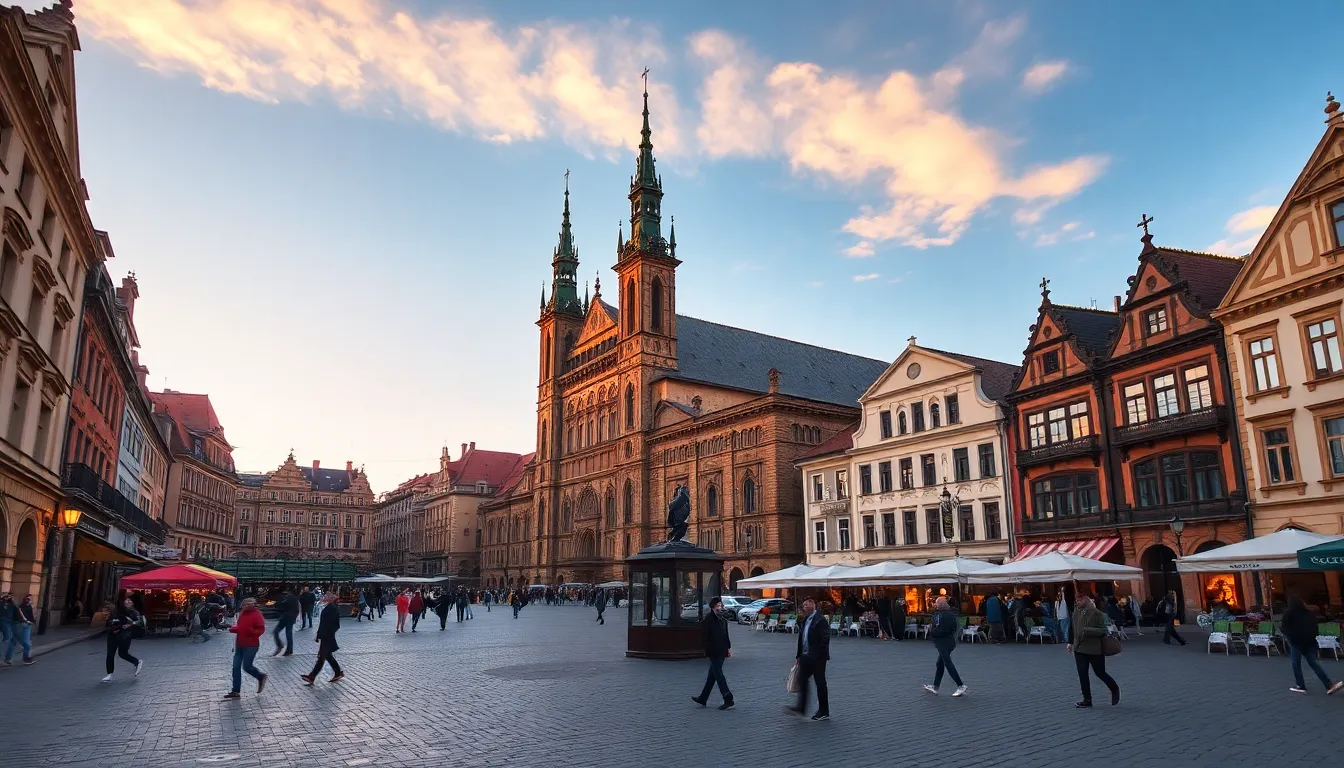
The final morning lifts toward Krakow’s living heritage. We visit Wawel Cathedral and the castle hill, the coronation church of Polish kings and a thousand years of national and Catholic history standing above the Vistula. From there, the Old Town, the great market square, the Cloth Hall, and St. Mary’s Basilica with its hourly trumpet call from the tower. After the weight of Day 2, this morning lets your group see Krakow as a place still fully alive.
Before departure, gather your group for a short closing reflection. Even a weekend deserves this, and in a short trip it matters more, not less, because there has been so little time to process and people need a moment to gather what they felt. Ask each person to name one thing they are carrying home. People often surprise themselves with what comes out, even after only three days. I have heard things in a weekend closing circle as deep as anything said at the end of a ten-day trip. The afternoon is free for last walks and final time in the square, and we handle the airport transfers so the closing hours are yours.
If you are considering a short Krakow trip for your group, whether as a standalone weekend or a scouting visit before a longer pilgrimage, I would be glad to help you shape it. You can see how we run group heritage tours, read the Poland destination overview, or look at the group leader’s guide for pastors and rabbis. Group leaders travel free with fifteen or more participants, which holds even for a short trip. When you want to plan it, contact us here.
FAQ: Weekend Krakow Heritage Trip
Can you really see Krakow’s heritage in a weekend?
You can have a real, focused encounter with it. Three days covers Kazimierz, a careful Auschwitz visit, and Wawel with the Old Town, all based in one hotel with minimal travel. What a weekend cannot give you is the full week-long emotional arc that builds context before the camps. For that, you need the longer itinerary.
Should you include Auschwitz on a weekend trip?
Yes, if you give it a full day and prepare your group the evening before. The one thing I will not do is rush it to save time. If the schedule is too tight to honor that day properly, I would drop another site rather than shortchange Auschwitz.
How far is Auschwitz from Krakow?
About an hour and a half each way by coach. That makes it a manageable day trip out and back, which is exactly why a Krakow-based weekend can include it without overstretching the schedule.
Is a weekend enough to scout for a longer trip?
It is a good way to do it. Many leaders take a focused Krakow weekend to experience the city and the Auschwitz visit before bringing their full congregation on a longer Poland journey. It helps them speak to their community from firsthand experience when they build the bigger group.
What is the best part of Krakow for a short heritage visit?
Kazimierz, the historic Jewish quarter, is the heart of it, because it holds both the centuries of Jewish religious life and the vibrant neighborhood that lives there today. Pairing it with Wawel and the Old Town gives a short trip both the heritage weight and the living city.