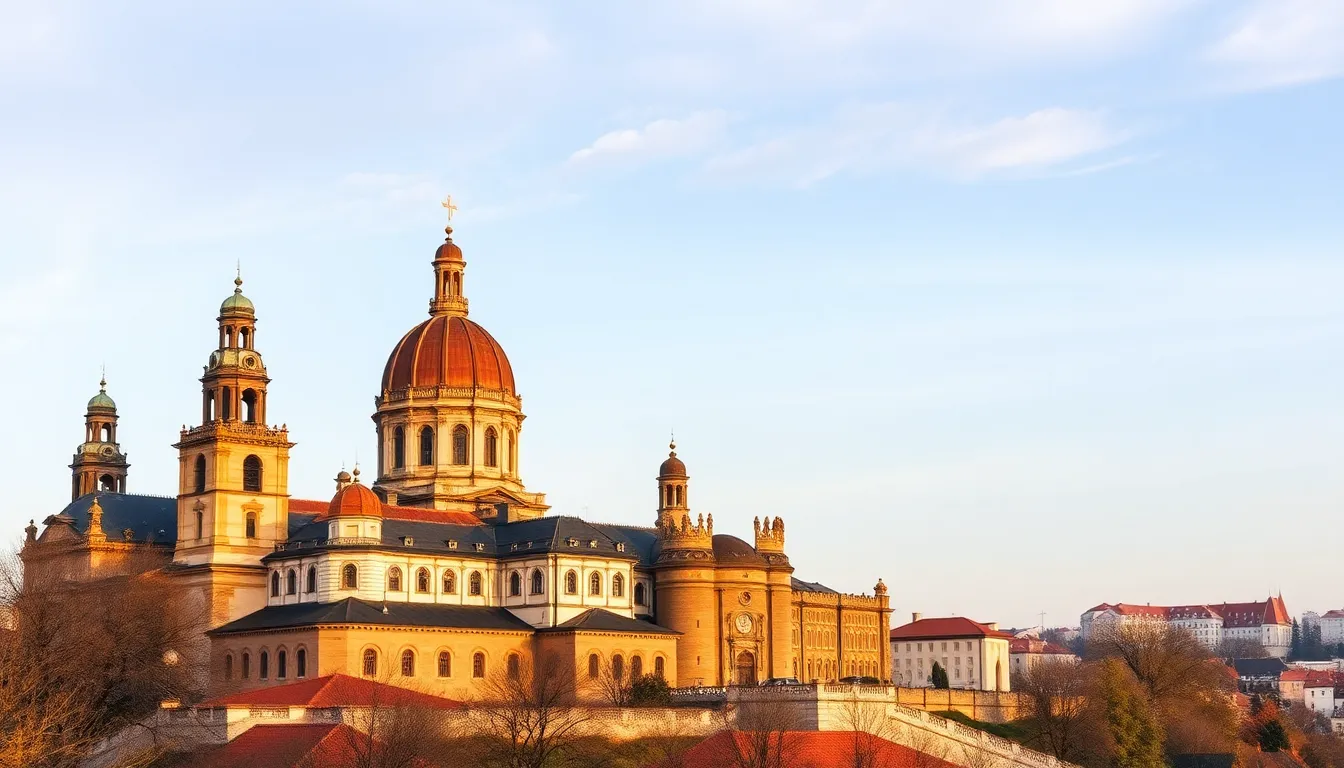
I always bring groups up Wawel Hill on foot, even when the bus could get closer. There is a reason for it. You climb the same approach Polish kings climbed to their coronations, and pilgrims climbed for a thousand years, and you arrive at the top a little out of breath and ready to pay attention. Then the cathedral comes into view, that strange, beautiful jumble of chapels and domes and towers from every century of Polish history, and the group goes quiet.
If you want to understand Poland in a single building, this is it. Wawel Cathedral is where kings were crowned and buried, where the patron saint of the nation was martyred and is venerated, and where a young priest named Karol Wojtyla celebrated his first Mass. Church and crown and nation meet here. No other building in Poland carries this much weight.
This guide covers the cathedral and how a faith group should approach it. It builds on our overview of spiritual sites in Poland and connects closely to the heritage of John Paul II in Krakow.
What Wawel Cathedral Is
Wawel Cathedral, formally the Cathedral Basilica of Saints Stanislaus and Wenceslaus, stands atop Wawel Hill in the center of Krakow, beside the royal castle. The current building is the third cathedral on this site, consecrated in 1364, though parts of earlier structures survive beneath and within it, including a Romanesque crypt.
For roughly 500 years, this was the coronation church of the Kingdom of Poland. Nearly every Polish monarch from the 14th to the 18th century was crowned here, and most are buried here. It served as the cathedral of the Diocese, later Archdiocese, of Krakow, the seat of the bishop. The result is a building that grew across the centuries, with chapels added by king after king in Gothic, Renaissance, and Baroque styles, all clustered around the central Gothic core.
I tell groups not to expect architectural unity. Wawel is not unified. It is layered, the way a nation’s history is layered, and that is exactly what makes it extraordinary.
Saint Stanislaus, Patron of Poland
At the center of the cathedral, beneath the main dome, stands the silver shrine of Saint Stanislaus, the patron saint of Poland. Stanislaus was the Bishop of Krakow who was killed in 1079, by tradition on the orders of King Boleslaw II after the bishop confronted the king. He was canonized in 1253.
His shrine became the spiritual center of the cathedral and a symbol of the moral authority of the church standing up to royal power. For centuries, Polish kings would visit his tomb before and after their coronations. The placement is deliberate: the saint who defied a king sits at the heart of the church where kings were crowned. That tension is part of the Polish story, and it is worth pointing out to a group.
The Royal Tombs
Wawel is, among other things, a national mausoleum. The kings, queens, and national heroes buried here turn a walk through the cathedral into a walk through Polish history.
The crypts and chapels hold monarchs spanning centuries, including Casimir the Great, the king who famously “found Poland built of wood and left it built of stone.” Beyond the royals, the cathedral and its crypts hold national heroes and cultural figures who shaped the nation, a reflection of how completely Poland fused faith and national identity in this one place. Groups often find the royal tombs more moving than they expect, because each one anchors a chapter of the story standing around them.
The Sigismund Bell
High in one of the towers hangs the Sigismund Bell, cast in 1520, one of the largest historic bells in Poland. It rings only on the most significant religious and national occasions. Polish tradition holds that touching the bell’s clapper brings good fortune, and the climb up the wooden stairs of the tower to reach it is a favorite with groups who have the energy and the time. From the tower you also get a view across Krakow’s Old Town.
The John Paul II Connection
For many of the groups I lead, the deepest pull at Wawel is not the kings. It is a young priest.
On November 2, 1946, the day after his ordination, Karol Wojtyla celebrated his first Masses in the crypt of Wawel, surrounded by the tombs of Polish kings and saints. He chose that place deliberately. Years later, as Archbishop of Krakow from 1964 to 1978, Wawel became his cathedral, the seat of his ministry. He preached here, ordained priests here, and led the life of the archdiocese from this hill.
When he became Pope John Paul II in 1978, his bond with Wawel did not loosen. The cathedral remained, in a sense, his home church. For a Catholic group following the John Paul II story through Krakow, Wawel is where his priesthood and his episcopate were rooted. Standing in the crypt where he said his first Mass connects the whole arc of his life, from the obscure ordination to the global papacy.
Visiting Wawel Well
A few things I have learned about leading groups here:
- It is an active cathedral. Mass and prayer happen here daily. Coordinate visits around the schedule, and keep voices low.
- Tickets are layered. General entry, the royal tombs, the Sigismund Bell tower, and the cathedral museum often require separate tickets. Sort this out in advance for a group of 15 or more.
- The tower climb is real. The stairs to the Sigismund Bell are narrow and steep. Worth it for those who can manage it, but not for everyone, so plan for a split.
- Allow time, but not the whole day. Two hours covers the cathedral well. Pair it with the rest of Wawel Hill and the Old Town.
- Photography is restricted inside the cathedral. Tell your group before you enter.
Wawel pairs naturally with the other Krakow faith sites. Most groups combine it with the Divine Mercy Sanctuary at Lagiewniki and the John Paul II locations in the Old Town for a full pilgrimage day.
Where Wawel Fits in Your Itinerary
Wawel sits at the center of Krakow, which makes it easy to fold into any itinerary. For a Catholic group, it anchors the Old Town portion of a John Paul II pilgrimage and connects to Czestochowa and Wadowice in the wider trip. For a Protestant or interfaith group, Wawel is one of the clearest places in Poland to see how completely faith and nation were bound together over a thousand years. You do not have to be Catholic to feel the weight of standing where a nation crowned its kings and buried its saints in the same room.
Heritage Tours builds custom faith itineraries across Poland for groups of every denomination. Group leaders travel free with 15 or more participants. You can see how we structure these journeys on our Poland destination page or learn about the group leader experience.
FAQ: Wawel Cathedral
What is Wawel Cathedral known for?
Wawel Cathedral in Krakow was the coronation and burial church of Polish monarchs for around 500 years. It holds the shrine of Saint Stanislaus, the patron saint of Poland, the tombs of kings and national heroes, the historic Sigismund Bell, and a deep connection to Pope John Paul II, who served here as Archbishop of Krakow. It is widely regarded as the spiritual heart of Poland.
Who is buried in Wawel Cathedral?
Wawel holds the tombs of most Polish kings and queens from the 14th to the 18th century, including Casimir the Great, alongside national heroes and cultural figures honored in its crypts. The cathedral functions as a national mausoleum as well as an active church.
What is the connection between Wawel and John Paul II?
Karol Wojtyla celebrated his first Masses in the crypt of Wawel the day after his ordination in 1946. As Archbishop of Krakow from 1964 to 1978, Wawel was his cathedral, where he preached and ordained priests. The cathedral remained central to his identity even after he became Pope John Paul II.
Who was Saint Stanislaus?
Saint Stanislaus was the Bishop of Krakow, killed in 1079 after confronting King Boleslaw II, and canonized in 1253. He is the patron saint of Poland, and his silver shrine stands at the center of Wawel Cathedral, symbolizing the church’s moral authority before royal power.
How long does a visit to Wawel Cathedral take?
About two hours covers the cathedral, including the royal tombs and, for those able to climb, the Sigismund Bell tower. Different areas often require separate tickets, so arrange these in advance for groups. Wawel pairs well with the rest of Wawel Hill, the Old Town, and the Lagiewniki sanctuary.
If you want to bring your community up Wawel Hill, I would be glad to help you plan a visit that does the cathedral justice. It is where the whole Polish story sits in one room. Contact us whenever you are ready to begin.