You are thinking about bringing your congregation to Poland. And unlike any other trip you have organized, this one keeps you up at night.
That is the right response. Poland is not Greece or Italy or even Israel. Those destinations carry history and beauty and spiritual meaning. Poland carries all of that, plus a weight that changes the experience fundamentally. When you bring your community here, you are not just their travel organizer. You are their guide through one of the most emotionally demanding journeys they will ever take.
I have helped group leaders plan heritage journeys for over forty years. Many of the conversations I have with rabbis and pastors about Poland follow the same pattern. They know they want to go. They know their community should go. But they are not sure how to plan it, how to prepare their people, or how to carry the responsibility.
This guide is for you.
Why Poland Is Unlike Any Other Destination
Every heritage destination asks something of the group leader. Israel asks you to navigate competing narratives. Greece asks you to bring ancient history alive. Poland asks you to hold your community through grief.
That is not metaphor. When your group walks through Auschwitz-Birkenau, some people will weep. Some will go silent. Some will feel nothing and then feel guilty about it. Some will be angry. A few will need to leave. You will need to be present for all of them while managing your own response at the same time.
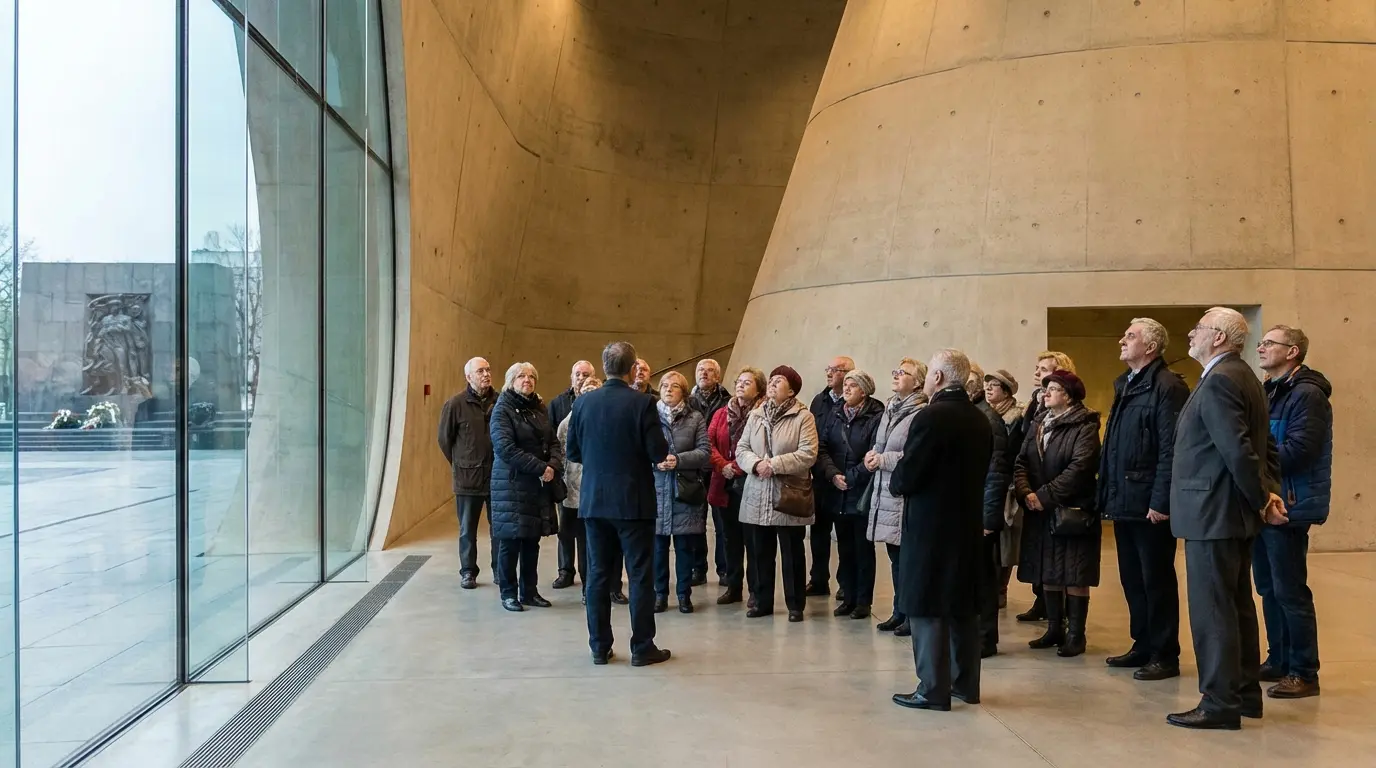
But Poland is more than its memorial sites. If you plan the journey well, your community will also experience Krakow’s Kazimierz district, where Jewish life still continues. They will walk through the POLIN Museum and encounter a thousand years of Jewish civilization. They may visit Lublin, once called “the Jerusalem of Poland,” and stand in a yeshiva that trained some of the greatest minds in European Judaism.
The memorial sites are essential. But they are not the whole story. And how you frame this trip for your community will determine what they carry home from it.
The Free Leader Program: What It Means for Your Budget
Let me address something practical first, because it changes the conversation for many congregations.
The 15-Participant Threshold
When your group reaches 15 participants, you travel free. Airfare, hotel, touring, meals that are included in the itinerary. All of it. This is Heritage Tours’ standard policy, and it applies to every group trip we organize.
For synagogues and churches operating on congregational budgets, this matters more than almost anything else I can tell you. The person doing the work of planning, recruiting, preparing, and leading should not also be paying for the privilege.
What’s Covered
Your flight, your accommodations, your ground transportation, your meals as included in the group itinerary, and your entry to all scheduled sites. You travel on the same terms as your group members, at no cost to you or to the congregation.
This is not a discount. It is not a rebate. Your spot is fully covered from the moment your group hits 15 participants.
Defining What Kind of Trip You’re Organizing
Before you start recruiting, you need to make a decision that will shape everything else. And this is one of the most important conversations I have with group leaders who call me.
Holocaust Memorial Journey vs. Full Heritage Journey
A Holocaust memorial journey focuses on the sites of destruction: Auschwitz-Birkenau, Treblinka, the Warsaw Ghetto, and other memorial sites. The purpose is to bear witness. The emotional register is grief, remembrance, and responsibility.
A full heritage journey includes those sites but places them within the broader story of Jewish life in Poland. It includes Kazimierz, Lublin, the POLIN Museum, and sometimes lesser-known sites like Tykocin or Lodz. The purpose is to understand the civilization that was destroyed, not only the destruction itself.
Why the Distinction Matters for Your Community
The distinction matters because it changes what your group carries home.
A memorial-only journey can leave people with grief and no framework to hold it. They saw what happened. They felt it. But they have no sense of what existed before. The destruction is the whole story.
A heritage journey gives the grief context. When your community has spent a morning in Kazimierz, seeing the synagogues and streets where Jewish life thrived for centuries, and then visits Auschwitz the following day, they understand that what was destroyed was not an abstraction. It was real. Specific. Alive.
Most group leaders I work with choose the heritage approach. But both are valid. What matters is that you make the choice consciously, not by default.
How to Frame Poland for Your Community Before You Leave
This section may be the most important part of this guide. How you talk about Poland before your community ever boards the plane will shape their entire experience.
For Jewish Groups: The Conversation You Need to Have
If you lead a Jewish community, your members likely have some connection to Poland already. For some, it is ancestral. Their grandparents or great-grandparents came from Polish towns. For others, it is communal. The Holocaust is part of their identity even if their family was not directly affected.
The conversation you need to have before departure is honest and direct. You are going to a place where something was built and something was destroyed. Both of those are true. You will see the evidence of both. There will be moments that are difficult to bear, and there will be moments of unexpected beauty. You do not need to feel any particular thing. You need to be present.
I also recommend discussing the experience of walking through Auschwitz specifically. Some people fear they will break down. Others fear they will feel nothing. Naming both possibilities before the trip gives people permission to have whatever response they have.
For Christian Groups: What Poland Asks of Non-Jewish Witnesses
If you lead a Christian community, Poland asks a different set of questions. Your group is bearing witness to what happened to another people, in a country with a deep Christian history.
For many Christian groups, Poland raises questions about complicity, silence, and what faith demands in the face of suffering. These are not comfortable questions. They are the right ones. Preparing your community to sit with those questions, without rushing toward easy answers, is part of your role as their leader.
I have worked with pastors who frame the Poland journey as an act of solidarity. Others frame it as an exercise in moral witness. The framing you choose should reflect your community’s theology and temperament. But whatever framing you use, be honest about the emotional weight of the trip.
Handling Descendants in Your Group
If your community includes people who are descendants of Polish Jews, their experience of this trip will be qualitatively different from everyone else’s. When they stand at Auschwitz, they may be standing where their relatives were murdered. When they visit a small town, they may be looking at the streets their grandparents walked.
As a group leader, you should know before departure who in your group has personal connections to Poland. Have a private conversation with each of them. Ask what they need. Some will want time alone at specific sites. Others will want to visit their family’s town of origin. Others will not want any special attention at all.
Heritage Tours can work with you to build personal stops into the group itinerary. If a member’s family came from a specific town, we can often arrange a stop there, even if it is not on the standard route.
Building Your Group: Recruitment, Deposits, and Timeline
How to Talk About Poland in a Way That Moves People to Say Yes
When you announce the trip to your congregation, how you describe it matters. Here is what I have seen work.
Do not lead with Auschwitz. Lead with the full story. “We are going to Poland to understand a thousand years of Jewish and Christian heritage, and to bear witness to what happened to that heritage during the Holocaust.” That framing gives people a reason to go that is larger than grief alone.
Be specific about what they will see. Kazimierz. The POLIN Museum. Wawel Cathedral. The Black Madonna at Czestochowa. When people can picture specific places, the trip becomes real to them.
And be honest about the emotional dimension. “This will be the most meaningful trip our community has ever taken. It will also be the most demanding. We will support each other through it.” That honesty builds trust. For the broader mechanics of recruiting, setting deposits, and building a timeline, the complete guide for group leaders walks through the process step by step.
Who Will Need Extra Support on This Trip
Every group includes people who will need more care than others. Descendants of Holocaust survivors. Elderly members who remember World War II. Younger members who have never visited a memorial site. People processing their own grief or loss.
Knowing who these members are before you leave allows you to plan for it. Seat them near you on the bus. Check in with them at meal times. Build in enough unscheduled time that anyone who needs a quiet hour can take it.
What Heritage Tours Handles (And What You Don’t Have to)
Hotel Pickup and Dropoff
Your group is met at the airport and transferred to the hotel. Every day of touring begins with a bus pickup at the hotel and ends with a return. You are not managing transportation. You are not hailing taxis or navigating public transit in a foreign country. That is our job.
Itinerary Building With Emotional Arc in Mind
This is something Heritage Tours does that I believe makes a real difference. We do not just schedule sites in geographic order. We build itineraries with emotional pacing in mind.
That means we do not start with Auschwitz. We do not put two heavy memorial sites back to back without something restorative in between. We schedule reflection time. We build in meals at places where your group can be together without the weight of what they just experienced pressing down on them.
The sequence of a Poland heritage journey is not a detail. It is a design choice. And it is one of the things I care about most when working with group leaders.
Local Operators Who Know the Sites and the History
Heritage Tours works with local operators in Poland who are not generic tour guides. They are educators. They know the history, they know the sites, and they know how to work with heritage groups from different faith communities.
Your guide at Auschwitz will not give a script. They will read your group, adjust their pace, and create space for the experience your community needs. That level of care comes from working with people who have spent years doing this work.
After the Trip: The Conversation You’ll Need to Continue
I want to tell you something that many group leaders do not expect. The trip does not end when the plane lands home.
Poland stays with people. It surfaces in conversations weeks and months later. Some community members will want to talk about what they saw. Others will process it quietly. A few may struggle.
The best thing you can do as a group leader is plan for this. Schedule a community gathering two to three weeks after you return. Create space for people to share what the journey meant to them. Bring photographs. Let people tell their stories.
Some congregations continue the conversation through study groups, memorial services, or community action. The form matters less than the intention. Your community went through something significant together. Honoring that experience after you return is as important as preparing for it before you leave.
Do not use the word “closure.” This is not a trip that closes anything. It opens something. And what your community does with that opening is the real measure of whether the journey was worthwhile.
Your Next Step
If you have read this far, you are serious about Poland. Good. And if you are also weighing where else to take your community, our group trips to Israel follow the same leader-supported model.
Here is what I would suggest. Pick up the phone or send us a message through our contact page. Tell me about your community. Tell me what you are hoping for. Tell me what concerns you. I will listen, and then I will tell you honestly whether Heritage Tours is the right fit for your group.
I have been doing this for a long time. I do not pressure anyone. I do not rush anyone. Poland is too important for that. When you are ready, I am here.
Frequently Asked Questions
How do you plan a group Jewish heritage tour to Poland?
Start by deciding what kind of journey you want: a Holocaust memorial trip focused on bearing witness, or a full heritage journey that includes pre-war Jewish life alongside the memorial sites. Recruit at least 15 participants to qualify for the free leader program. Begin community conversations about the trip well before departure. Heritage Tours handles all ground arrangements, guides, hotels, transportation, and itinerary design, so your role is to prepare your community emotionally and spiritually.
What is the difference between a Holocaust memorial tour and a heritage tour of Poland?
A Holocaust memorial tour focuses on the sites of destruction: Auschwitz-Birkenau, Treblinka, the Warsaw Ghetto. A heritage tour includes those sites but adds the pre-war story: Krakow’s Kazimierz district, Lublin’s yeshivas, the POLIN Museum, and sometimes lesser-known sites like Tykocin or Lodz. Heritage tours give your community the context of what was destroyed, not only the destruction itself.
How do you prepare your congregation emotionally for a trip to Auschwitz?
Hold honest conversations before departure about what they will see. Discuss the range of emotions people may experience, including silence, tears, anger, or numbness, and normalize all responses. Provide historical context so members understand what Auschwitz was. Build reflection time into the itinerary. Consider scheduling Auschwitz after sites that provide context, like POLIN or Kazimierz. Heritage Tours designs itineraries with this emotional pacing built in.
How many participants do you need for the Heritage Tours free leader program?
The threshold is 15 participants. Once your group reaches 15, the group leader’s travel is fully covered: airfare, accommodations, ground transportation, meals included in the itinerary, and all site entries. This applies to every Heritage Tours group journey.
What should a pastor or rabbi tell their community before a Poland heritage trip?
Frame the trip honestly. Describe both what they will learn and what they will feel. Lead with the full heritage story, not just the Holocaust sites. Be specific about what they will see, from the POLIN Museum to Auschwitz, from Kazimierz to Treblinka. Acknowledge the emotional weight directly. And let people know they will be supported throughout the journey. Honesty and specificity build trust and help people say yes.